Hey there, tech fans! The latest numbers are in for the second quarter of 2026, and they paint a pretty wild picture. Multiple research firms just dropped their smartphone shipment data, revealing that while the global market took a hit, Apple and Samsung actually managed to swim against the current and grow.
According to preliminary stats from Counterpoint Research’s Market Monitor, the global smartphone market saw shipments plummet by 11% year-over-year in Q2 2026. That’s the lowest second-quarter figure since 2013. The main culprit? A nasty shortage of storage components that’s shaking up the whole industry.
Counterpoint points out that storage suppliers have been prioritizing AI data centers over consumer gadgets. As a result, DRAM and NAND prices have been skyrocketing all quarter. Smartphone makers, especially for budget and mid-range models, have had to pass these higher costs onto us through multiple price hikes. Ouch.
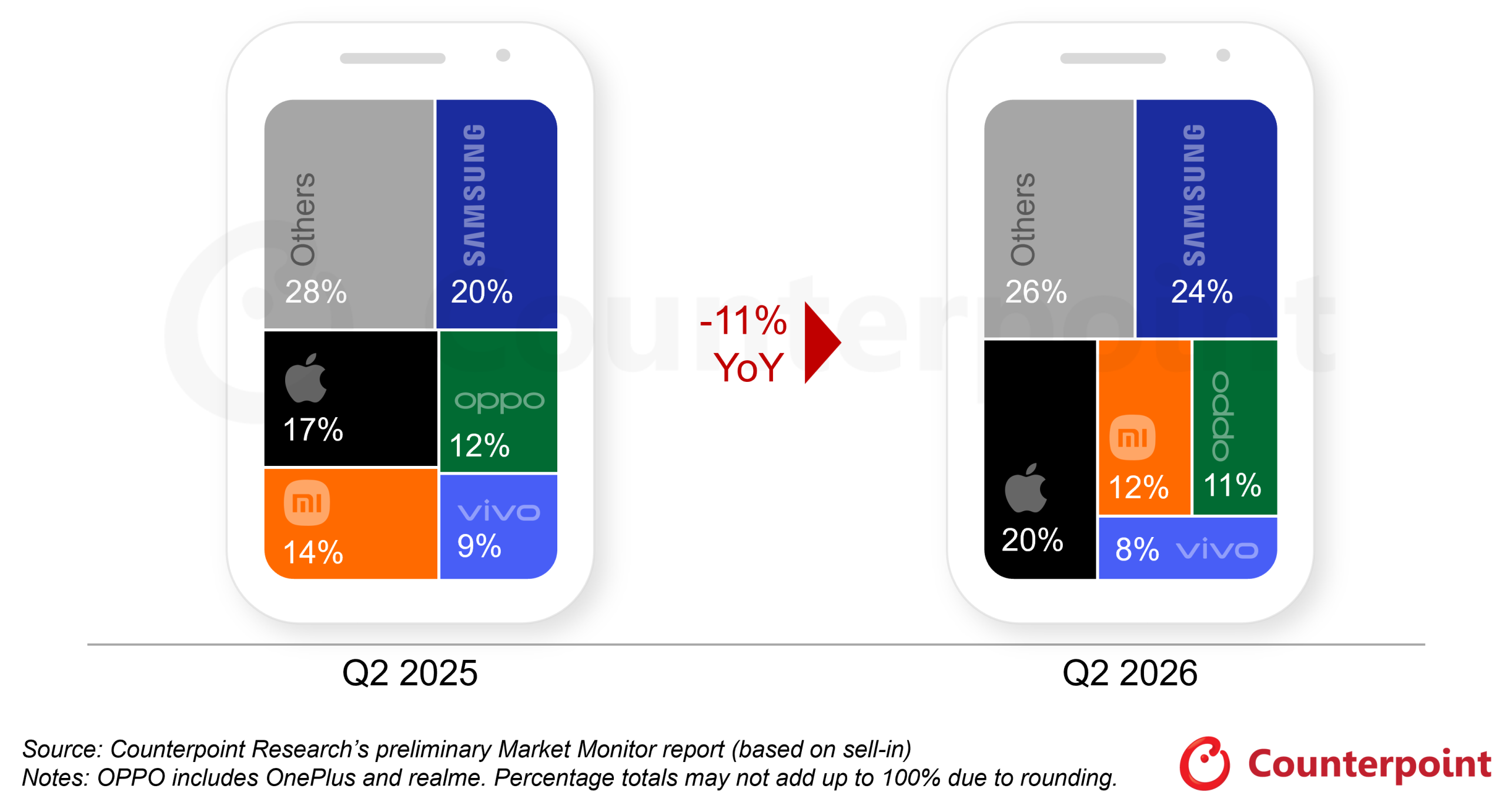
Here’s what happened: Samsung snatched back the top spot with a 24% market share, posting the fastest year-over-year growth among the big five. Apple wasn’t far behind, growing 3% and hitting a record 20% market share. Interestingly, Apple was the only major player that didn’t raise its smartphone prices this quarter.
Over on the Chinese side, things got rough. Xiaomi, OPPO, and vivo all saw double-digit shipment declines. Counterpoint’s analysis suggests that because these brands focus heavily on price-sensitive entry-level and mid-range segments, they got hit hardest as consumers held back on upgrades, switched to older models, or simply stretched out their replacement cycles.
Huawei, though, was a bright spot. It grew 6% year-over-year, thanks largely to strong sales of its Mate 80 series, Nova 15 series, and the newly launched Enjoy 90 series.

IDC’s early data tells a similar story: global shipments hit 277.5 million units, down 6.7% from last year. This marks the second straight quarter of decline. IDC echoes that the memory crisis is not only jacking up costs but also creating supply bottlenecks.
Francisco Jeronimo, IDC’s VP for Global Client Devices, notes that the gap between the high-end and low-end markets widened even more in Q2. Samsung and Apple both grew their shipments, expanding their market shares by 3.2 and 3.8 percentage points respectively, cementing their dominance.
In China alone, the market shipped about 66 million units, a 4.3% drop year-over-year—the fifth consecutive quarter of decline.
IDC explains that starting in late March, Android makers began raising prices or tweaking specs to cope with rising component costs, which really dampened folks’ desire to upgrade. Plus, the boost from government subsidies has faded. Even the “618” shopping festival saw a nearly 15% drop in sales compared to last year, showing just how sluggish demand has become.
Omdia’s latest research also reports a 4% global shipment decline in Q2. The ongoing memory supply crunch is disrupting everything and pushing up costs. The market is clearly polarizing, with different makers taking very different paths based on their strategies, target audiences, and price points.
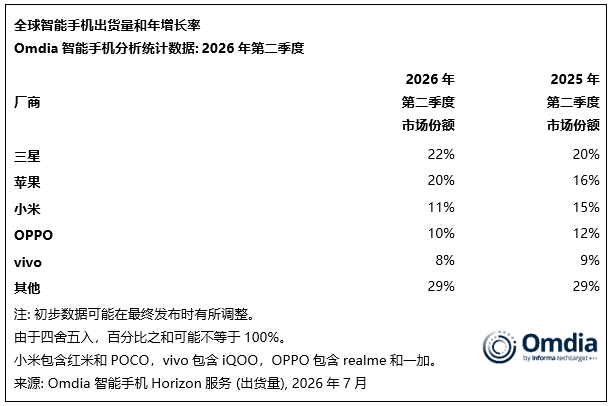
Samsung and Apple are the exceptions, growing their market shares by 2% and 4% compared to Q2 2025. They’re among the few that managed to grow while everyone else was shrinking.
Samsung held onto its No.1 spot with a 22% share, thanks to steady demand and solid supply. Apple, meanwhile, posted its best-ever Q2 performance, grabbing a record 20% market share during what’s usually a quiet season.
As mass-market demand keeps sliding, it’s squeezing the space for everyone outside the top two. Looking at the rankings, Xiaomi holds third place with 11%, OPPO is restructuring its three sub-brands and sits at 10%, and vivo rounds out the top five with 8%.
And the outlook? All three research firms aren’t exactly optimistic about the rest of the year or 2027.
Counterpoint Research expects global shipments to fall about 14% for all of 2026, with the storage shortage likely lasting into 2027.
IDC warns that as cheaper inventory from earlier buys runs out, cost pressures will really hit home in the second half of the year. They predict China’s smartphone market could see a 20% shipment drop in H2 2026. Looking ahead to 2027, storage prices aren’t expected to ease much, so the market will still face serious headwinds.
But here’s the silver lining from IDC: people’s need for a phone isn’t going away—it’s just being delayed. Smartphones are still essential devices we all carry. They expect a recovery around 2028-2029, when a new replacement cycle kicks in.
Runar Bjorhovde, Principal Analyst at Omdia, puts it this way: “We expect the biggest shipment pressure in the next two quarters. This is usually a busy season with new launches, holiday promos, and shopping festivals driving demand. But all that will clash with limited memory chip supply. So, we’ll likely see makers shift even more toward higher-priced segments to capture upgrade demand during the 2026 sales season. While moving upmarket helps protect margins and revenue, it also means fewer choices for budget-conscious buyers. Many folks may have to delay upgrades, settle for less, use installment plans, or go for refurbished devices.”