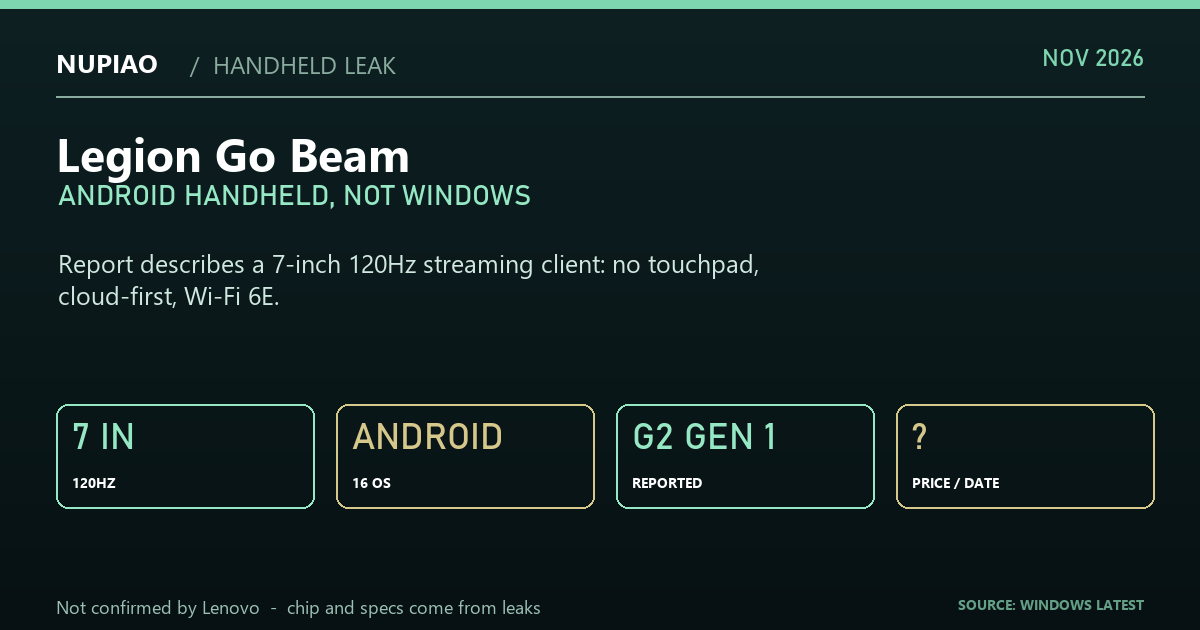
Legion Go Beam is a reported Lenovo handheld that runs Android instead of Windows or SteamOS, built around a 7-inch 120Hz display and cloud streaming. It surfaced in a Windows Latest report on November 24. Lenovo has not announced it, so the specifications below are leaks, not confirmed details.
Source note: the original report came from Windows Latest; the details here are cross-checked against same-day coverage from CNMO, Sina Finance and SMZDM. Nothing in this article is confirmed by Lenovo, and the processor in particular is an inference from leaks rather than a stated fact.
What the leak describes
The Beam is said to be a one-piece handheld with a white shell and Lenovo’s green ring around the stick tops. It keeps the full set of controls — D-pad, ABXY face buttons, LB/LT and RB/RT shoulders, plus Y1 and Y2 buttons on the back — and adds four function keys flanking the screen, one of them marked with the Legion logo. Because it runs Android, there is no touchpad, the component Windows handhelds rely on for mouse input in desktop applications.
Connectivity is deliberately modest: a single USB-C port, a 3.5mm headphone jack, a microSD slot and two exhaust vents along the top edge, with a large vent grille on the back. A 7-inch 120Hz panel is the one display figure that repeats consistently across reports. Resolution and panel type have not leaked, and battery capacity is unknown.
The chip question, and why the design makes sense if it is true
The processor is reported as a Snapdragon G2 Gen 1 with Wi-Fi 6E and Lenovo’s own Legion Space software preinstalled. That is a plausible pairing for a streaming client — the G2 series targets handheld gaming, and Wi-Fi 6E’s 6GHz band is useful when the device is acting as a screen and controller for a PC in another room. But it remains a leak. Lenovo has published nothing, and the timing could shift.
Read the omitted parts as a statement of intent. Reports describe the Beam as dropping the touchpad, switching from a 16:10 to a 16:9 panel, losing the detachable grips and removing the trigger bumpers found on the Legion Go S. Those are the features that make a handheld usable as a local PC. Strip them out and what remains is a bright, light remote display with good controls, which is exactly what GeForce Now, Xbox Cloud Gaming and PC streaming need.
| Reported feature | Legion Go Beam | Legion C700 (released, China) |
|---|---|---|
| Operating system | Android 16 (leaked) | Android 16 (confirmed) |
| Screen | 7-inch, 120Hz, reportedly 16:9 | 7.82-inch, 120Hz |
| Chip | Reportedly Snapdragon G2 Gen 1 | MediaTek Dimensity 7400 |
| Connectivity | Wi-Fi 6E, single USB-C, microSD | Not detailed in the leak coverage |
| Price | Not announced | 2,199 yuan at launch |
Lenovo has already tried this
This would not be Lenovo’s first Android handheld. In August the company launched the Legion C700 in China with a Dimensity 7400 chip, a 7.82-inch 120Hz screen and Android 16 at 2,199 yuan. By November, community posts were quoting street prices around 1,330 yuan after discounts and bundles. Lenovo also sells the Legion Tab Gen 5, with a Snapdragon 8 Elite Gen 5 and an 8.8-inch 165Hz screen for $849.99.
The Beam would sit below the Windows-based Legion Go S in the lineup rather than replace it. One report puts a CES appearance as early as January. That fits a product meant to be cheap enough to leave on the coffee table: a streaming client does not need the silicon that runs a local 3A game, and skipping Windows avoids both the licence cost and the interface overhead on a small screen.
Why the price curve matters
The reason a company would build an Android streaming handheld is visible in the other half of the market. Legion Go 2’s 2TB North American edition went from about $1,480 at launch to $2,849 by April, with coverage pointing at memory and storage costs. Valve raised Steam Deck OLED prices in May, from $549 to $789 for the 512GB model and from $649 to $949 for the 1TB model, citing the same component pressure.
Against that, a cloud-first device that leans on a phone-class chip can hold a much lower price. The trade is obvious and worth stating plainly: you are renting someone else’s hardware over a network. Streaming quality depends on your connection, input latency is higher than local rendering, and the service you rely on can change its terms. The appeal is that the machine itself stays affordable and quiet while the heavy work happens elsewhere.
What is not known
Pricing, release date, resolution, battery size and the final chip are all unconfirmed. Even the screen aspect ratio comes from a single round of leaks. Reports that the Beam was designed around cloud services name GeForce Now and Xbox Game Pass, but Lenovo has not published a list of supported platforms, and cloud catalogues differ by region.
The sensible position is to treat this as a direction of travel rather than a purchase decision. If you want a handheld now, the C700 is a known quantity with a falling price; if you want one that runs PC games locally, the ROG Xbox Ally X20 covers the other end of the market. More subscription context is in our 2026 console price guide.
FAQ
Has Lenovo confirmed the Legion Go Beam?
No. The device appeared in a Windows Latest report on November 24 and subsequent coverage. Lenovo has not published a product page, price or release date, so all specifications should be treated as unconfirmed.
Will it run PC games locally?
Leaks point the other way. The reported Android 16 system, Snapdragon G2 Gen 1 chip and removal of the touchpad suggest a device designed for PC and cloud streaming rather than native PC game playback.
Which chip does it use?
Reports suggest a Snapdragon G2 Gen 1 with Wi-Fi 6E. That is an inference from leaked material, not a confirmed specification from Lenovo or Qualcomm.
How is it different from the Legion C700?
The C700 is already on sale in China with a 7.82-inch screen and a Dimensity 7400. The Beam is reported to be smaller, at 7 inches, with a focus on streaming and a yet-unannounced price.
When could it launch?
One report suggests CES in January as the earliest public appearance. Lenovo has given no date, and the project could change before launch.
The original report is at Windows Latest ; same-day coverage is from Tencent News and Sina Finance .