Console prices in 2026 have moved in the wrong direction. Every major platform now costs more than it did at launch: the PlayStation 5 disc edition is $649.99, the Xbox Series X is $799.99, and the Nintendo Switch 2 is $499.99 after a September increase. If you are shopping for a holiday gift this month, here is what each system actually costs, when the hikes took effect, and why the same component shortage pushed all three at once.
Verification note: current US prices and their effective dates follow a Tom’s Guide buying guide published November 8, 2026 and a price roundup updated November 9, 2026. The component-cost figures come from the same roundup, which cites TrendForce, Goldman Sachs and Microsoft’s own statements on memory pricing. Prices were checked again on November 16, 2026.
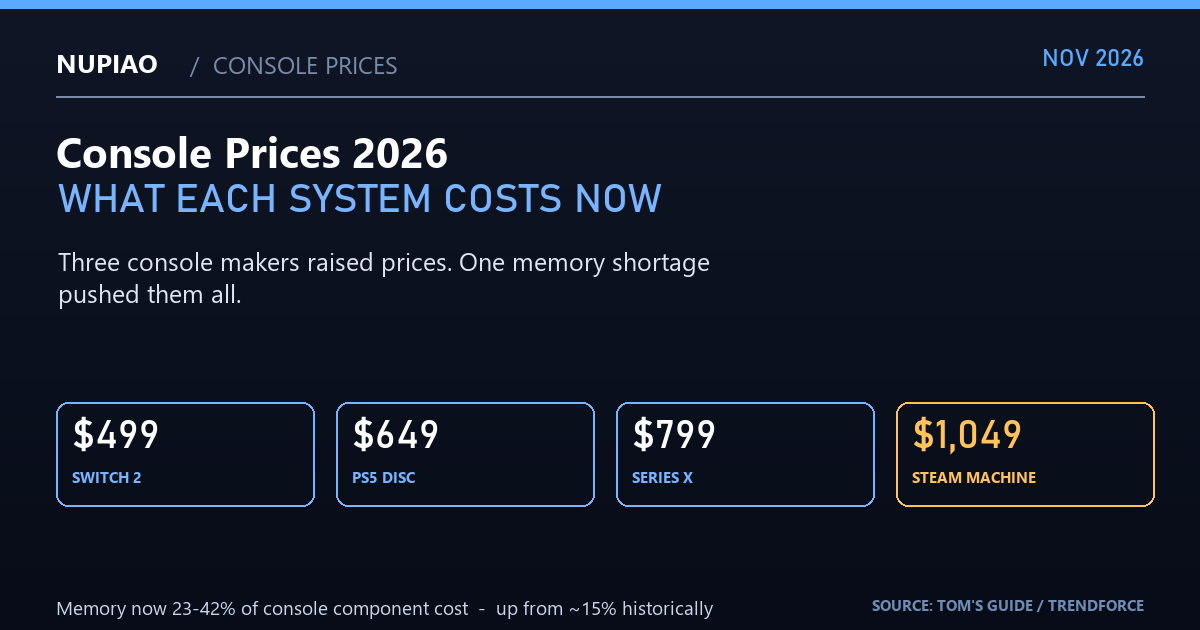
The price ladder right now
Console pricing used to be predictable. A system launched at a set price, held it for years, and perhaps dropped $50 around the midpoint of the generation. That pattern has broken. Sony, Microsoft and Nintendo have each raised prices since 2025, and Valve pushed the Steam Machine’s price up before the machine even went on sale.
| System | Current US price | When the change took effect |
|---|---|---|
| Nintendo Switch 2 | $499.99 | September 1, 2026, up from $449.99 |
| PlayStation 5 (disc) | $649.99 | April 2026, the second increase after August 2025 |
| PlayStation 5 Digital | $599.99 | Same April 2026 adjustment |
| PlayStation 5 Pro | $899.99 | April 2026 |
| Xbox Series X | $799.99 | August 1, 2026, up from a $499.99 launch price |
| Xbox Series S (512GB) | $499.99 | August 1, 2026 |
| Steam Deck OLED (512GB) | $789 | May 2026, up $240 |
| Steam Machine (512GB) | $1,049 | Launched June 29, 2026 at this price |
Two details are easy to miss. First, the Xbox Series S now costs what the Series X did at launch — Microsoft has raised Xbox prices three times since May 2025. Second, the PS5 Pro ships without a disc drive, so the $79.99 add-on is part of the real cost for anyone with a physical collection.
Why all of them went up at once
There is no evidence the companies coordinated. The cause is upstream. AI data centres need enormous quantities of high-bandwidth memory, and Samsung, SK Hynix and Micron — the three firms that produce almost all of the world’s DRAM — shifted fab capacity toward HBM. That left less commodity DDR5 and NAND for consoles, handhelds and phones, and what remained cost far more.
The scale is worth putting in numbers. HBM was estimated to consume roughly 23 percent of DRAM wafers in 2026. DRAM prices rose about 170 percent over 2025, and NAND contract prices jumped more than 60 percent in a single month in November 2025. A 32GB DDR5 desktop kit that cost around $95 in the summer of 2025 was above $400 by September 2026. Goldman Sachs projected a 4.9 percent global DRAM shortfall for 2026, the widest in fifteen years, and TrendForce now estimates memory makes up 23 to 42 percent of a console’s component cost, against around 15 percent historically.
Microsoft was the most direct about it. When it announced the August increase, the company said memory and storage prices had risen more than 2.5 times, and it expected another doubling by the fall of 2027. That is a blunt way of saying the pressure is not over.
Nintendo is the outlier — for now
Of the three console makers, only Nintendo has said it will hold. At a November 5 earnings briefing, president Shuntaro Furukawa told Reuters the company can secure enough memory supply and has no plan to raise the Switch 2 price again. The wording leaves room: the company said it is not currently considering another adjustment, rather than promising a fixed price indefinitely. What backs the statement up is inventory, not a pricing philosophy.
Nintendo’s own numbers explain why holding matters. Switch 2 sold 2.67 million units in the July-to-September quarter, down 41 percent from 4.54 million a year earlier. First-half software sales reached 24.49 million units, up 18.8 percent, led by Tomodachi Life: Living the Dream at 8.81 million. Hardware is the weak spot, and another price rise would not help it.
What is actually worth buying in November
With GTA VI landing on November 19, the timing of a hardware purchase is awkward. The Switch 2 remains the cheapest of the four systems listed above, and its backwards compatibility gives it a large library on day one. The Mario Kart World bundle at $549.99 and the Switch Sports Resort bundle at $529.99 both work out cheaper than buying the game separately.
The PS5 is the machine most households will use for GTA VI, and the disc edition at $649.99 is the flexible choice. A Fortnite bundle appeared at Target for $549.99 in early November, which is the kind of limited discount worth watching for. The PS5 Pro is harder to recommend: stock has been tight, and used units have been listed above $1,500. At that price a mid-range gaming PC is the better conversation.
For Xbox, the hardware is no longer the value proposition — Game Pass is. The Series X is a capable 4K/60 machine with a good controller, but at $799.99 it asks a lot. Microsoft Store refurbished consoles, discounted by up to $100, are the least painful legitimate route in. The Steam Machine at $1,049 is an interesting curiosity with 16GB of RAM and a semi-custom AMD APU, but its internals do not match the price, and it makes the other consoles look reasonable by comparison.
Does waiting help?
Probably not, at least before the end of 2027. Microsoft’s own forecast points to memory costs doubling again, and there is no sign of HBM demand easing. Retailers may discount bundles around Black Friday, but a list-price cut is a different thing, and none of the three console makers has signalled one. If you need a system for GTA VI, buying during a bundle promotion is more realistic than waiting for a price drop that may never arrive.
FAQ
Why did console prices go up in 2026?
AI data centres absorbed much of the global supply of DRAM and NAND, pushing component costs sharply higher. Memory now accounts for 23 to 42 percent of a console’s component cost, up from about 15 percent historically, and all three console makers passed part of that on.
Will Switch 2 get more expensive?
Nintendo said on November 5 that it has secured enough memory and is not currently considering another price increase. That is not a long-term guarantee, but it is the clearest statement from any of the three makers.
Which console is cheapest right now?
The Switch 2 at $499.99 is the lowest entry price among the current systems. The PS5 Digital is $599.99, the PS5 disc edition $649.99 and the Xbox Series X $799.99.
Is the PS5 Pro worth $899.99?
Only if you can find one at list price and you care about ray tracing and the PSSR upscaler. It ships without a disc drive, and recent stock shortages have pushed resale prices far above MSRP.
Are Black Friday console deals likely?
Bundle discounts and retailer-specific offers are common, and a PS5 Fortnite bundle was already listed below MSRP in early November. Straight list-price cuts are much less likely given the memory-cost forecast.
For more hardware coverage, see our News section and the Guides category. Pricing details follow Tom’s Guide , November 8, 2026, with Nintendo’s statement reported by Reuters on November 5.