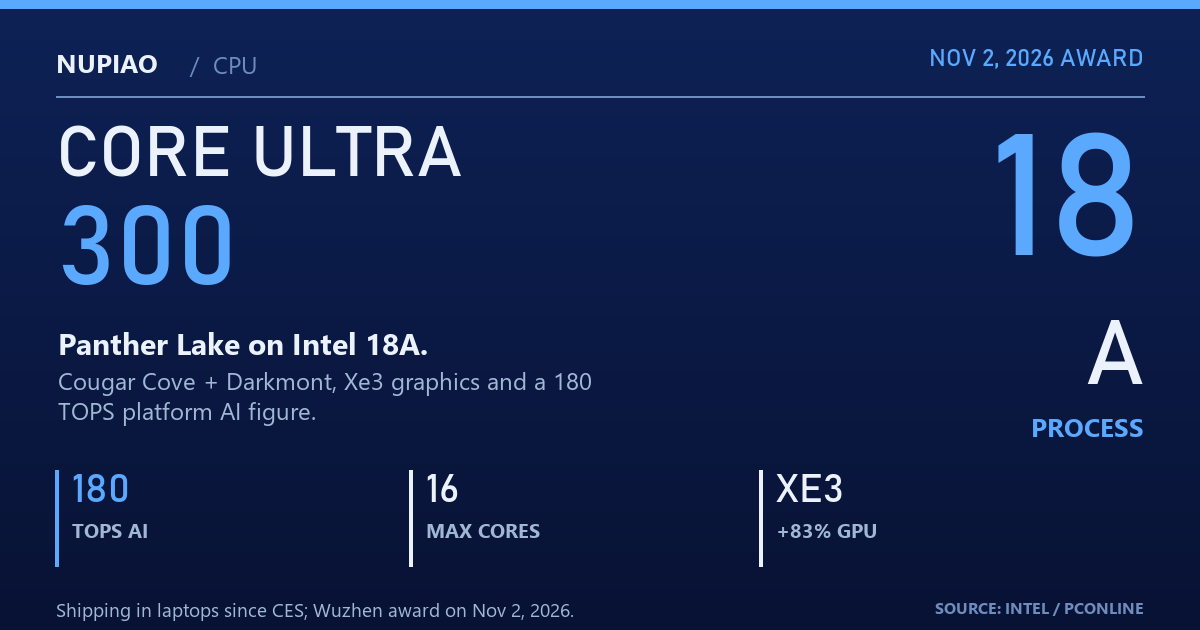
Intel’s third-generation Core Ultra processors, built on the company’s 18A process and sold under the Panther Lake codename, started shipping in laptops at CES in January and picked up a major endorsement on November 2, 2026, when the chip won a Leading Science and Technology Award at the World Internet Conference in Wuzhen. After a rough few years of delayed nodes and lost share, this is the part Intel is betting its client business on. Here is what Panther Lake actually delivers, and where the caveats still sit.
Verification note: architecture, specs and launch timing follow Intel’s CES 2026 keynote (January 5, 2026) and the Intel newsroom Googlebook announcement (October 5, 2026). The Wuzhen award and battery-life testing figures come from Pacific Computer (PConline) on November 2, 2026; early Geekbench scores for the Core Ultra 7 365 are attributed to an engineering sample dated December 17, 2025, with unfinished drivers.
What 18A actually buys
Panther Lake is the first client chip on Intel 18A, the most advanced logic node the company builds and manufactures in the United States. Two techniques matter: RibbonFET, a gate-all-around transistor that wraps the gate around the channel for tighter current control, and PowerVia, which moves power delivery to the back of the wafer to free up front-side routing. Intel says the logic internal ratio is about 70 percent. Together they are meant to deliver more performance inside the same power budget, which is the whole point of a mobile chip.
Cores, graphics and the AI number
| Block | Panther Lake (Core Ultra 300) | What changed |
|---|---|---|
| CPU | Cougar Cove P-cores + Darkmont E-cores, up to 16 cores | New hybrid core generation |
| GPU | Xe3 “Celestial”, up to 12 cores | +83% vs Xe2 |
| NPU | 5th generation | 50 TOPS |
| Platform AI | 180 TOPS total (CPU 10 + NPU 50 + GPU 120) | Offline HD image in ~10s |
| Memory / I/O | LPDDR5X-8533, PCIe 5.0, Foveros 3D | Same family as prior gen |
The CPU module uses Intel 18A, the GPU module uses TSMC N3E, and the platform controller uses TSMC N6, stitched together with Foveros 3D packaging. That mix is why “Intel 18A” and “TSMC” both appear on the same die.
Battery life is the quiet win
The most persuasive numbers are the ones that show up in a normal workday. A Zenbook Duo with the Core Ultra X9 388H and a 99Wh battery scored close to 14 hours in Procyon’s office test and about 22 hours looping 4K video. The integrated Arc B390 graphics tested roughly 70 percent faster than the previous Arc 140T in Notebookcheck’s gaming suite. For a thin-and-light, that combination — all-day office battery and a usable iGPU — is the upgrade people actually feel.
Where you can buy one now
At CES 2026, MSI launched Prestige, Titan, Stealth and Cyborg models on Panther Lake, while Lenovo showed the Yoga Slim 7i Ultra Aura Edition with the Core Ultra X9 388H. Intel also revealed a handheld-gaming variant of Panther Lake at the show. On October 5, 2026, the first Googlebook laptops from Acer, ASUS and Lenovo powered by Core Ultra Series 3 (the Panther Lake brand for Chromebook-class machines) went on sale in the US, Canada, the UK, Germany, France, Australia and New Zealand.
The AI PC pitch
Intel is targeting 500 pre-installed AI features across its 2026 systems, and at Wuzhen it demoed agent PCs, an AI Box, an AI NAS and enterprise AI workstations. The 180 TOPS platform figure breaks down as roughly 10 from the CPU, 50 from the NPU and 120 from the GPU, and Intel claims it can render a high-definition image fully offline in about 10 seconds. Whether that pitch lands with buyers depends less on the number than on whether the features show up in software people open.
The Wuzhen award matters less for the trophy than for what it signals. China is a market where Intel’s foundry story needs to land, and tying 18A to a recognised science-and-technology prize is part of that effort. It does not change the silicon, but it shows Intel is willing to spend political and marketing capital on client chips at a moment when its data-centre business gets most of the attention.
The honest caveat
An early Geekbench run for the Core Ultra 7 365, dated December 2025, showed a single-core score of 2,451 and a multi-core score of 9,714 — below the prior generation’s averages of 2,639 and 10,318 — but that was an engineering sample with drivers and system tuning still in progress, so it is not a shipping verdict. The bigger unknowns are 18A yield and volume, and the competitive field: AMD’s Strix Point and Halo parts and Qualcomm’s Snapdragon X are already in market. Panther Lake looks like a real step forward on paper; the next year decides whether it ships in the quantities and configurations that matter.
The competition it still has to beat
Panther Lake does not arrive into an empty field. AMD’s Strix Point and the higher-end Strix Halo parts already ship with strong integrated graphics and competitive battery life, and Qualcomm’s Snapdragon X keeps pushing the always-connected, high-efficiency angle in Windows laptops. Intel’s answer is 18A manufacturing credibility and a higher headline AI number, but buyers rarely choose a laptop for the process node. The semi-modular Panther Lake designs shown at CES, where the I/O, battery and even the motherboard can be swapped later, are a genuine differentiator for repair and longevity, even if they stay a niche for now. The handheld-gaming variant is the more immediately useful spin, putting a proper x86 chip with Xe3 graphics into a form factor that has been dominated by AMD APUs.
FAQ
When is Panther Lake available?
Laptops with Core Ultra 300 (Panther Lake) launched at CES in January 2026, and Googlebook models with Core Ultra Series 3 went on sale October 5, 2026, in selected markets including the US and UK.
What is Intel 18A?
Intel’s most advanced logic process, combining RibbonFET gate-all-around transistors and PowerVia backside power delivery. It is designed and built in the United States at Intel’s Arizona fab.
How is the battery life?
In testing with a 99Wh battery, a Panther Lake system reached about 14 hours of office work and roughly 22 hours of 4K video playback, with the Arc B390 iGPU about 70 percent faster than the previous generation.
How fast is the AI performance?
Intel quotes 180 TOPS across the platform: about 10 from the CPU, 50 from the NPU and 120 from the GPU, enough to render an offline HD image in around 10 seconds.
For more hardware coverage, see our News section and the Guides category. Architecture and availability follow Intel and the CES 2026 announcements, with Wuzhen award detail from PConline , November 2, 2026.