On the evening of July 24th, Nvidia CEO Jensen Huang fired off his very first tweet on X after joining the platform. But instead of hyping up his company’s chips or products, he straight-up shared a joint open letter titled “Open Weight and American Leadership in AI,” giving a big thumbs-up to open-weight AI models.
In his tweet, Huang wrote: “AI is going to transform every industry, empower every company, and be built by every country. Open-source models boost security and cybersecurity, speed up innovation and adoption, and enable sovereignty. The world needs both cutting-edge closed-source and open-source models.”
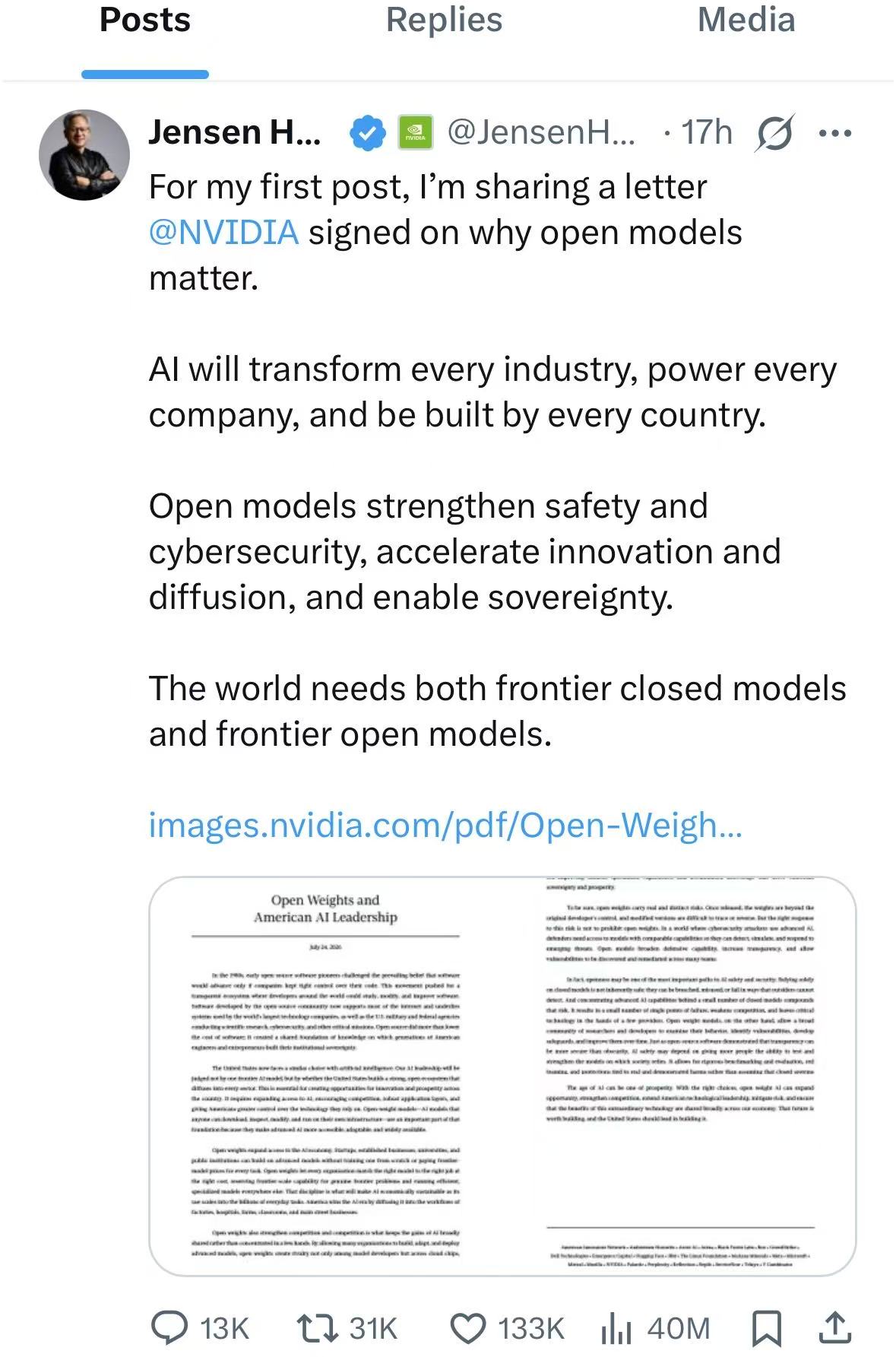
Within just over ten minutes of that first tweet, his follower count had already hit over 10,000. Big tech names like Microsoft CEO Satya Nadella and renowned tech journalist Mark Gurman were among the first to chime in. As of this writing, Huang’s personal X account has racked up 689,000 followers.
This industry-wide open letter covers the whole AI chain, pulling together 25 companies and organizations, including Nvidia, Meta, Microsoft, Palantir, CrowdStrike, IBM, ServiceNow, Hugging Face, Mistral AI, Perplexity, investment firm a16z, and startup incubator Y Combinator. It spans hardware makers, general AI players, cybersecurity providers, open-source model platforms, and AI startups.
But here’s the twist: the three biggest names in the closed-source AI game—OpenAI, Anthropic, and Google—didn’t sign on. That highlights the deep split within Silicon Valley over AI tech directions, business models, and regulatory approaches.
As competition heats up, some top US AI companies have started sounding the alarm on “distillation” risks. They claim rivals can copy advanced model capabilities by calling APIs heavily, getting the model to generate answers, and then training other models on that data. Meanwhile, US Congress and regulators are hashing out policies around cross-border AI model weight flows and open-source model controls.
The open letter lays out why open-source models matter. It argues that “US AI leadership” shouldn’t just be about having the single most advanced AI model—it’s about building a strong, open ecosystem that can spread across industries. It also says open-source models boost competition, and competition ensures that AI’s benefits are shared widely, not hoarded by a handful of firms.
Drawing on the history of open-source software, the letter makes the case for open-weight AI models to keep the US globally competitive in AI. It urges US regulators to craft careful rules around AI model weights, instead of slapping on overly restrictive measures that could stifle the development, distribution, and commercial use of open-weight models.
The letter also tackles model distillation and similar tech practices, drawing a line between legitimate iterative improvements and illegal theft of model weights. It suggests handling violations through business rules and targeted legislation, rather than imposing blanket restrictions on open-source models.
The letter adds that relying solely on closed models isn’t actually safe. Those models can be hacked, misused, or break down in ways that are hard to spot from the outside. Plus, concentrating advanced AI capabilities in just a handful of closed models only makes those risks worse.
As the world’s go-to supplier of AI computing chips, Nvidia has long been deeply invested in providing the hardware for training and running large models. The more vibrant the open model ecosystem gets, the more GPU computing power developers around the world will need for training, fine-tuning, and deploying those models—and that’s a boon for Nvidia.
Back in March, Nvidia filed a disclosure with the US Securities and Exchange Commission revealing plans to invest a whopping $26 billion over five years specifically in open-weight AI model R&D and ecosystem building. That money will be doled out in phases, covering everything from training open-weight models and building computing infrastructure to expanding R&D teams, developing software toolchains, and running the open-source ecosystem.
Meanwhile, Meta has been using its Llama series of open-source models to steadily win over the small and mid-sized developer crowd, chipping away at the pricing power of closed-source players.
Microsoft, despite being OpenAI’s biggest investor, still chose to sign the letter. It’s a hedging move: by offering Azure cloud services to handle open-source model computing needs, it avoids putting all its eggs in one closed-source basket.
Against this loud open-source alliance, the three big closed-source players—OpenAI, Anthropic, and Google—were conspicuously absent, each driven by their own business interests.
From a business standpoint, OpenAI and Anthropic are both pushing toward IPOs with valuations in the trillions. Their core value hinges entirely on proprietary closed-source model subscriptions and high-margin API licensing. Widespread adoption of high-performance open-weight models would directly undercut their paid business models.
Google, while open-sourcing some tools and smaller models, keeps its flagship Gemini series of frontier large models firmly closed-source. That’s how it maintains its competitive edge in enterprise services and cloud business differentiation.