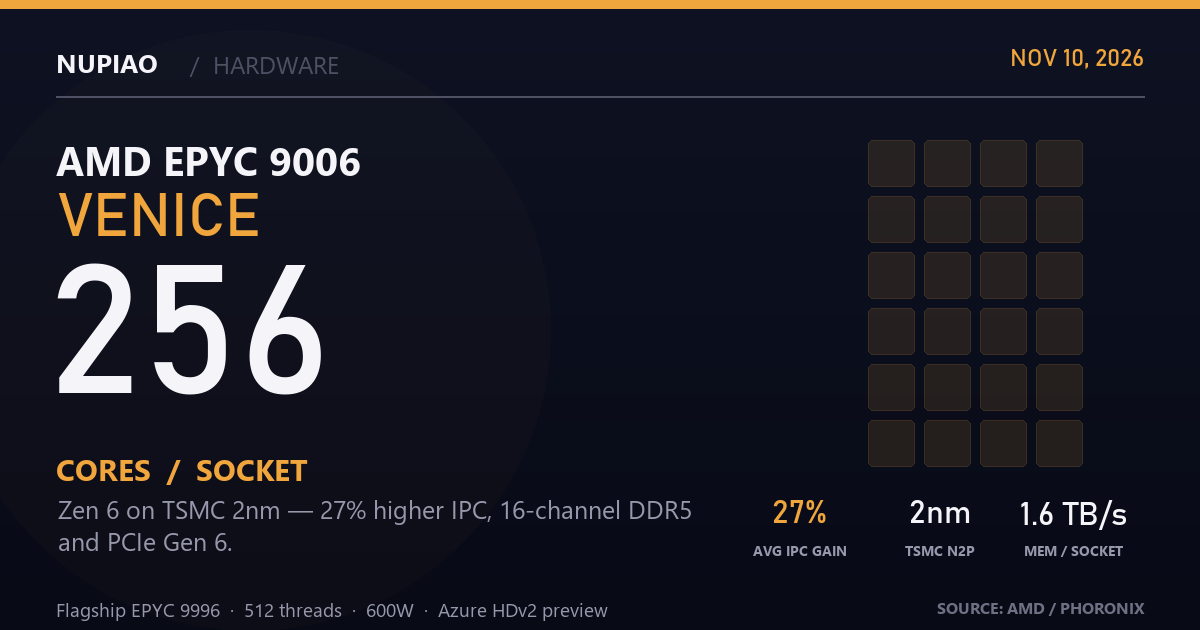
AMD’s sixth-generation EPYC 9006 processors, codenamed Venice, went on sale November 10, 2026, and they are the first server chips built on Zen 6 and TSMC’s 2nm process. The headline part is the EPYC 9996: 256 cores, 512 threads, a $14,904 list price and a claim of 27% higher instructions per clock than Zen 5. Independent reviews landed the same day, which means there is now real benchmark data to argue with rather than just AMD’s slides.
Verification note: launch date, SKU specs and 1KU pricing come from AMD’s EPYC 9006 availability announcement and the Phoronix, ServeTheHome, TechPowerUp, Tom’s Hardware and Wccftech reviews published November 10–11, 2026. Benchmark comparisons cited below are those outlets’ measurements, not AMD marketing figures. Pricing is for 1,000-unit orders and excludes OEM system margins.
What actually shipped on November 10
AMD showed the full EPYC 9006 family back in July at its Advancing AI event, but that was a paper launch. November 10 is the date the SP7 parts became orderable and OEM systems started leaving docks. Phoronix called it “the actual hardware availability” after what it described as a soft announcement over the summer, and ServeTheHome’s review team got a 2U reference system — codenamed Nigeria — to test before the embargo lifted.
The socket is new, too. Venice moves to SP7, and there are four sub-families rather than one line: the SP7 parts for AI data centres, the SP8 models for general-purpose servers, the high-cache 9006X “Venice-X” chips and the LPDDR5X “Verano” parts. Only SP7 is on sale now. SP8 arrives in the first half of 2027; the 9006X and Verano follow in the second half.
That split matters more than it sounds. AMD is no longer shipping one socket into every job. A hyperscaler running inference nodes and a company running a database get different silicon, different memory subsystems and different price points. It is a strategy that only makes sense when you are selling millions of cores, but AMD is now in that position.
Zen 6 and the 2nm jump
The headline number everyone quotes is 27% average IPC uplift over Zen 5, with AMD breaking that out as roughly 20% in enterprise workloads and 31% in AI tasks. Those figures come from AMD’s own server benchmarks, and they are the ones to be most skeptical of — IPC is heavily workload-dependent, and “average” hides a lot. Wccftech’s deep dive attributes the gain to larger op-caches, improved branch prediction, native FP16 support and wider VNNI-INT8 pipes.
The manufacturing change is less glamorous and probably more important. Zen 5 was built on TSMC’s 4nm N4P; Zen 6 moves to 2nm N2P. For a chip that can pull 600 watts, density and power efficiency translate directly into how many cores you can fit in a rack before the power bill stops making sense. The other quiet change is the core complex: AMD doubled the Zen 6c complex to 32 cores and quadrupled its L3 to 128MB, which is where the 256-core / 1,024MB flagship comes from.
| Generation | Codename | Max cores | Process | Memory | Peak power |
|---|---|---|---|---|---|
| EPYC 9004 | Genoa | 128 / 256 | 5nm | 12ch DDR5-4800 | 400W |
| EPYC 9005 | Turin | 192 / 384 | 4nm / 3nm | 12ch DDR5-6400 | 500W |
| EPYC 9006 (SP7) | Venice | 256 / 512 | 2nm | 16ch DDR5-8000 / MRDIMM-12800 | 600W |
The memory column is where Venice stretches furthest. Sixteen channels at DDR5-8000, or MRDIMM-12800, works out to about 1.6 TB/s of bandwidth per socket — a little over twice what Turin offered. Agentic AI workloads, which spend a lot of time fetching context and moving data rather than doing dense matrix maths, tend to hit memory bandwidth before they hit FLOPs. That is the argument for building a CPU-heavy host for GPU clusters, and it is why AMD keeps talking about agents instead of just training.
The benchmarks, minus the marketing slides
A cross-section of the independent coverage, all published on launch day:
- Phoronix tested the EPYC 9996 in dual-socket configuration — 512 cores and 1,024 threads — and called the result a “grand slam.” Its comparison set included AMD’s own prior-gen EPYC 9965 and Intel’s Xeon 6980P Granite Rapids.
- ServeTheHome ran the 9996 through its agentic-workload-focused AgentSTH V7 suite and a preview of next year’s V8, with AMD’s 9686F taking the top spot in its high-frequency category.
- Tom’s Hardware reports the 9686F outclassing Nvidia’s Vera CPU in certain benchmarks, while dual 9996s deliver up to 93% more performance than the previous generation in SPEC CPU 2026.
- AMD’s own slides claim 2.2x Intel’s Xeon 6980P in HPC workloads and up to 3.2x in NAMD specifically. Treat those as the best-case framing.
A useful note on fairness: Phoronix said it did not have a Vera system on hand for a clean 1:1 comparison and will publish that separately. Several of the “beats Nvidia” headlines in circulation are AMD slide numbers, not independent head-to-heads. The honest summary is that Venice is a large, real generational step over Turin; where it lands against Intel and Nvidia depends on the workload and, in some cases, on a benchmark that has not been run yet.
Also worth flagging: the SP7 parts at up to 600W are air-cooled in AMD’s 2U reference design. The prior-generation Volcano 2U needed liquid cooling. That is a genuine engineering win for anyone whose datacentre was not built for liquid loops.
The 9686F is the part worth watching
The 256-core flagship gets the coverage, but the EPYC 9686F may end up mattering more to ordinary buyers. It is a 96-core / 192-thread high-frequency Zen 6 part with a 3.4GHz base and — after production silicon came in better than expected — a 5.3GHz boost, up from the 5.0GHz AMD originally disclosed. It carries 384MB of L3, a 500W default rating with a 400–600W configurable range, and the same PCIe 6.0 and 16-channel memory support.
High core counts scale beautifully for batch jobs and badly for everything else. A lot of server work — single-threaded licensing, build pipelines, database transactions, the control plane of an AI cluster — cares about clock speed far more than thread count. The 9686F is AMD’s answer to that, and its 5.3GHz boost is the number that will make application owners pay attention.
What Venice means for Intel and Nvidia
Three things are happening at once. Intel’s Diamond Rapids is not due until next year, which gives AMD a clear window. Nvidia is pushing rack-scale systems where the CPU is increasingly a host for its own accelerators, and Venice is AMD’s claim that a general-purpose server CPU still has a strategic role. And cloud providers are racing to offer the new hardware: Microsoft Azure announced a preview of its HDv2 instances built on Venice, making it the first cloud to expose sixth-gen EPYC to customers.
AMD’s datacentre revenue hit $8.5 billion in the third quarter, up 97% year on year, against $7.3 billion for Intel’s Data Center and AI group. Those are AMD’s figures via its own earnings, but the direction is not in dispute. The interesting question for 2027 is whether the 2nm supply chain — wafers, substrates, advanced packaging, HBM and MRDIMM memory — can keep up with the order book. On paper, Venice is a knockout. Paper is not a shipment.
The realistic read
Venice is the biggest EPYC generational change since AMD moved to a separate I/O die with Rome, and the 2nm process plus PCIe Gen 6 plus 16 memory channels is a genuine platform shift rather than a tick on a roadmap. But the 27% IPC figure is AMD’s average, the headline competitor comparisons are mostly AMD slides, and the parts most people can actually buy today are the SP7 SKUs at the expensive end of the range.
If you are planning a refresh, the sensible move is to wait for the independent workload data that matches your own — Phoronix and ServeTheHome have both promised follow-ups — rather than buying on the 256-core headline. If you are running agent pipelines or memory-bound HPC, though, the case for Venice is already fairly strong, and the 9686F is worth a look even if you never need 256 cores.
FAQ
Is AMD EPYC 9006 Venice available now?
Yes. The SP7 models became generally available on November 10, 2026, with systems shipping from OEM and ODM partners. The SP8 models arrive in H1 2027, and the 9006X and Verano variants in H2 2027.
How much does the EPYC 9996 cost?
$14,904 per chip for orders of 1,000 units, roughly the same as the 192-core EPYC 9965 at launch. That works out to about $58 per core. Complete server systems will cost considerably more.
What is new in Zen 6?
A move to TSMC 2nm N2P, a 27% average IPC uplift over Zen 5, larger op-caches, better branch prediction, native FP16 and wider VNNI-INT8 pipes. The Zen 6c complex doubles to 32 cores and quadruples its L3 cache to 128MB.
How does Venice compare to Intel Xeon and Nvidia Vera?
AMD claims up to 2.2x the Xeon 6980P in HPC workloads and up to 3.2x in NAMD. Tom’s Hardware found the 9686F ahead of Nvidia’s Vera in some benchmarks. Most direct Vera comparisons are still AMD-supplied, and Phoronix has said a clean independent head-to-head is still to come.
What is the EPYC 9686F?
A 96-core / 192-thread high-frequency Zen 6 chip with a 5.3GHz boost, 384MB of L3 and a 500W default rating. It is aimed at latency-sensitive and single-threaded server work rather than maximum core density.
For more hardware coverage, see our News section and the Guides category. Reporting follows Phoronix , ServeTheHome and TechPowerUp , November 10–11, 2026.