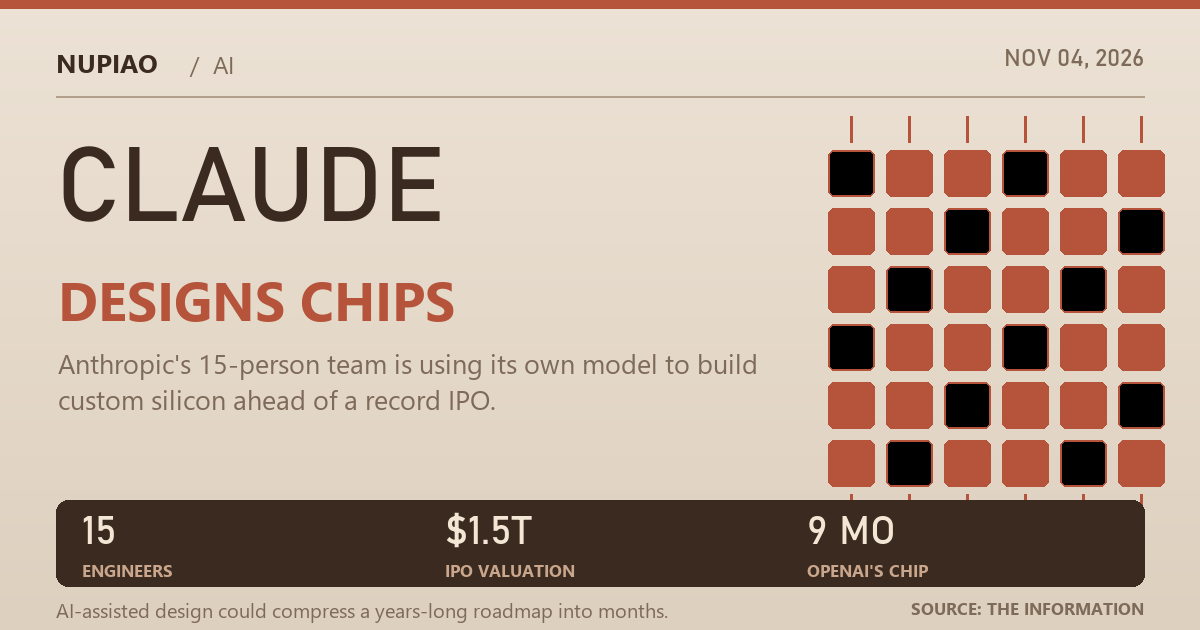
Anthropic is using its own Claude model to design custom AI chips, and it told prospective IPO investors that a 15-person team can compress a job that normally takes years. The claim, reported by The Information on November 3, is less about one startup’s hardware ambitions than about a bigger question: whether frontier models can actually do semiconductor engineering well enough to threaten the toolschip designers already pay for.
Verification note: the 15-person team, the investor meetings and the $1.5 trillion valuation come from The Information, relayed by Cailian Press, Huanqiu and DIGITIMES on November 3–5, 2026. The Samsung turnaround figure is Anthropic’s own claim reported earlier this year. Anthropic has not published quantified time savings or confirmed commercialising the design capability.
What Anthropic actually told investors
In closed-door meetings ahead of a planned IPO later this month, Anthropic presented AI-assisted chip design as a competitive advantage. The company said its newly formed 15-person hardware team is using Claude in the engineering and design work for custom chips, and that engineers found the process “significantly” faster than the traditional workflows at established chipmakers such as Nvidia and AMD.
Be careful with that comparison. It is Anthropic’s own estimate against a benchmark it chose, not a measured head-to-head. No specific percentage, task type or silicon has been disclosed. The valuation attached to the pitch — around $1.5 trillion, according to four people familiar — is what made the story travel, but the technical claim is the part that matters longer term.
The company first confirmed an internal semiconductor team in August, tasked with designing chips for training and running Claude. It has since held preliminary talks with Samsung Electronics about foundry work and approached multiple electronic design automation startups about buying or licensing chip-design datasets to further train the model. That last detail is telling: Anthropic is trying to acquire the domain data it does not have.
Why chip design is the test case
Hardware design is slow, expensive and almost unforgiving of error. A modern chip can take years to move from architecture to tape-out, with huge amounts of time spent verifying that millions of tiny circuits behave correctly. That makes it an awkward but attractive proving ground for a model: the work is structured, the feedback is binary, and the cost of getting it right is enormous.
Anthropic’s own job posting for the team puts it plainly — hardware design is hard and has very low error tolerance, “which is exactly what we want Claude to be good at.” The framing is a bet that models which reason carefully over code can be pushed to reason carefully over silicon.
There is some independent evidence, though it is early. Samsung said in August that it used Claude on a custom SoC verification task that its engineers had expected to take a little over a month; a second-year engineer using Claude Code completed it in two days, roughly a 15-fold speed-up. Verification is not the same as full design, but it is a real task at a real chipmaker, and it gives the claim an anchor outside Anthropic.
| Player | Approach | Status reported |
|---|---|---|
| Anthropic | 15-person team; Claude for custom chip engineering | Internal use; talks with Samsung foundry |
| OpenAI | Jalapeño chip with Broadcom, built using its own models | Says design took ~9 months; scale-up planned 2027 |
| Samsung | Claude used for SoC verification | Claims ~1 month of work done in 2 days |
| Synopsys / Cadence | Sell the EDA software the industry uses today | ~$16bn combined revenue this fiscal year |
The OpenAI comparison is doing a lot of work
Anthropic is not alone. OpenAI’s chief financial officer Sarah Friar said in September that chip design, alongside financial services and life sciences, is a business the company is targeting. OpenAI says it used its own models, working with Broadcom, to design a custom chip codenamed Jalapeño in about nine months, with large-scale deployment planned from 2027.
Nine months is the number everybody quotes, and it should be read carefully. “Design” here covers a specific custom accelerator built on an established partner’s process, not a general-purpose CPU designed from scratch. It is still a dramatic shortening of a normal timeline, and it is why analysts are watching the EDA market.
Why Synopsys and Cadence should pay attention
Synopsys and Cadence sell the software that chip engineers use to design, simulate and verify silicon before it is manufactured. The two companies are expected to bring in about $16 billion in combined revenue this fiscal year. If frontier models can do a meaningful share of that work, the threat is structural, not incremental.
The catch is adoption. Chip companies guard their design files carefully, and for intellectual-property reasons they tend to prefer running open models on their own isolated hardware rather than sending layouts to an external frontier model. Anthropic has also approached EDA vendors for training data, and winning that trust will be a longer job than winning a benchmark.
There is a benchmark, by the way, and it is a reality check. A test published last month measuring chip-design ability across leading models gave the top score to Claude Fable 5.1 — at 16.6%. Best in the field, and still a long way from taking over the workflow. Anyone selling the idea that AI is about to design chips unsupervised is selling something.
The awkward part: Anthropic’s investors are its suppliers
Here is the tension nobody put in the investor deck. Anthropic runs on chips from Amazon, Google, Nvidia and AMD, and those companies have collectively committed roughly $90 billion to it. They are also its main infrastructure and cloud providers. If Anthropic builds a model that designs better chips than its suppliers can, or starts selling that capability, the relationship gets complicated fast.
Anthropic has said it will keep a “multi-chip” strategy, with Amazon, Google, Nvidia and AMD hardware remaining core. It has not said whether it will commercialise Claude’s chip-design ability at all. For now, the most likely use is internal: shorten its own hardware roadmap and reduce the cost of the compute it desperately needs. Selling design tools would put it directly against Synopsys and Cadence, and against the partners funding it.
The realistic read
AI-assisted chip design is real, but it is assistance, not autonomy. The credible near-term gain is in verification, script generation and exploration of design options — the parts of the job that are laborious and rule-bound. The hard architectural decisions, and the accountability when a $100 million tape-out fails, still sit with people.
What Anthropic is really pitching to IPO investors is a compounding advantage: a model that helps build the hardware that runs the model. If even a fraction of the claimed speed-up holds up, it is a genuine moat. If the 15-person team produces a chip that works, on time, on a partner’s process, this will look like the beginning of something. Until then, treat the timeline claims as marketing with a promising demo behind them.
FAQ
Is Anthropic designing its own AI chips?
Yes. It confirmed an internal semiconductor team in August 2026 and told IPO investors in November that a 15-person group is using Claude to design custom chips for training and running the model.
How much faster is Claude at chip design?
Anthropic says “significantly” faster than traditional workflows at Nvidia and AMD, but has published no measured figure. A separate Samsung task saw a month-long verification job completed in two days with Claude.
What is OpenAI doing in this area?
OpenAI says it designed a custom chip, Jalapeño, with Broadcom using its own models in about nine months, with large-scale deployment from 2027.
Could this disrupt Synopsys and Cadence?
Potentially, if AI design tools are sold externally. Neither company’s revenue is at immediate risk — they are expected to earn about $16 billion combined this year — and chipmakers’ IP concerns make adoption slow.
Is AI good enough to design chips on its own?
No. The best model scored 16.6% on a recent chip-design benchmark. The realistic near-term use is assisting engineers with verification and routine work, not replacing them.
For more on the sector, see our News coverage and the artificial intelligence tag. Reporting follows The Information , DIGITIMES and Cailian Press, November 3–5, 2026.