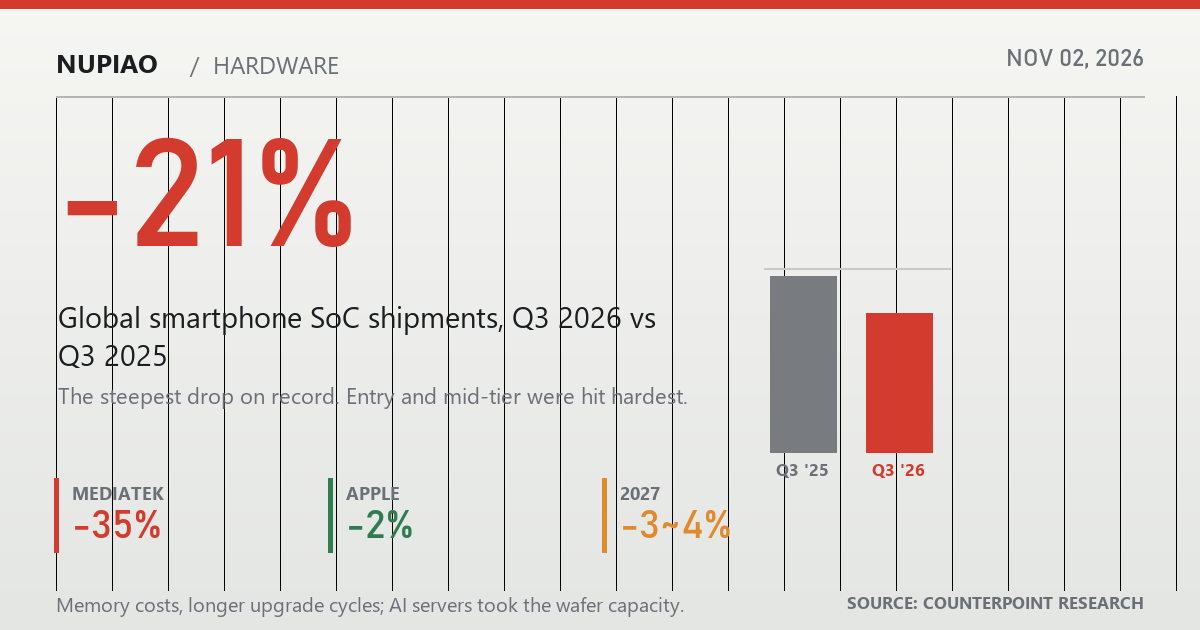
Global smartphone SoC shipments fell 21% year on year in the third quarter of 2026, according to Counterpoint Research — the sharpest quarterly contraction the market has recorded. The damage was not spread evenly. MediaTek’s shipments dropped roughly 35%, while Apple’s slipped only about 2%, and the split says more about what is happening than the headline number does.
Verification note: shipment and share figures come from Counterpoint Research’s “Global Smartphone SoC Shipments, Preliminary View” report, published November 2, 2026, via domestic financial media. Forward estimates and pricing data are Counterpoint’s and IDC’s, as cited in the same reporting. These are preliminary figures and may be revised.
The 21% drop, in numbers
Counterpoint’s preliminary view puts Q3 2026 smartphone SoC shipments 21% below Q3 2025. The firm expects the full calendar year to finish about 20% down, with another 3–4% decline in 2027 before any real recovery. IDC separately counts Q3 global smartphone shipments at 255.3 million units, down 22% — the largest single-quarter fall in its records.
Those two datasets measure different things — chips shipped versus phones shipped — but they tell the same story. Brands are ordering fewer components because they are building fewer phones, and building fewer phones because the cost of the parts, especially memory, has made a lot of low-margin models uneconomic.
| Vendor | Q3 2026 SoC share | Q3 2025 share | Shipment change |
|---|---|---|---|
| MediaTek | 28% | 34% | down ~35% |
| Apple | 21% | 17% | down ~2% |
| Qualcomm / UNISOC / Samsung | remaining share | varied pressure | |
| Total market | — | down 21% | |
Why MediaTek fell 35% and Apple only 2%
This is the part worth sitting with. MediaTek sells into exactly the entry and mid-tier phones that got squeezed first and hardest. When component costs climb, the brands that build cheap phones respond by cutting the cheapest models from their line-up rather than eating the loss. MediaTek’s order book shrinks as a result — by roughly a third, according to Counterpoint’s share and total-market figures.
Apple’s declines were about 2% over the same period. It shipped into the premium tier, where a memory price rise of a few dozen dollars per device is absorbed far more easily, and where demand has been more resilient. Apple and Samsung both run vertically integrated supply chains and premium-heavy line-ups, which is why their shipments have held up so much better than the market.
Qualcomm is caught in the middle. Domestic Chinese brands slowing their orders hits Snapdragon volume, and Samsung’s Galaxy S26 series complicated things further by mixing chips — some units with the Snapdragon 8 Elite Gen 5, others with Samsung’s own Exynos 2600. That split diverts flagship orders away from Qualcomm at exactly the wrong moment.
Memory is the cause, not the symptom
It is tempting to read this as another “people aren’t upgrading” story. Upgrade cycles are getting longer, yes — IDC puts the average smartphone lifespan around 43 months — but that is a background condition, not what changed this quarter. What changed is the price of memory.
AI data centres have pulled wafer allocation toward high-bandwidth memory and server DRAM, where the margins are better. Counterpoint’s price tracking shows mobile DRAM and NAND up 5–10% quarter on quarter in Q3, with another roughly 5% expected in Q4. Over the past twelve months, memory contract prices have risen by more than 550%; one widely cited figure has a 16 GB DDR5 chip going from $8.70 in October 2025 to over $48 by November 2026.
That is a component cost problem that ends up a product strategy problem. IDC estimated earlier this year that memory costs were up nearly 300% year on year and accounted for over 65% of the bill of materials on low-end phones. When the memory in an entry-level handset costs more than the SoC, the business case for shipping that handset at all starts to fall apart.
The 2nm race did not slow down
Here is the odd contradiction in the data: shipments collapsed, but the flagship process-node race sped up. Three 2nm flagship SoCs launched in the same month — Apple’s A20 series, MediaTek’s Dimensity 9600 Pro, and Qualcomm’s Snapdragon 8 Elite Gen 6. All arrived in September 2026.
Moving to 2nm improves performance and efficiency but raises manufacturing cost substantially. Counterpoint expects those three chips to give high-end SoC shipments a temporary lift in Q4, without changing the broader trend. In other words, the top of the market can keep running while the bottom contracts. That is precisely the dynamic that flattened Apple’s decline and wrecked MediaTek’s.
Samsung is leaning into the same logic from the other direction. Its in-house Exynos share reached 9% in Q2 2026, up two points quarter on quarter, driven by the Galaxy S26’s Exynos 2600. The company is also courting custom SoC customers, offering design, foundry, memory and advanced packaging as a single package — a way to make its fabs useful even when phone volumes sag.
What this means if you are actually buying a phone
Plain answer: waiting is unlikely to get you a cheaper device. Counterpoint expects memory prices to keep rising through 2027, just more slowly, and IDC has said the industry’s cost structure has shifted permanently rather than cyclically. Market recovery, on IDC’s reading, is not until 2028.
What may change is the mix on the shelf. Brands are trimming entry-level line-ups and quietly dropping configurations that no longer clear a profit margin. If you are shopping in the budget or mid-tier, the most useful thing you can do is watch which storage and RAM configurations remain available, because the cheap ones are the first to go. The resale market for large-memory older phones has heated up for the same reason — a 16 GB or 1 TB second-hand handset now holds value it would not have a year ago.
FAQ
How much did smartphone SoC shipments fall in Q3 2026?
21% year on year, according to Counterpoint Research’s preliminary report. Counterpoint expects roughly a 20% decline for the full year and a further 3–4% in 2027.
Which chipmaker was hit hardest?
MediaTek, whose shipments fell about 35% as entry and mid-tier phone orders dried up. Apple’s fell only about 2%.
Why are smartphone SoC shipments dropping?
Mainly memory costs. AI data-centre demand has pushed up DRAM and NAND prices, raising the bill of materials on phones and making low-margin models unviable. Longer upgrade cycles are a secondary factor.
Are phones getting more expensive?
Yes, and Counterpoint expects memory prices to keep climbing into 2027. IDC believes the current cost structure is a permanent shift, with a market recovery unlikely before 2028.
Did flagship chips slow down?
No. Three 2nm flagship SoCs — Apple A20, MediaTek Dimensity 9600 Pro and Qualcomm Snapdragon 8 Elite Gen 6 — launched in September 2026. The premium tier is holding up while the low end contracts.
For related reading, see our News coverage and the semiconductor tag. Figures follow Counterpoint Research and IDC as reported on November 2, 2026.