By
Edited by Liu Fangyuan
With less than ten days to go before the 2026 World Artificial Intelligence Conference (WAIC) officially kicks off, on July 8, NUPIAO got a sneak peek from the organizing committee into some core exhibitors and has put together the key forum highlights and debut products for this year.
Tencent’s Chief AI Scientist Yao Shunyu and former Alibaba Qwen lead Lin Junyang are set to share the stage once again, over 200 embodied AI companies will gather under one roof, and domestic computing power will reveal its latest report card—these are the absolute “must-see list” for WAIC this year.
Computing Power: From Chips to Clusters, Self-Controlled Innovations Flood In
Given the current restrictions on advanced manufacturing processes, how far has domestic computing power really come? Computing infrastructure is undoubtedly the heavyweight highlight of WAIC this year.
As the computing race deepens, inference demand has overtaken training, and the industry is now asking, “What’s the effective computing power?” This year, the computing power trend at the conference has shifted from “comparing single cards” to “comparing systems”—think computing infrastructure, power-computing synergy, optical interconnects, token costs, and storage-computing synergy—all making a collective debut at WAIC.
Huawei will showcase the world’s strongest supernode cluster, the Atlas 950 SuperCluster, with computing power exceeding 500,000 cards; Zhongke Shuguang will also bring its scaleX 100,000-card super-intelligent fusion cluster system; ZTE and other manufacturers will display domestic Matrix supernodes based on OEX+dOCS architecture. Xizhi Technology will directly tackle the technical debate of “Can optical computing replace electricity?” A host of Chinese companies like Wuxing Qionggong, Lixun, and Xinhua San will all deliver their computing power answers with system-level engineering and architectural innovation.
“14nm equals 4nm.” At the first stop of our tour, NUPIAO walked into the recently unveiled Zhangjiang headquarters of Shanghai Oriental Computing Chip Technology Co., Ltd. This “unicorn” chose the WAIC timing to officially pull back the curtain and reveal itself to the world.
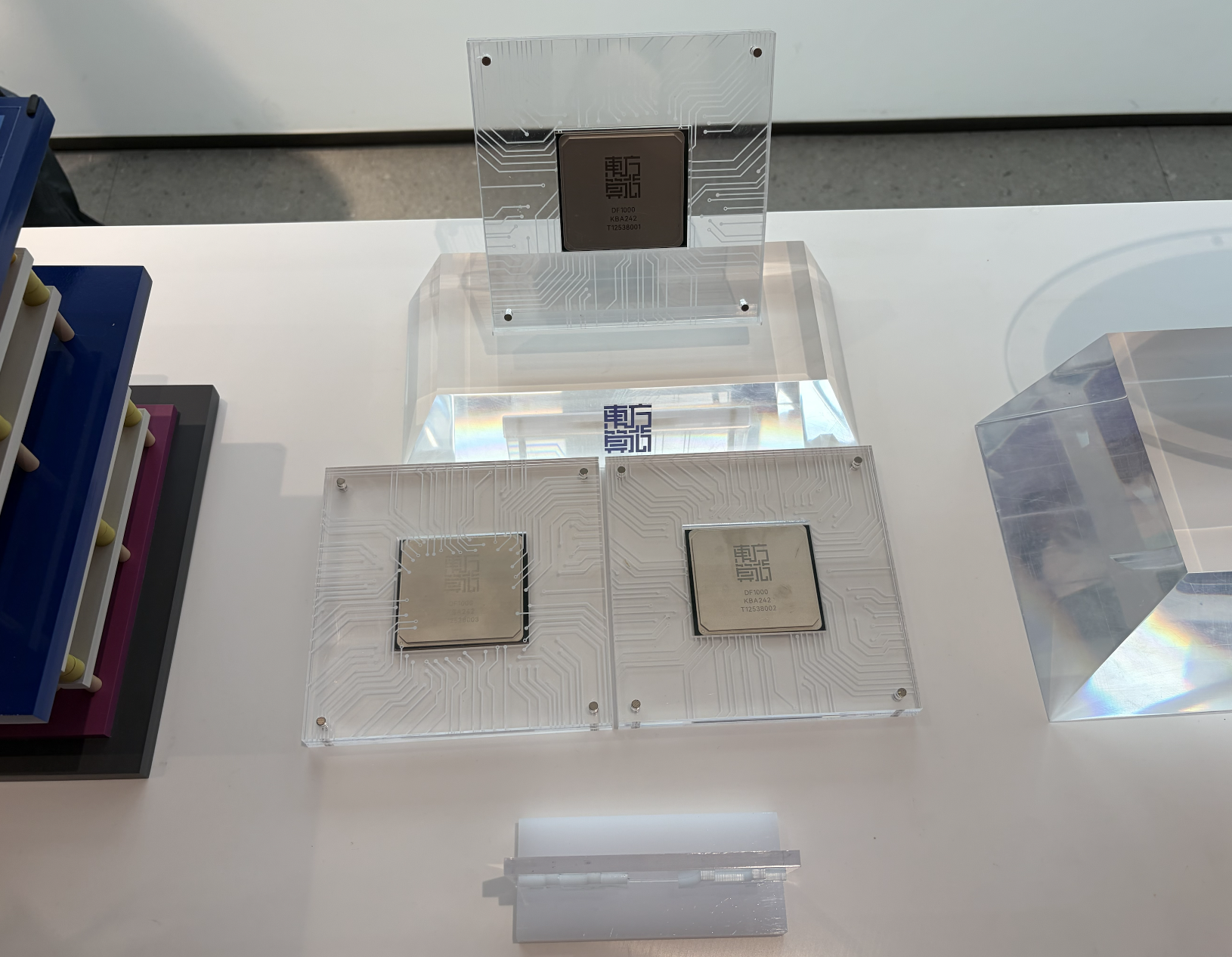
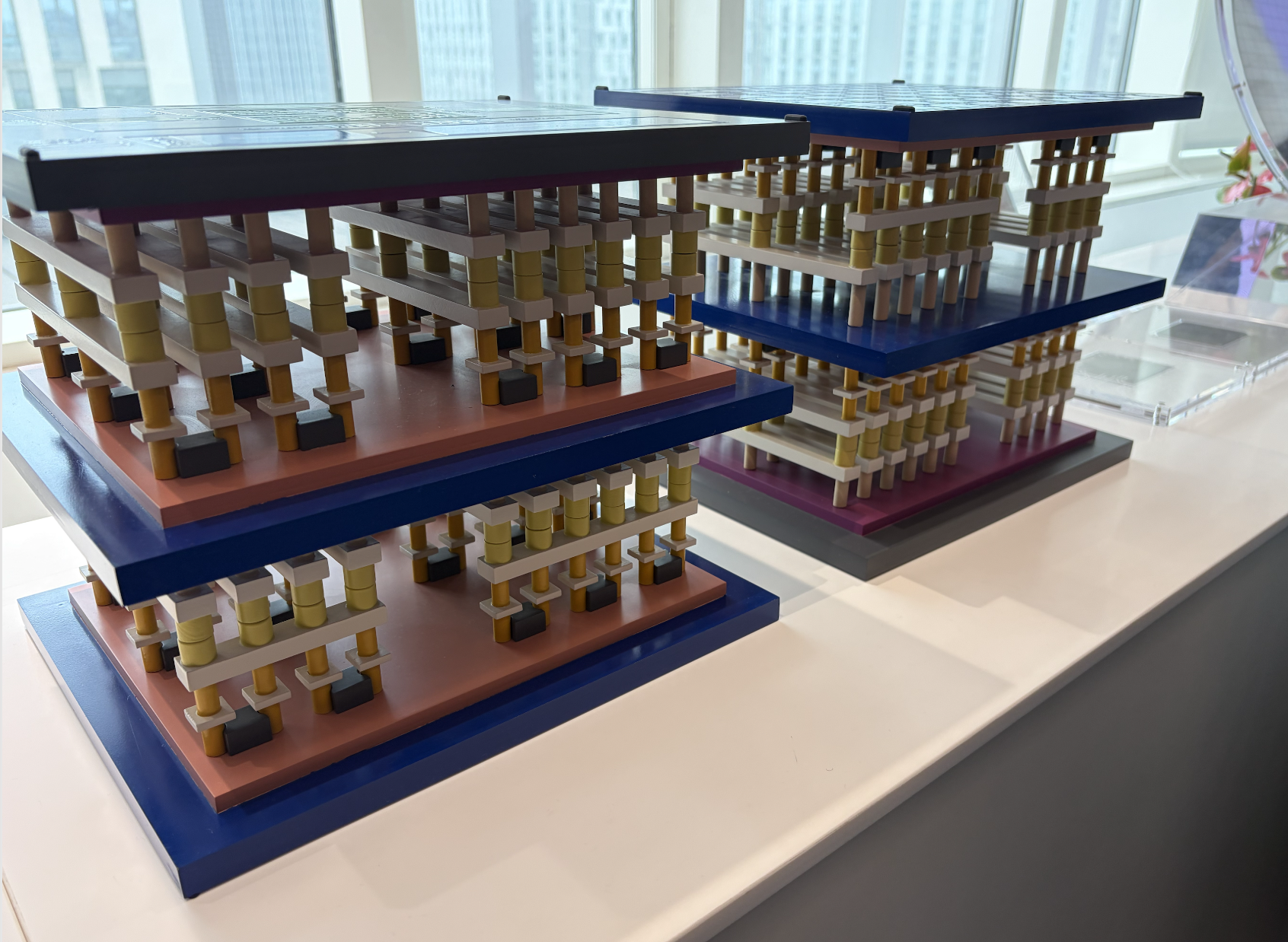
Stepping into the exhibition hall, Oriental Computing Chip showcased its debut product, the DF1000 chip series AI accelerator, while the chip model demonstrated its 3D stacking technology. Xu Ziming, head of the marketing department at Oriental Computing Chip, said that by following two disruptive technical paths—”software-defined chips + 3D stacked near-memory computing architecture”—the company has carved out a new, self-controlled path for domestic computing power.
Right now, the domestic 3D computing chip track is heating up. Huawei’s recently released “Tau (τ) Law” also aims for equivalent performance gains through 3D stacking and software-hardware synergy, and this route is becoming a consensus for domestic computing power to make a breakthrough by changing lanes.
Xu Ziming explained that overseas mainstream chips typically have a hardware resource utilization rate of only 50% to 60%, leaving a lot of transistors idle. By reallocating via software, Oriental Computing Chip can revitalize that idle capacity, squeezing out higher effective computing power per unit area. The DF1000’s three-layer stack structure—a gray computing layer in the middle, with storage layers above and below—drastically reduces physical distance compared to traditional 2.5D flat packaging. More contact area means greater bandwidth.
Since setting up in Zhangjiang in 2024, Oriental Computing Chip has grown rapidly, now boasting over 500 employees. Most crucially, the DF1000 uses a fully domestic, stable supply chain from chip design and wafer manufacturing to packaging and testing. During WAIC 2026, Oriental Computing Chip will also prominently feature its servers and computing clusters.
On the front of 100% full-chain self-control and multi-dimensional breakthroughs, besides Oriental Computing Chip’s 3D near-memory computing, Shanghai Silang Technology will bring its 100% independently developed “Tianqiong” 3D scientific computer to push high-end computing power self-control further. Domestic manufacturer Muxi’s dedicated GPU for the high-end AI4S (AI for Science) vertical marks a new pattern where domestic chips not only achieve standardized replacement in mainstream large model tracks but also form a “specialized facility breakthrough” in cutting-edge scientific simulations like life sciences and materials science.
AI4S: Nobel Laureate Brings “AI Problem-Solving,” Yao and Lin to Share Stage Again
At this year’s WAIC, AI4S (AI for Science) is listed as one of the core topics, and the caliber of related guest lineups and the heat of cutting-edge topics will hit new highs.
NUPIAO has learned that at the Youth Roundtable Forum, Tencent’s Yao Shunyu and ex-Alibaba’s Lin Junyang will once again share the stage for a dialogue. The much-anticipated “Double Yao Dialogue” jointly presented by Tencent and Google DeepMind will also be a major draw.
Just last month, on June 7, 2021 Nobel Prize winner in Physics and founder of complex systems theory Giorgio Parisi announced that his team, using the AI model Claude Opus 4.7, successfully solved a physics problem that had been stuck for 12 years in about 40 rounds of interactive dialogue. He comes to WAIC with the dual halo of “Nobel + AI solves a 12-year problem.” Joining him on stage will be Max Tegmark (MIT professor), cosmologist, AI safety advocate, and author of “Life 3.0,” who will contemplate AI’s ultimate destiny from a cosmic scale.
Thanks to its data and industry advantages, China might be the place to “turn the tables” in the global AI4S competition. While people everywhere are buzzing about the potential of “AI for Science,” one Shanghai company has already produced a tangible, touchable product.
At Tianyu Technology’s enterprise exhibition hall in Minhang’s Da Lingang Bay area, NUPIAO saw a set of automated equipment driven by an AI agent running non-stop. At WAIC 2026, Tianyu will prominently showcase its conversational protein R&D agent, MatwingsVenus™ (XiaoWu™). Users can complete the entire process—from industry research and database retrieval to protein design and automated experimental validation—through natural language dialogue, truly realizing “just talk to design proteins.”
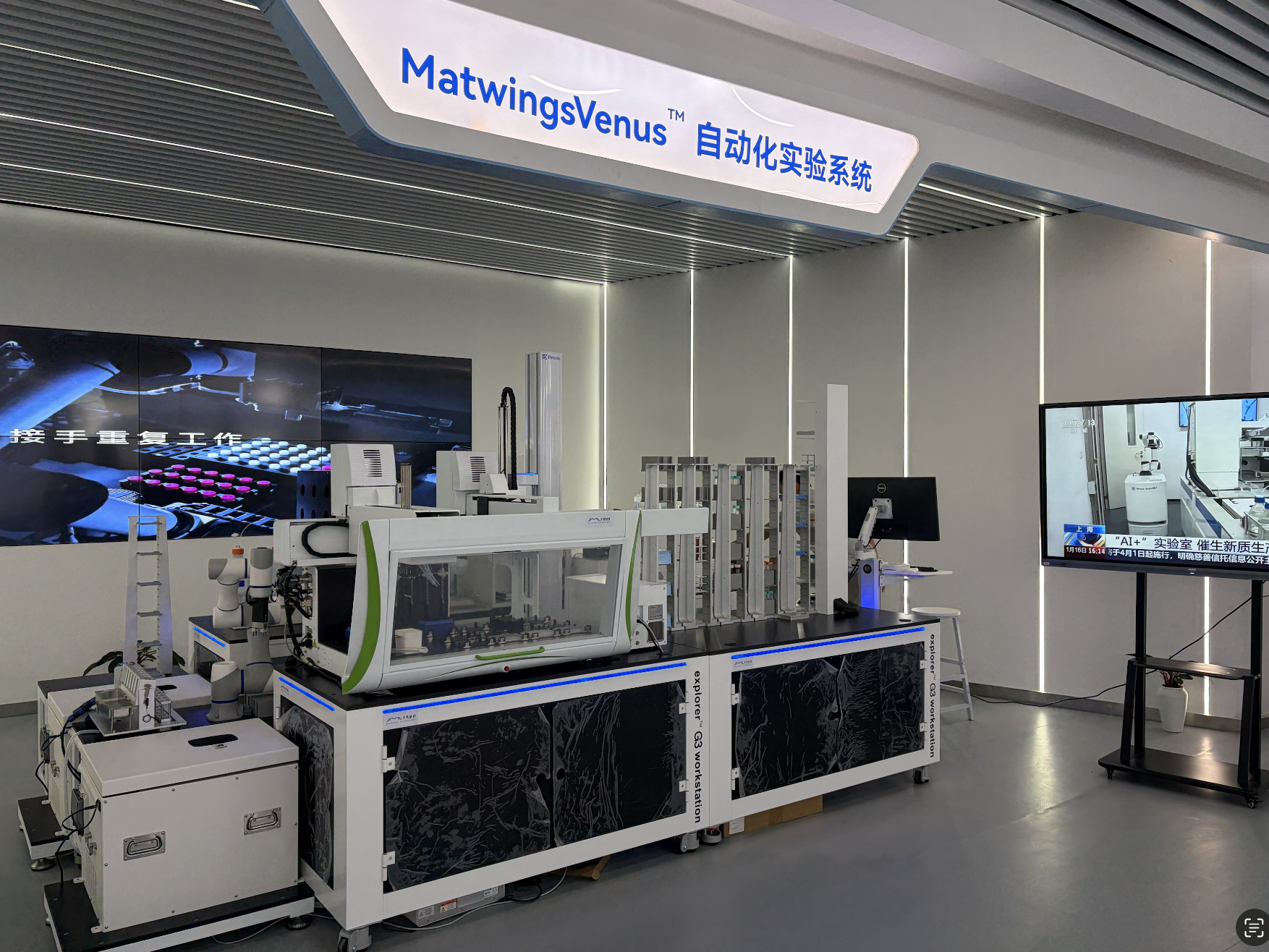
“AlphaFold solved the prediction from sequence to structure, but structure is just a bare-bones house—you can’t live in it. We solve the mapping from sequence to function,” Hong Liang, founder of Tianyu Technology, told NUPIAO and other media. In early 2023, Tianyu’s large model began validation in real projects; in 2024, they designed a protein using AI for a pharmaceutical company that achieved 5-ton scale-up production—the world’s first industrialized protein product made with a large model, with proven industrial implementation experience.
China is forming a new competitive edge in AI4S, a new high ground in global tech competition. Beyond this, WAIC will also feature major breakthroughs in AI applications in meteorology, materials, and life sciences. China’s Meteorological Administration’s “Mazu” AI weather model has already been deployed in over 40 countries, including Pakistan, Ethiopia, Mongolia, and Djibouti. The Southern Power Grid’s AI weather model “Dawate Tianxiang” recently achieved a temperature forecast deviation of only 0.9°C.
Embodied AI: 200 Companies Exhibit Together, Direct Dialogue Between Chinese and US Practitioners
In 2026, embodied AI has reached a watershed moment—moving from “showing off in the lab” to “doing real work in the industry.” This year, WAIC will see over 200 embodied AI companies exhibiting and competing on the same floor, with top domestic and international practitioners engaging in face-to-face discussions on technical routes, engineering bottlenecks, and how to achieve mass deployment.
On the exhibition front, Zhiyuan is bringing a six-product lineup, Yushu Technology will publicly reveal its robot unmanned factory for the first time, and companies like Galaxy General, Tashi Zhihang, Leju, Fourier, Qianxun Intelligence, Songyan Power, Yunshenchu, and Sudu Technology will all showcase their latest standout products.
Zhou Yan, founder of Genesis AI, which just completed a $105 million seed round, breaking the record for Chinese fundraising in Silicon Valley, and Ren Zhiwei, a core researcher at Physical Intelligence, representing the “Silicon Valley Chinese robot dream team,” will make their first systematic public appearance back in China. At the forum “Wisdom Unleashes Embodiment: An Integrated Embodied AI Tech Stack and Its Applications,” Su Hang, a core scholar in embodied AI from Tsinghua University, will join Zhiyuan’s Yao Yinqing on stage to debate the technical route choice of “VLA vs. Physical World Layer.”
Right now, preparations for the conference are entering the final sprint. Under the theme “Intelligent Partners, Co-Creating the Future,” Chinese audiences will get an up-close and personal feel for the dense explosion of AI innovation.