On July 28, data from the U.S. stock market close showed that Elon Musk’s two core assets are under simultaneous pressure. SpaceX’s stock continued its downward trend, nearly halving from its post-IPO peak. Tesla, meanwhile, hit a new low for 2026. In just a month and a half, SpaceX’s market cap evaporated by over $1 trillion, while Tesla’s year-to-date losses have reached 31%. The synchronized slump of these two companies has tarnished Musk’s trillionaire status, with his personal wealth evaporating by about $130 billion (roughly 880 billion yuan) in just five trading days. This comes just weeks after he became the first person in human history to see his net worth break the $1 trillion mark.
As the largest IPO in history, SpaceX landed on the Nasdaq on June 12 under the ticker symbol SPCX, with an IPO price of $135 per share. The base fundraising scale reached $75 billion, and with the overallotment option, total proceeds hit approximately $86.25 billion, setting a new global IPO record and surpassing Saudi Aramco.
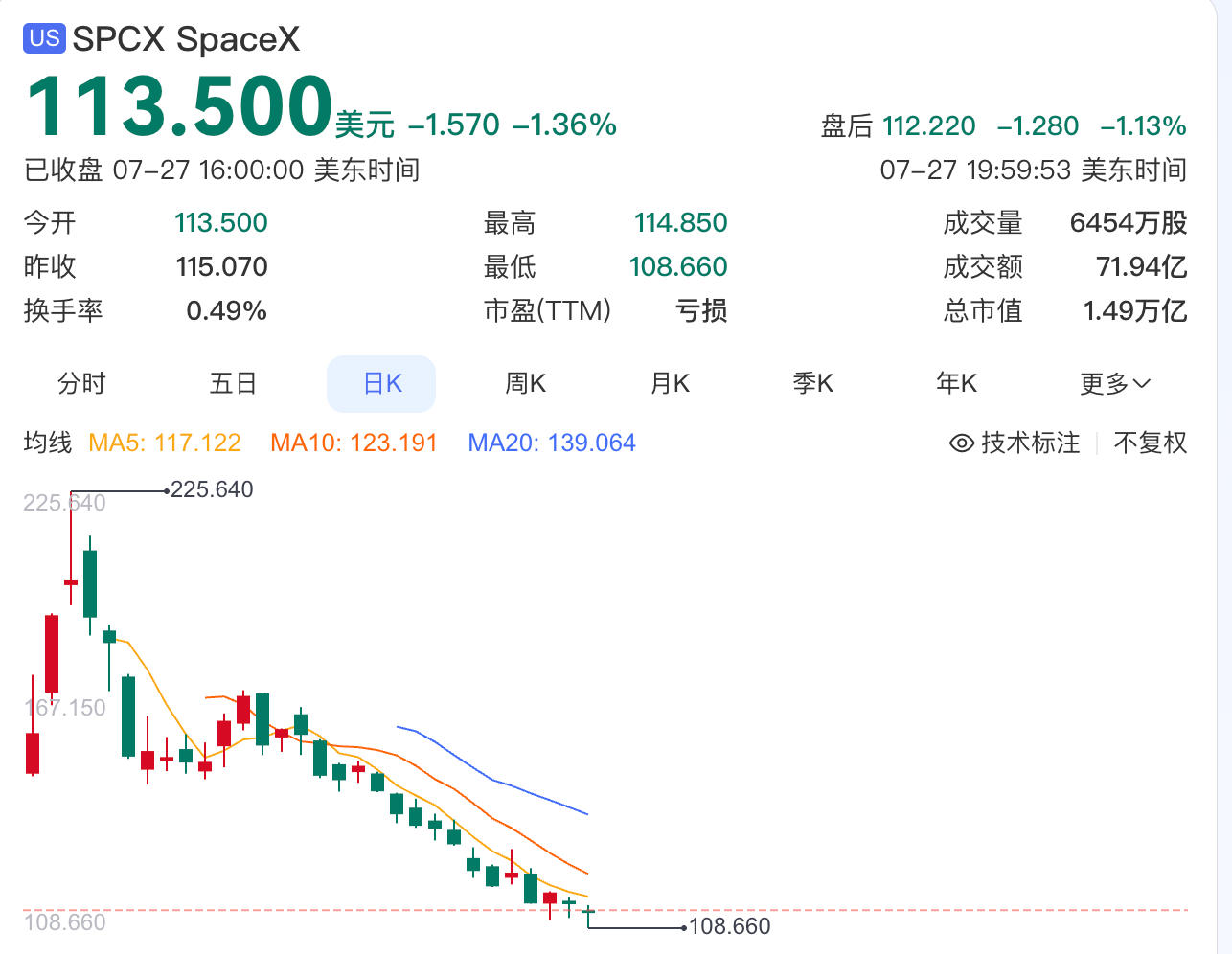
In the early days of trading, market sentiment was red-hot. Retail and institutional money poured in, pushing the stock price rapidly higher. On its first day, the stock closed at $160.95, up 19.22% from the IPO price, giving it a total market cap exceeding $2.1 trillion. Over the next three trading days, buying pressure continued. On June 16, the stock hit an all-time high of $225.64, pushing the market cap to roughly $2.66 trillion and briefly surpassing Amazon to rank among the top five most valuable publicly traded companies globally. Musk’s personal net worth also broke the $1 trillion mark.
But the frenzy didn’t last. From there, SpaceX’s stock entered a one-way downward slide. Right after the IPO, the market gave SpaceX an extremely high valuation premium based on grand narratives like Starlink’s commercialization, the Starship reusable rocket, and Mars colonization. Even though the company posted a net loss of $4.937 billion for the full year of 2025, and its first-quarter loss in 2026 widened to $4.276 billion, investors were still willing to pay up for long-term growth potential. However, as the Starship test flight was called off at the last minute, project progress fell short of expectations, Starlink user growth slowed, and competitors like Amazon’s Project Kuiper accelerated their plans, market concerns about the pace of its commercialization began to mount. At the same time, the anticipated unlocking of lock-up shares and the broader tech stock correction sped up SpaceX’s valuation regression, gradually pulling its once fundamentals-detached stock price back toward a more reasonable range.
On June 22, SpaceX suffered a single-day crash of over 16%, wiping out about $400 billion in market cap in one day. The sell-off accelerated in July, and the stock first broke below its $135 IPO price in mid-July. As of the close on July 27, SpaceX stock was trading at $113.50, down roughly 49.7% from its peak of $225.64, with its market cap evaporating by over $1.2 trillion. That’s almost the entire market cap of Musk’s other company, Tesla, which stands at $1.22 trillion.
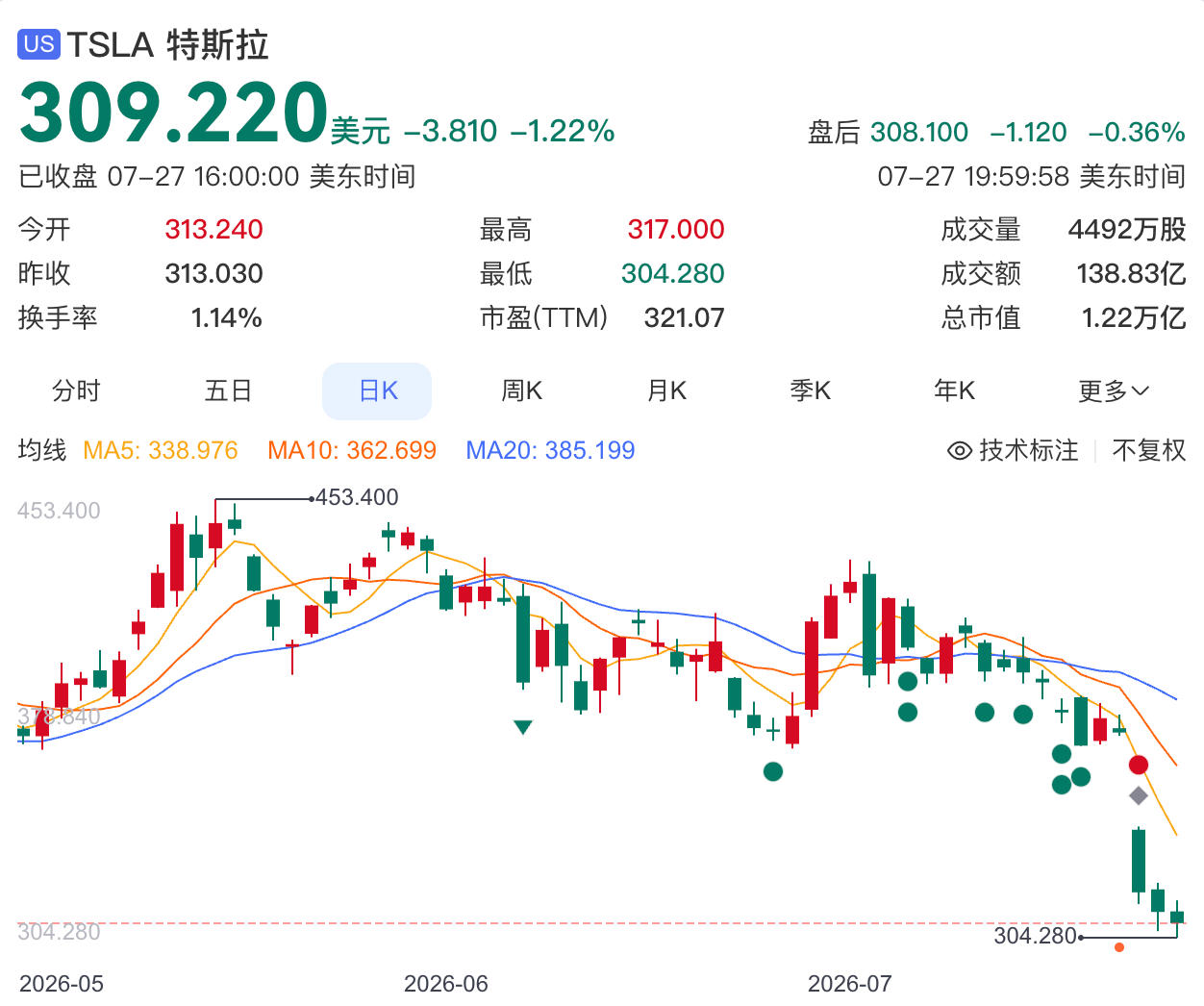
Tesla’s stock has also been on a persistent downtrend in 2026, recently hitting a new low for the year. On July 23, battered by disappointing Q2 earnings, Tesla’s stock plunged 14.52% in a single day, its biggest single-day drop since March 2025, wiping out roughly $200 billion in market cap. The decline continued in the following sessions, with the stock hitting an intraday low of $304 on July 27, a new low for 2026. Tesla is the worst performer among the “Magnificent Seven” tech stocks this year. Before the crash, Tesla’s forward P/E ratio was as high as 151 times, making it the most expensive of the “Magnificent Seven.” After the crash, its trailing P/E ratio still stands at 289.84 times, far above its five-year median of 107.37 times.

Earnings data shows that Tesla is currently stuck in a classic “revenue growth without profit growth” dilemma, which is the internal factor weighing on its stock price. In Q2 2026, the company’s total revenue hit $28.24 billion, up 26% year-over-year, and vehicle deliveries reached 480,100 units—both all-time highs. But on the profit side, things took a cliff dive. Operating profit for the quarter was just $398 million, a staggering 57% drop year-over-year. The operating margin plummeted to 1.4% from 4.1% in the same quarter last year. Excluding revenue from carbon credits, the automotive gross margin slipped further to 16.3%, as relentless price wars continue to erode core business profitability.
What’s even more worrying for the market is Tesla’s cash flow situation. To support long-term projects like autonomous driving, humanoid robots, and AI supercomputing, Tesla’s capital expenditures in Q2 surged 142% year-over-year. This pushed free cash flow into negative territory for the first time in two years, with a net outflow of $1.09 billion for the quarter. The company expects capital expenditures to exceed $25 billion for the full year and to keep growing over the next two to three years. This massive cash-burning model is raising widespread concern among investors about the company’s financial health.
Public equity data shows that Musk holds about 13% of Tesla’s shares and roughly 42% of SpaceX’s equity. When SpaceX’s stock was surging right after the IPO, his personal net worth briefly topped $1.4 trillion, firmly securing his spot as the world’s richest person with a huge lead over the runner-up. However, since over 90% of Musk’s net worth is tied up in just two stocks—SpaceX and Tesla—his wealth is highly dependent on stock price fluctuations. With SpaceX’s market cap cut in half and Tesla continuing to slide, his wealth has quickly fallen back below the $1 trillion mark. Musk even joked about it on social media, calling himself an “ex-trillionaire.”