Tomorrow (July 24), the Family Division of the Seoul High Court will deliver its verdict on the retrial of the divorce asset division case between SK Hynix’s “boss” Choi Tae-won and his ex-wife, Roh Sook-young.
This chaebol family lawsuit—dubbed the “divorce of the century” by Korean media—has dragged on for nearly a decade, with multiple reversals, and now faces a decisive judicial ruling. The appellate judge will determine how to split Choi’s assets, which peaked at around $5 billion on paper, and what share his ex-wife Roh Sook-young is entitled to.
Back in 1988, as South Korea’s economy soared, Choi Tae-won—son of the SK Group founder and heir to the empire—married Roh Sook-young, the eldest daughter of then-President Roh Tae-woo. The wedding, held at the Blue House, was hailed by local media as the “wedding of the century,” a union seen as a deep intertwining of political and business power.
The marriage lasted 34 years and produced three children. During that time, Choi took full control of SK Group, spearheaded the acquisition of Hynix, and aggressively expanded into the semiconductor sector, catapulting the company into a global leader in memory chips.
In 2015, Choi publicly admitted to a long-term extramarital affair in an open letter, revealing he had a daughter out of wedlock and expressing his desire to divorce. Roh initially refused. It wasn’t until 2017, after Choi formally filed for divorce mediation and talks collapsed, that the couple entered full-blown litigation.
In 2019, after all three children had reached adulthood, Roh changed tack and filed a countersuit. Instead of trying to save the marriage, she demanded a massive asset split and compensation for emotional distress, kicking off a protracted legal war.
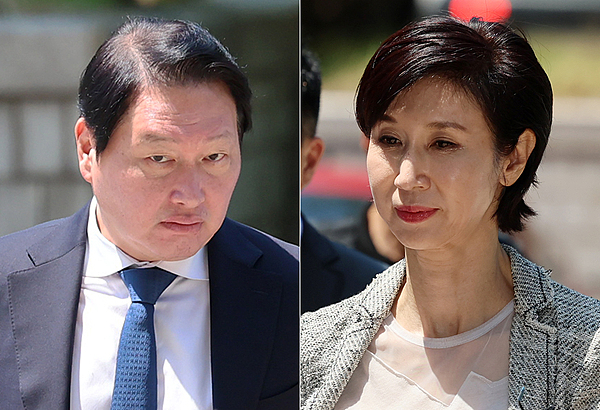
Looking back at the rulings, it’s clear the case has seen wildly different outcomes, which is exactly what the retrial needs to sort out.
In the first trial in 2022, the Seoul Family Court decided that most of Choi’s SK shares were inherited or gifted from family, making them his personal property. It ordered him to pay Roh just 66.5 billion won in asset division, plus 100 million won for emotional damages—a tiny fraction of his total wealth. Roh immediately appealed, arguing the ruling ignored her decades of contributions to the family and business.
Then came the bombshell in the 2024 appeals court ruling. The panel bought Roh’s argument, acknowledging that former President Roh Tae-woo had provided resources and financial support to SK Group in its early days, and that Roh Sook-young had helped maintain family ties to stabilize the company. They jacked up the asset division to 1.3808 trillion won (nearly $1 billion) and raised emotional damages to 2 billion won, making it the most expensive divorce settlement in South Korean history.
Choi immediately appealed that massive judgment. In October 2025, the Supreme Court upheld the 2 billion won in emotional damages but scrapped the huge asset division. Their reasoning: there were compliance issues with the source of the 30 billion won that Roh Tae-woo had put into SK, so it couldn’t count as Roh Sook-young’s effective contribution. The case was sent back to the Seoul High Court for retrial, with only the divorce itself finalized.
As the retrial kicked off in 2026, the court tried mediation twice. But the two sides couldn’t agree on asset scope or valuation methods, so both attempts failed. The court then set July 24 for the verdict.
Since early 2025, SK Hynix’s stock price has surged nearly tenfold, more than doubling Choi’s net worth. On July 10, SK Hynix went public on the Nasdaq in New York with an ADR listing, and its shares jumped 12.76% that day. The offering raised a total of $26.5 billion, making it the second-largest stock offering in U.S. history.
With the retrial verdict coming tomorrow, everyone’s eyes are on two key points that will decide how much money is on the table.
First, there’s the big question: are the SK holding company shares marital property? Choi’s lawyers insist that most of his shares came from his father and are not subject to division because they weren’t accumulated through joint effort during the marriage. Roh’s camp, on the other hand, argues that over 34 years, she kept the chaebol family stable and used her political connections to smooth the group’s path, making a real contribution to the stock’s long-term growth. They want a 50-50 split of the shares.
The second big fight is over when to value the assets. From 2025 onwards, the AI boom sent demand for memory chips through the roof, pushing SK Hynix’s market value sky-high. Choi’s personal net worth hit around $5 billion at its peak.
Choi’s legal team argues that the marriage was effectively over long before, so the recent stock surge is down to the company’s own business moves and industry tailwinds. Roh had no hand in that, they say, so under Korean law, those post-separation gains shouldn’t count. They want the valuation pegged to April 16, 2024, when the appeals court wrapped up its arguments and SK shares were at 160,000 won each.
Roh’s side, however, wants the latest stock price on the day of the retrial verdict as the baseline. That would be June 26, 2026, when SK Hynix shares were trading at over 800,000 won each. If the ruling goes her way, her asset division could be as high as $1 billion.
Still, Choi’s lawyers think the final number will be way lower than that.
As a pillar of Korea’s semiconductor industry, the stability of SK Group’s shareholding structure is a big deal for the capital markets. If this verdict forces Choi to hand over a big chunk of SK holding company shares, Roh could become a major shareholder, potentially shaking up the controlling stake and corporate governance—at least in the short term, it could rattle the stock price.
Many analysts at Korean brokerages point out in their reports that, beyond the dollar amount, the long-term impact of how this case settles two key legal questions—”Can inherited chaebol shares be divided?” and “Who owns passive asset growth after a marriage ends?”—will be far more significant.