Recently, the popular antique appraisal influencer “Tingquan Appreciating Treasures” (formerly known as “Tingquan Appraising Treasures”), who boasts tens of millions of followers, publicly addressed the rumor that he “lost all his parents’ savings on stocks and got blocked by them.” He explained that the whole thing was just a playful joke he cracked with fans during a live stream, and urged the media to report the facts honestly, stressing that he’s always had a great relationship with his parents.
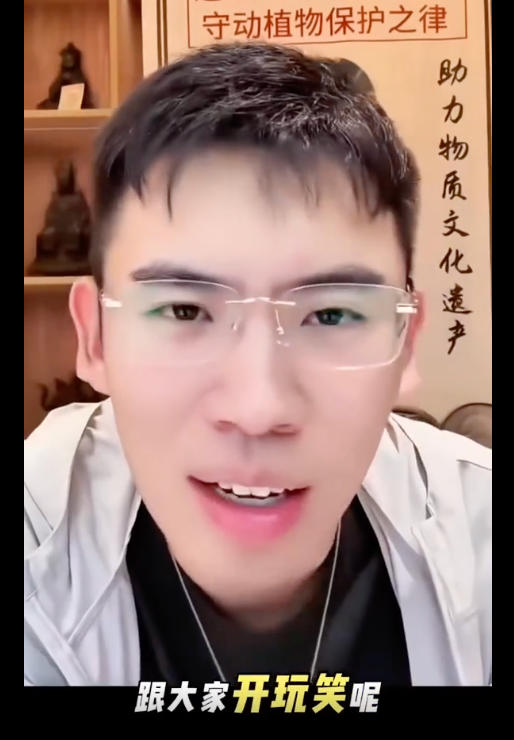
During a live stream on July 26, “Tingquan Appreciating Treasures” talked about his recent stock trading experiences, getting pretty emotional as he declared he’s completely quit the stock market, uninstalled all trading apps, and even blurted out, “If I ever trade again, I’ll cut off my own hands!” In the clip, he described how his personality shifted after getting into stocks, constantly pushing his parents to throw their pension into the market with an arrogant attitude. Every morning at 9:30 sharp, he’d blow up the family group chat, urging his folks to “go all in” and “double down.” When his elders tried to reason with him, he’d lecture them back, acting so bossy that “you couldn’t tell who the parent was.” In the end, his parents lost their entire life savings, principal and all, and blocked him, even kicking him out of the family group chat.

As the top-tier influencer in the antique appraisal niche on Douyin, “Tingquan Appreciating Treasures,” whose real name is Ding Xiangxu, rose to fame thanks to his deep knowledge of artifacts and his hilarious, engaging live-streaming style. He’s one of the most influential antique authentication bloggers in the country. He constantly drops jokes and pulls off creative stunts during his streams, turning them into a massive, entertaining appraisal talk show. Back in early January 2024, his fan count was under 3 million, but in less than a month, it doubled, hitting 6 million by mid-February. Within the next six months, he gained nearly 15 million more followers. Currently, his Douyin account has 34.65 million fans.
No matter how much of this story is made up, the fact that it sparked such a heated debate mainly boils down to how it struck a chord with investors’ emotions. Since July this year, the A-share market has ended its first-half structural rally and taken a sharp, rapid downturn. From July 1 to 17, the STAR 50 Index dropped over 22%, and the ChiNext Index fell more than 21%. In this fast-moving decline, many investors saw huge losses in their portfolios.
Interestingly, “Tingquan Appreciating Treasures” isn’t the only influencer whose stock losses have grabbed headlines lately. Another blogger with millions of followers, “Fengge Die On The Road,” also trended for massive stock losses. He publicly said he’s uninstalled all trading apps, claiming he lost 500,000 yuan in just 48 hours. He kept falling into the trap of “panic selling at lows and chasing highs,” hitting every wrong market move perfectly, earning him the nickname “reverse indicator” from netizens.
Then there’s the finance blogger “Da Zengzi,” who shared that he started with 1.2 million yuan in the market but ended up with just 170,000 yuan—a brutal 85% loss. To break even, he’d need a 567% gain, which is next to impossible. And earlier on, the first-generation influencer “Liu Ji Shou” blew up the internet when news broke that he lost 3 million yuan from his mother-in-law’s house sale money, which was meant for his wife, by trading stocks.

According to a survey by the China Securities Investor Protection Fund, over 60% of individual investors in the A-share market have never received systematic investment education. Nearly 40% use short-term living funds for stock trading, creating a serious mismatch between risk tolerance and actual trading behavior. Especially during market euphoria, a flood of new investors jump in without respecting the market, treating it as a quick way to get rich. But when the tide turns, they pay a heavy price. Regulators have been pushing investor education for years, constantly reminding people that “the stock market is risky, invest carefully.” Yet, with every market cycle, someone ends up repeating the same mistakes.
What’s more alarming is the rise of short-video and live-streaming platforms, where stock trading content has become a new traffic magnet. Many non-professional bloggers share their investment stories and post screenshots of returns, luring followers in and then monetizing through courses and communities—hiding plenty of risks. Some accounts exaggerate profits, hide losses, or even engage in illegal activities like unauthorized stock recommendations and market manipulation to grab attention. In March 2026, the Beijing Securities Regulatory Bureau cracked down on a bunch of “influencer market manipulators.” These bloggers made money by charging membership fees and guiding stock trades, causing dozens of investors to lose millions of yuan combined. The China Securities Regulatory Commission has repeatedly warned investors to be wary of so-called “stock gurus” and “folk market legends,” urging them not to trust unknown stock tips and to stick with legal, compliant investment channels.