Reported by NUPIAO
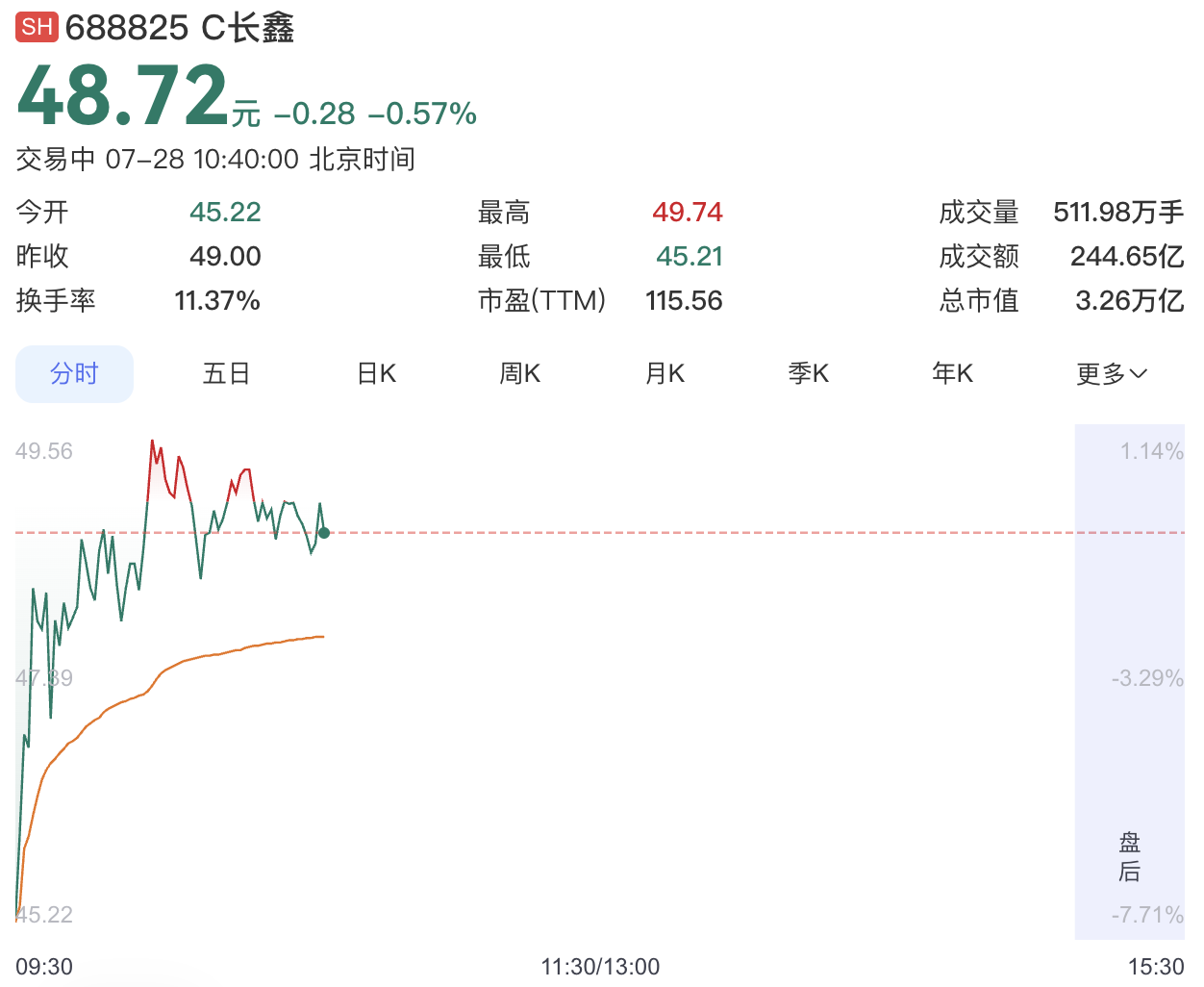
On July 28, in its second trading day on the STAR Market, CXMT (ChangXin Memory Technologies) opened at 45.22 yuan per share. As of press time, it was trading at 48.72 yuan, down 0.57%, giving it a market cap of 3.26 trillion yuan.
Just yesterday, this Chinese DRAM giant made its official debut on the STAR Market, smashing multiple A-share records on its first day. With a total trading volume of 141.187 billion yuan, it became the first stock in A-share history to surpass the 100-billion-yuan single-day turnover mark. That handsome performance handed all its strategic investors a massive paper windfall—and that includes Xiaomi founder Lei Jun.
According to CXMT’s preliminary placement results released on July 20, Xiaomi’s wholly-owned subsidiary, Wuhan 1810 Enterprise Management Co., Ltd. (hereafter “1810”), made the strategic placement list, securing 18.2448 million shares. Based on the offering price, that’s a total investment of about 158 million yuan.
Tianyancha data shows that 1810 was founded in 2021, mainly in the business services sector, with a registered capital of 53 billion yuan and a paid-in capital of 37.857 billion yuan. The company’s controlling shareholder is Xiaomi Technology Co., Ltd., and Lei Jun holds 97.48% of Xiaomi Technology’s shares. By that math, Lei Jun’s paper profit from CXMT on its first trading day would be a cool 717 million yuan.
But on the morning of July 28, Xu Jieyun, Special Assistant to the Chairman of Xiaomi Group and Deputy General Manager of the Strategic Marketing Department, responded, saying, “Hey folks, just take it as a bit of fun—don’t take it too seriously. Honestly, you can’t really calculate it that way. This is a company investment, and you can’t lump together the gains of a specific subsidiary entity with personal wealth. Oh, and by the way, best wishes again to CXMT.”


Alibaba and NIO also reaped big rewards from the CXMT IPO. Alibaba Group, through two entities, holds nearly 5% of CXMT’s shares, for a total investment of about 7.6 billion yuan. Based on CXMT’s market cap on its debut day, the value of Alibaba’s stake has soared past 170 billion yuan, netting a paper profit of over 160 billion yuan—a return multiple of more than 20 times.
In fact, Alibaba jumped into CXMT back in December 2021. At that time, Alibaba (China) Network Technology Co., Ltd. invested about 1.5 billion yuan to get roughly 1.12% of CXMT’s shares. Then, in June 2026, Alibaba poured another 6.1 billion yuan into CXMT’s capital increase through its subsidiary, Zhejiang Alibaba Cloud Computing Co., Ltd., pushing its total stake to nearly 5%. That move made Alibaba Cloud CXMT’s sixth-largest shareholder and the biggest industrial investor in the final funding round before the IPO.
NIO also made the strategic placement list for CXMT’s IPO, committing to a 158 million yuan subscription with an 18-month lock-up period for about 18.2448 million shares. With CXMT’s closing price of 49 yuan per share on July 27, NIO’s paper profit sits at around 740 million yuan, with a yield exceeding 465%.
In response to the news of NIO becoming a strategic investor in CXMT, NIO Chairman William Li told the media that the partnership is going smoothly and that working with CXMT helps stabilize NIO’s supply chain. Li himself recently attended a thank-you dinner hosted by CXMT.
CXMT, headquartered in Hefei, Anhui, operates three 12-inch DRAM fabs across Hefei and Beijing. According to Omdia data, it’s China’s number one and the world’s fourth-largest DRAM manufacturer.
It’s worth noting that Hefei’s state-owned capital started laying the groundwork in the integrated circuit industry long before CXMT was born. Back in 2013, Hefei released its integrated circuit industry development plan, first proposing the building of an influential “China Silicon Valley.” CXMT’s listing marks a historic leap for Hefei’s IC investments, generating over a trillion yuan in paper profits for Hefei’s state capital. Hefei’s total A-share market cap has now surpassed 4 trillion yuan, making it the second-largest city in the Yangtze River Delta by A-share market value.
Inside CXMT, 14 directors, senior executives, and core technical staff—along with their close relatives—indirectly hold a combined 2.034 billion shares. Based on the closing price of 49 yuan per share, the total market value of their holdings comes to a staggering 99.666 billion yuan.
Banks and insurance firms that bet on CXMT also pocketed tidy gains. Five major state-owned banks invested through AICs and their funds. Agricultural Bank of China Investment, CCB Investment, ICBC Financial Investment, Bank of China Investment, and Bank of Communications Financial hold approximately 574 million, 498 million, 383 million, 230 million, and 230 million shares, respectively, totaling about 1.915 billion shares. Additionally, China Merchants Bank, Shanghai Pudong Development Bank, and Huishang Bank also hold stakes through fund investments. The combined potential appreciation for all these banks’ holdings is over 100 billion yuan.
On the insurance side, Hexie Health Insurance holds 901 million shares, China Life Investment 476 million, PICC Capital 467 million, Sunshine Life 225 million, China Post Life 225 million, and PICC Ke Chuang 90 million shares, totaling about 2.384 billion shares, valued at over 100 billion yuan as well.
But not everyone got lucky. Market rumors suggest that Country Garden once held a small stake in CXMT during its fundraising phase. However, squeezed by its own debt and liquidity pressures, it cashed out completely just before the IPO, directly missing out on a potential paper gain of nearly 50 billion yuan.
One thing to keep in mind: these placement shares come with lengthy lock-up periods. The paper profits for Lei Jun and the Xiaomi camp, the banks and insurers, and the tech giants are just static estimates. Future stock price swings will ultimately determine how much actually lands in their pockets.
And as for the buzz online, according to a report from Da Wan News, one CXMT employee said, “We’re just keeping a level head. No matter what people say online, it doesn’t really have much to do with us regular employees. We’re more concerned about whether our salaries and benefits will change in the future.”