On July 21, local time, Google’s DeepMind unveiled three new lightweight Gemini models: Gemini 3.6 Flash, Gemini 3.5 Flash-Lite, and the industry-specific Gemini 3.5 Flash Cyber. But the highly anticipated flagship version, Gemini 3.5 Pro, was nowhere to be found.
According to third-party evaluation data, Google’s current main Gemini lineup has fallen out of the global top 10, signaling mounting pressure in the high-stakes race for leading AI models.
Per official details, these three new models are laser-focused on large-scale commercial use. Gemini 3.6 Flash is a versatile lightweight model that boosts multimodal understanding, tool calling, and code generation, while cutting token consumption and pricing—perfect for agent deployment and high-volume document processing. Gemini 3.5 Flash-Lite prioritizes ultra-high throughput and low cost, ideal for latency-sensitive tasks like text summarization, data preprocessing, and real-time translation. Gemini 3.5 Flash Cyber is a cybersecurity-specific model, fine-tuned for vulnerability detection and code security checks, currently only available to select partners and not publicly released.
At this year’s Google I/O developer conference, CEO Sundar Pichai announced that Gemini 3.5 Pro was slated for a June release. The industry saw this flagship model as Google’s best shot at reclaiming ground in the high-end market, with expectations for a summer debut to rival OpenAI and Anthropic’s latest offerings.
But over two months later, Google still hasn’t set a firm launch date, only hinting that the model remains in closed partner testing. This repeated delay has sparked questions about Google’s challenges in cutting-edge AI development.
Third-party leaderboards paint a grim picture: the main Gemini models now rank outside the top 10 in overall scores.

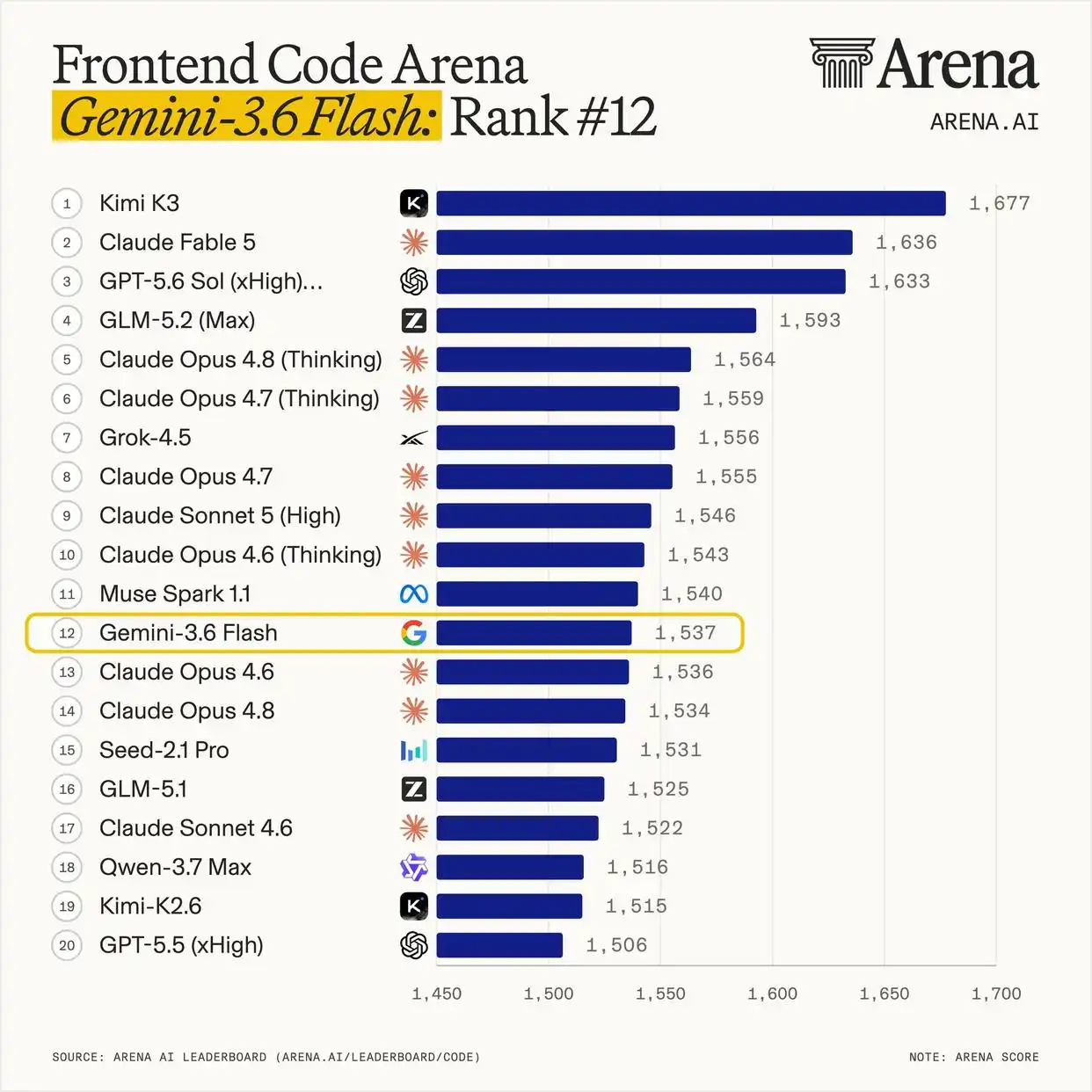
According to AI model evaluation platform Arena.ai, Gemini 3.6 Flash scored 1537 points in the front-end code arena, landing at 12th place. Domestically, Moonshot AI’s newly released Kimi K3 topped the chart with 1677 points, while Zhipu’s GLM-5.2 took fourth. Anthropic’s Claude and OpenAI’s GPT series also held strong positions.
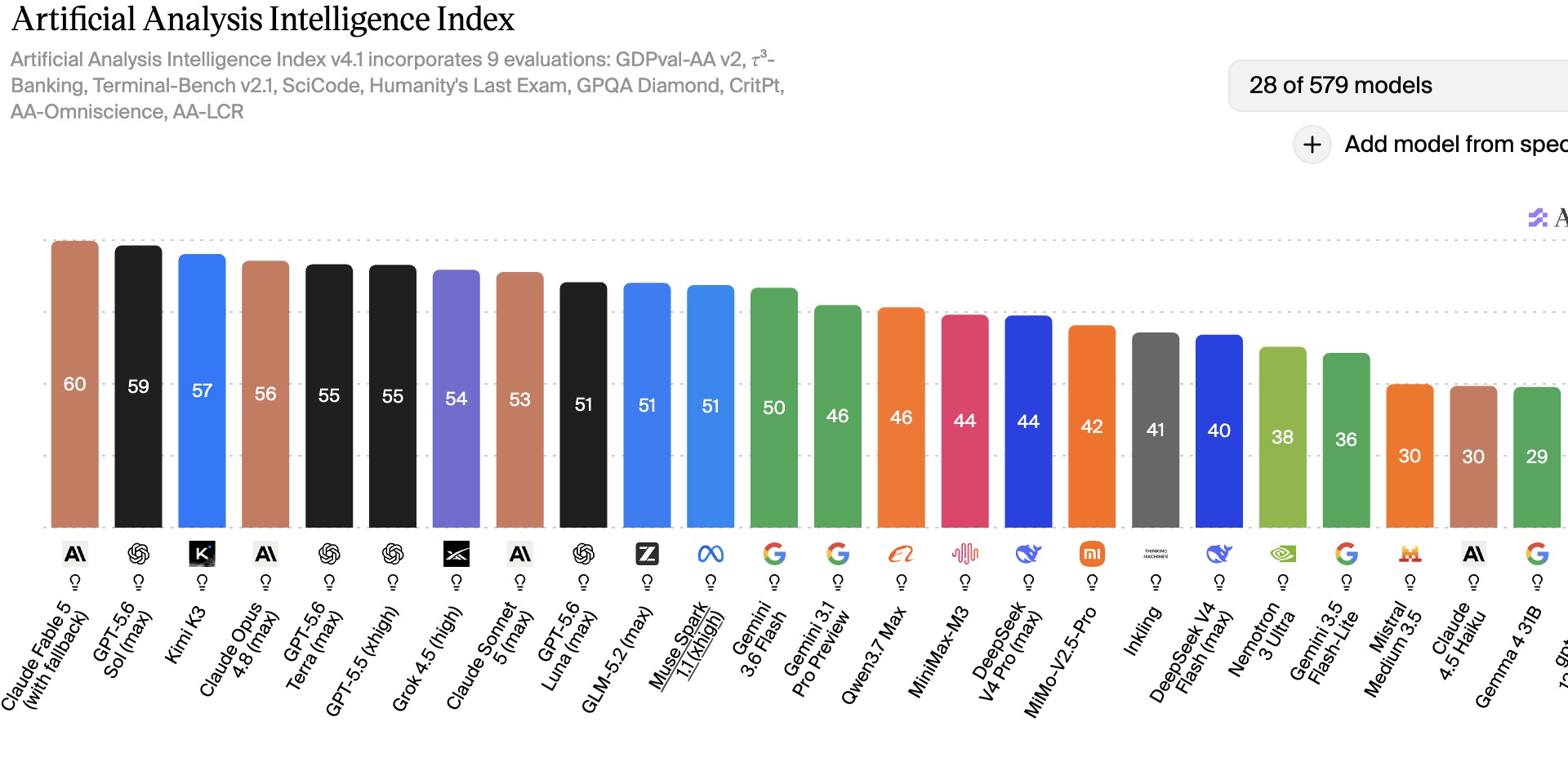
In the latest Artificial Analysis Smart Index rankings, none of Google’s models cracked the top 10 —a stark contrast to last year. Back in November 2024, Google’s Gemini 3 model briefly outpaced OpenAI, stunning the industry and sending Google’s stock soaring.
But as we hit 2026, the competition among top-tier AI models has grown fierce. OpenAI keeps iterating on its GPT high-end versions, strengthening complex reasoning and multimodal skills; Anthropic continues updating Claude, winning over enterprise clients with long-context capabilities and safety; meanwhile, Meta, DeepSeek, Moonshot AI, and others are churning out next-gen base models, squeezing the rankings from below.
On July 17, Moonshot AI officially launched Kimi K3, a massive model with 2.8 trillion parameters, a 100-token context window, and native visual understanding. Moonshot AI calls it “the most capable model ever created.”
Tesla CEO Elon Musk commented “Impressive” under a related review post. Soon after, he announced on social media that his AI company is training a new model with 2 trillion parameters, which “might surpass Kimi.”
Multiple blind tests show that current Gemini models lag behind the top tier in complex logic, long-chain task planning, and combined text-image reasoning. Some evaluators note that Google’s early lead in multimodal capabilities is being rapidly eroded.
Competitors are closing the multimodal gap, while Google drags its feet on a new flagship to push performance limits. The three new models are all lightweight, focusing on speed and cost, with only modest gains in core intelligence.
Market analysts suggest that behind the ranking slide, rivals maintain a steady flagship upgrade cadence—”flagships push performance ceilings, lightweight versions drive commercial adoption.” In contrast, Google keeps updating its mid-tier Flash series but lacks a high-end flagship, potentially weakening its influence in enterprise markets.
Still, some argue that from a business angle, Google’s approach saves money. More companies are focusing on AI ROI; burning through massive tokens doesn’t always yield the best outcomes. Google CEO Sundar Pichai himself noted that mixing Flash models with cutting-edge ones can save a ton of cash.
Compared to competitors, Google boasts an ecosystem of Android, Chrome, Workspace, Search, and cloud services. The strategy is to cut costs, boost speed, and enhance task-specific capabilities, rather than just chasing model size or rankings.
But that doesn’t mean Google’s parent company Alphabet is scaling back AI investments. According to public earnings and investor updates, Alphabet has raised its 2026 annual capital expenditure to $180-$190 billion—nearly double the previous year—with most funds going to AI compute clusters, data center expansions, and custom chip development. In Q1 alone, capital spending hit $35.7 billion, up over 100% year-over-year.
Meanwhile, Google DeepMind continues to expand its research team, recruiting top AI talent, and has kicked off pre-training for the next-generation Gemini 4 base model.