

News by NUPIAO
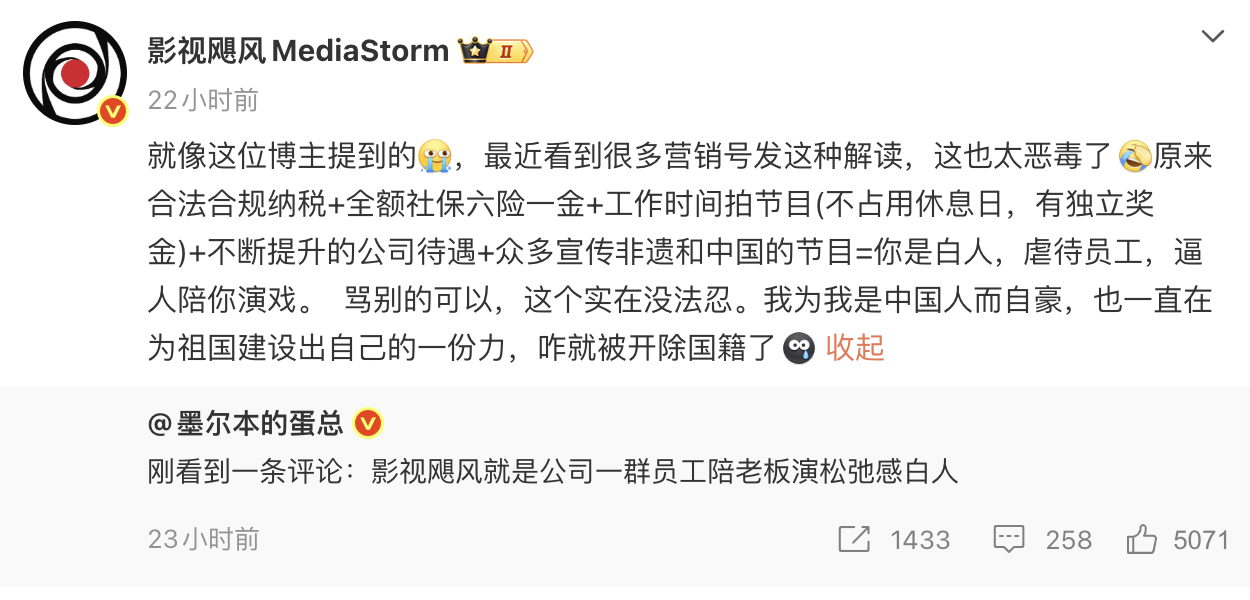
On July 20, a netizen commented: “FilmStorm is just a bunch of employees playing ‘relaxed white people’ for their boss,” implying the easygoing work vibe is a staged act mimicking Westerners. Soon, a flood of clickbait accounts amplified the remark, accusing the company of “faking a chill atmosphere.”
In response, FilmStorm fired back: “We’ve seen so many of these viral takes lately—it’s really vicious.”
“So doing things like paying taxes fully, offering full social insurance plus six funds, filming shows during work hours (no weekends required, with separate bonuses), constantly improving benefits, and producing tons of shows promoting intangible cultural heritage and China—all that makes us ‘white people’ who mistreat employees and force them to perform? You can trash other stuff, but we can’t take this,” the company stated.
Meanwhile, the company’s employee insurance status also drew public scrutiny.
According to Tianyancha, FilmStorm’s associated firm, Hangzhou Xingao Media Co., Ltd., was founded in August 2016 with legal representative Pan Tianhong (Tim) and a registered capital of about ¥1.053 million. Its business covers TV and film production, creative works, and film shooting services, co-owned by Tim, Pan Shuimiao, Zhao Min, and others. The number of insured employees surged from 11 in 2019 to 122 in 2025—more than ten times in six years.

This February, Tim appeared at the Insigma Insta360 annual meeting and gave a speech. On stage, he announced that in 2026, one employee would get ¥1 million and nine months off to climb Mount Everest—if they already have mountain experience and a passion for it. That remark immediately sparked debates about FilmStorm’s perks.
Many still see FilmStorm as just a 10-million-follower tech YouTuber. Founder Tim started his venture in 2016 and returned to China in 2018 to build a team in Hangzhou. Early on, he gained traction with smartphone cinematic shooting tutorials and gear reviews, amassing 40 million followers across platforms like Bilibili, Douyin, and Xiaohongshu.
What sets FilmStorm apart is its targeted content lineup. The main channel focuses on camera, editing, and lighting tutorials; subchannel “A Tiny Difference” dives into Chinese industrial and intangible cultural heritage; while “StormCrew” produces team documentaries, regularly visiting traditional artisans and domestic tech factories, churning out content that celebrates local culture and homegrown tech.
Yet the company’s revenue model doesn’t rely on video views alone. It’s built a diverse income stream, with e-commerce through its own brand as the core, plus brand sponsorships, TVC customizations, and paid knowledge on filmmaking.
In an interview last October, Tim revealed that FilmStorm’s most profitable segment is e-commerce—just one T-shirt design sold 200,000 units last year. Previously, TVC ads were the top earner, but now they account for only about 10% of revenue. “E-commerce is where scaling really hits,” Tim said. “When users start sharing products organically, sales explode.”
Beyond content and e-commerce, FilmStorm was then considering venturing into education and training, like filmmaking courses for young people on shooting, editing, and building a personal brand. “This market is huge. Many young people want to learn but can’t find systematic teaching. We have hands-on experience, so our courses will be super practical,” Tim added.
When asked about the golden age of self-media, Tim admitted it’s not as hot as five years ago, but he believes there’s still room. “Platforms are more competitive now, and user attention is scattered, but quality content always finds an audience. The key is finding your own niche. New creators can break through if they pick a specific area and differentiate themselves.”
Just recently, FilmStorm launched an AI practical course on its livestream for ¥49. Within one day, sales hit over 100,000 copies, translating to an estimated single-day revenue of ¥4.9 million. The course has 16 lessons across five modules, priced at ¥99 (discounted to ¥49), covering basics like AI image generation, video creation, and prompt tutorials, plus advanced tricks like simulating robotic arm camera moves, bullet-time effects, and storyboard output. Buyer reviews are mixed—some find it concise and easy, while others say it’s too basic, more like reading a tool manual.
FilmStorm has weathered online storms before. In November 2025, its own-brand outdoor jacket was called out by a blogger for exaggerated claims about fabric and waterproofing, sparking controversy.
At the time, “Jufeng Shop MediaStore” responded by releasing test reports showing no detectable PFOA (carcinogen) in the jacket, with water pressure and breathability all passing standards. They also pointed out that the blogger’s sample was already damaged and the report incomplete—an attempt to cherry-pick data. Plus, the blogger themselves sold counterfeit high-end products.
For many consumers, buying FilmStorm gear hinges on Tim’s “tech guru” persona. Once that fan economy glow fades, the whole business model will face growth pressures.
