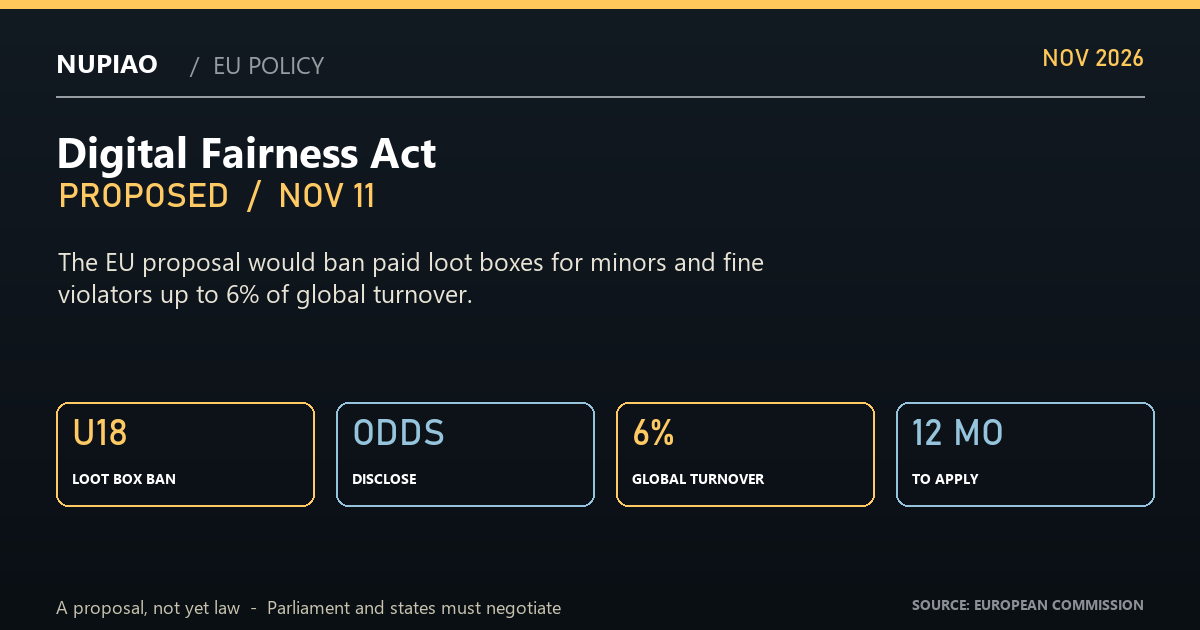
The European Commission has proposed a Digital Fairness Act that would ban paid loot boxes and pay-to-win mechanics for minors, require reward probabilities to be disclosed to adults and expose companies that break the rules to fines of up to 6% of worldwide annual turnover. The proposal was unveiled on November 11, 2026, after a 71-page draft leaked earlier in the week. For game publishers, it is the most significant European consumer rules reset since the GDPR — and it reaches well beyond Europe’s borders.
Verification note: the measures and the 6% fine come from a leaked 71-page draft published by Contexte and the Commission’s proposal presented on November 11, 2026, cross-checked with GamesIndustry.biz, Eurogamer and POLITICO. This is a proposal, not law. It must still be negotiated by the European Parliament and member states, and the final text may change substantially.
What the proposal actually covers
The Digital Fairness Act, or DFA, is broad. It addresses manipulative interface design, which regulators call dark patterns — false scarcity labels, fake countdown timers, pre-ticked paid add-ons and repetitive pop-ups pressuring a purchase. It covers addictive design features, unfair personalised advertising and pricing, influencer marketing without clear disclosure, subscription traps and hard-to-find cancellation buttons. Video games are named explicitly, but so are marketplaces, travel sites, streaming services and mobile apps.
The legal mechanism is a proposed regulation that would repeal and replace the Unfair Commercial Practices Directive. Because it is a regulation rather than a directive, it would apply directly in all member states once adopted, instead of being transposed into national law with local variations. Fines of up to 6% of worldwide annual turnover would be tied to a reform of the Consumer Protection Cooperation framework.
The gaming rules in detail
For anyone under 18, the draft would prohibit paid loot boxes and other paid random-reward systems. Pay-to-win and pay-to-progress mechanics — where paying is required to advance or gain an advantage — would also be barred for minors. Paid virtual currencies would be disabled by default on products aimed at minors and could only be switched on with parental approval. Profiling-based advertising to minors would be restricted, and personalised pricing that exploits vulnerable consumers would be limited.
Adults are treated differently. Paid random-reward systems remain permitted, but publishers would have to disclose the probability of each reward and provide tools to disable them. Purchases made with paid virtual currencies would have to show their real-money value clearly. That last requirement is aimed at the way in-game currencies obscure what a player is actually spending by converting cash into an abstract middle layer.
| Practice | Under 18 | Adults |
|---|---|---|
| Paid loot boxes / random rewards | Prohibited | Allowed with probability disclosure and a disable tool |
| Pay-to-win / pay-to-progress | Prohibited | Not covered by the minor-specific ban |
| Paid virtual currency | Off by default, parental approval required | Real-money value must be shown |
| Profiling-based ads | Restricted | Existing rules largely apply |
| Free trial to paid subscription | Explicit consent required | Advance reminder and explicit agreement required |
Why a European rule reaches global studios
The DFA would apply to any trader targeting consumers in the EU, including companies established outside the Union. That follows the logic of the existing Unfair Commercial Practices Directive and the reach of the GDPR before it. In practice, large publishers rarely maintain a deliberately weaker version of a game for Europe. If a loot box has to be removed or reworked for EU players, the same build tends to ship everywhere, because maintaining separate monetisation code paths is expensive and attracts bad press.
That is why industry groups are reacting as if this is a global rule. Video Games Europe and the European Game Developer Federation have criticised the proposal, arguing that terms like “pay-to-progress” are too vague and would create legal uncertainty. They point to PEGI’s age-rating system as protection that already exists. Publishers also worry about the interaction with the separate EU KIDS Act, which the draft repeatedly references without fully resolving.
The timetable, and a large dose of caution
Nothing changes for players this week. The Commission’s proposal now enters the ordinary legislative process, where the European Parliament and the Council of Representatives of member states negotiate amendments. That commonly takes a year or more, and the text that emerges can differ sharply from the draft. Germany has already signalled a preference for updating existing consumer-protection law rather than adding a new cross-sector regulation. If adopted, the rules are expected to apply roughly twelve months after entry into force.
The 6% headline figure is also worth keeping in perspective. It matches the top tier of GDPR and Digital Markets Act penalties, but it is a ceiling for the most serious infringements investigated at EU level, not a standard fine for a single mislabelled pop-up. Enforcement details are still being negotiated.
The honest read
Treat this as a strong signal of direction rather than a deadline. European regulators have moved from asking games to disclose odds to proposing outright bans on selling randomised rewards to minors, and the fine structure is designed to get attention. Studios with large live-service titles should be auditing their monetisation flows now. Players should expect the loudest change to be cosmetic at first — clearer pricing, real probability numbers and easier cancellation — with the harder questions about loot boxes settled in Brussels over the coming year.
FAQ
What is the EU Digital Fairness Act?
It is a proposed European regulation targeting dark patterns, addictive design, unfair personalised advertising, influencer marketing, subscription traps and paid loot boxes. The Commission presented it on November 11, 2026.
Does it ban loot boxes in games?
For minors, yes — the draft prohibits paid loot boxes and pay-to-win mechanics. For adults, paid random rewards would remain legal but would require disclosed probabilities and a tool to disable them.
How big are the proposed fines?
Up to 6% of worldwide annual turnover for the most serious infringements, in line with GDPR and Digital Markets Act penalty ceilings. The final enforcement framework is still under negotiation.
Is the Digital Fairness Act law yet?
No. It is a proposal that must be negotiated and approved by the European Parliament and member states. If adopted, it would apply roughly twelve months after entering into force.
Would it affect studios outside the EU?
Yes in principle. The proposal covers traders targeting EU consumers regardless of where they are established, and publishers typically apply one global build rather than maintaining separate regional monetisation systems.
For more industry coverage, see our News section. The proposal details come from the European Commission and reporting by GamesIndustry.biz and Eurogamer .