By |
Editor | NUPIAO
You don’t need the most cutting-edge manufacturing process or even HBM memory. Just how powerful can a homegrown Chinese AI chip actually be? Well, Shanghai just dropped a pretty compelling answer.
On July 13, Dongfang Suanxin launched its first major AI chip, the DF1000, right here in Shanghai. They’re calling it the world’s first software-defined near-memory computing 3D chip. The specs are impressive: it hits 520 TFLOPS of BF16 precision, boasts a memory bandwidth of 6.4 TB/s, and a Scale-up interconnect bandwidth of 900 GB/s.
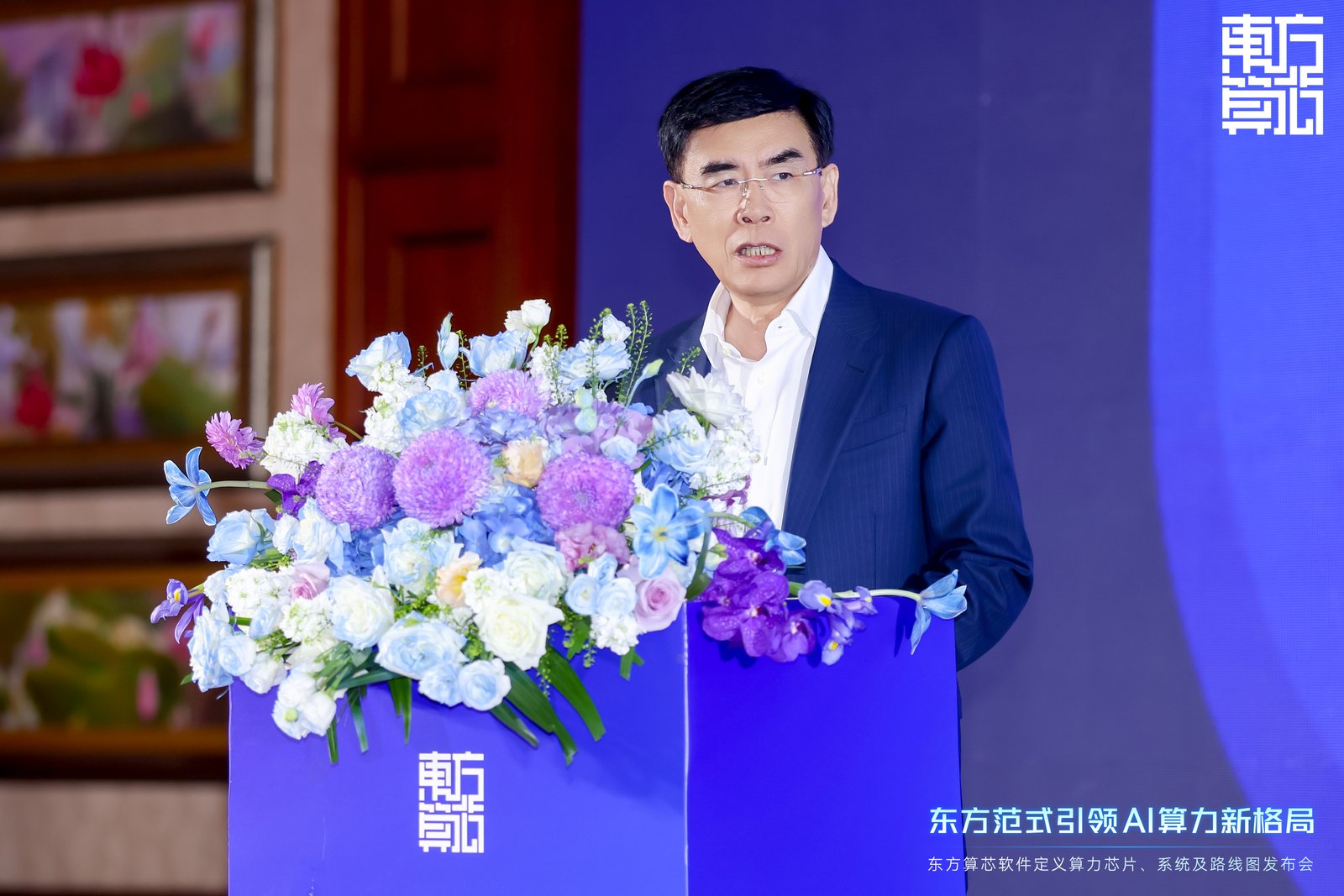
This chip takes a completely different road than what everyone else is on. When I sat down with Wei Shaojun, the Chairman and CEO of Dongfang Suanxin, he laid it out for me. He said domestic AI chips have basically had two main choices until now. One is the specialized ASIC route – great performance, but it lacks flexibility. The problem is, AI algorithms change dramatically every three to six months. The other is the mainstream GPGPU route, which is actually a good path, but it’s tightly tied to having the most advanced manufacturing tech.
Wei pointed out that in today’s world, where access to advanced processes is blocked, figuring out how to get top-tier performance using what’s available is a uniquely Chinese challenge, especially if we want to support those big general-purpose AI models.
So, Dongfang Suanxin chose a third path: software-defined chips combined with 3D stacked near-memory computing.
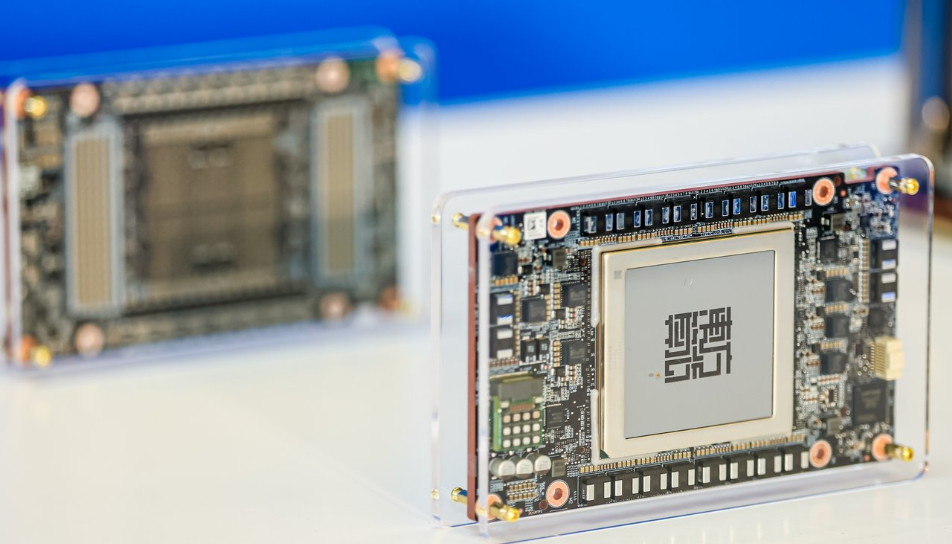
The software-defined part works by using spatial parallelism for task processing and time-division multiplexing of hardware resources. This boosts how efficiently the hardware is used, which in turn lowers the demands on the chip manufacturing process. The 3D stacking part vertically stacks the compute units with the memory units, cramming the interconnection distance down to sub-micron levels. This lets them swap out the restricted HBM for regular memory components, tackling the memory wall and bandwidth wall from the ground up.
It’s interesting, because with all the buzz around 3D stacking lately, a lot of folks in the industry think it’s the silver bullet for China’s chip bottlenecks. But Wei doesn’t totally buy that. “I personally think it’s just one approach, or maybe just a small piece of a much bigger puzzle,” he told me.
He explained that 3D is just one way to achieve near-memory computing. Right now, it’s mostly used for heterogeneous integration, mainly to solve the bandwidth problem. It doesn’t fix everything else. The real secret sauce, he says, is the software-defined chip. That’s what tackles the two core issues: computational efficiency and energy efficiency.
Wei also threw a bucket of cold water on the 3D stacking hype by talking about the yield problem. When you stack multiple chips together, the yield multiplies. 90% times 90% is only 81%. Stack enough layers, and your yield tanks. The cost pressure from that can kill any product’s competitiveness. “Don’t think that just because you do 3D, all your problems are solved,” he cautioned. “It’s not that simple.”
Still, Wei isn’t shy about the limits of this path. When I asked him about the technology ceiling, he admitted that the manufacturing process is still the ultimate ceiling. But his confidence comes from the starting point. Right now, they’re using less advanced processes to get performance that others need bleeding-edge tech for. As domestic processes improve, he sees them creating a situation where they’re chasing and being chased by international players.
“Our ceiling might just arrive a little later than everyone else’s,” Wei said. “We’re not afraid of competition. We welcome it. We even dare to compete, and we dare to win.”
From his perspective, the real practical value of this route lies in the supply chain – making it self-controlled and secure.
The DF1000 uses a fully domestic supply chain, from wafer manufacturing and packaging to testing and the supporting servers and cluster systems. “If your supply chain isn’t secure, even the best technology is useless,” Wei told me. Technology is important, he says, but solving the supply chain problem is even more critical. Only with a completely self-controlled and secure supply chain can future development be guaranteed.
Along with the chip itself, Dongfang Suanxin also launched a full stack of products, covering accelerator cards, servers, supernodes, and intelligent computing clusters. This includes the Dianfeng DF1000 accelerator card following the OAM 2.0 standard, the Qingyuan QY100 server that packs eight cards, the Tuoyu TY64 liquid-cooled supernode with 33 PFLOPS of single-node computing power, and the Huisuan HS128 intelligent computing cluster for large-scale training and inference.
They’ve already got their upgrade roadmap planned out. Guo Wei, the company’s VP, revealed that the DF2000 is expected to launch in Q4 2026, with all performance specs doubled. The DF3000 is then planned for Q4 2027, with everything doubled again.
For a company that’s just over two years old, this launch is a major step into the spotlight. Their official website and WeChat account only went live on July 1st of this year. Founded in May 2024 and based in Shanghai’s Zhangjiang area, the team now has over 500 people.
The investors are already betting on this new path. Public info shows Dongfang Suanxin completed its angel and Series A rounds in July 2024 and mid-2025. By April 2026, its post-money valuation after a Series A+ round hit 12.275 billion yuan, and the company plans to start its Series B round in Q4 this year.
Another reason Dongfang Suanxin is getting so much attention is its leader, Wei Shaojun. He’s been deep in chip design for years, a tenured professor at Tsinghua University, and currently serves as the Vice Chairman of the China Semiconductor Industry Association.
Dongfang Suanxin’s debut comes at a perfect time, as the window for domestic computing power substitution is wide open. According to IDC data, about 4 million AI accelerator cards were shipped in China in 2025. Domestic manufacturers shipped 1.65 million of those, breaking the 40% market share barrier for the first time and hitting 41%. NVIDIA’s share, meanwhile, dropped from about 70% in 2024 to 55%.
3D stacking is also becoming a hot trend for Chinese computing power to make a leapfrog move. Back in May, Huawei introduced its Tao (τ) Law, proposing technologies like LogicFolding to continuously compress signal propagation delays and boost transistor density for the ongoing evolution of semiconductors and electronic systems.
And for this leapfrog charge, Dongfang Suanxin has planted its flag in Shanghai. Wei said Shanghai has the most complete and best-integrated ecosystem for the domestic integrated circuit industry. He particularly values the city’s environment.
Shanghai’s 2025 economic data shows the city’s GDP broke through 5.67 trillion yuan, a 5.4% year-on-year increase at constant prices. The integrated circuit manufacturing and AI manufacturing sectors grew by 15.1% and 13.6%, respectively.
In the latest World IC Association ranking of the “Top 100 Global Integrated Circuit Industry Comprehensive Competitiveness Cities,” Shanghai ranked fourth globally and first in China.
According to information NUPIAO obtained from the Shanghai Municipal Commission of Economy and Informatization, the city now hosts over 1,200 integrated circuit companies. It has built a comprehensive industry chain system where all segments support each other. From chip design and manufacturing to packaging and testing, and from equipment/materials to EDA/IP, it has cultivated a number of leading companies in niche areas, including 35 listed on the STAR Market, the most of any city in China.
“Dongfang Suanxin was born in Shanghai, grows in Shanghai, and is rooted in Shanghai. In the future, we will leverage the city’s industrial highland advantages to serve the national strategy and embrace the global market,” Wei said.