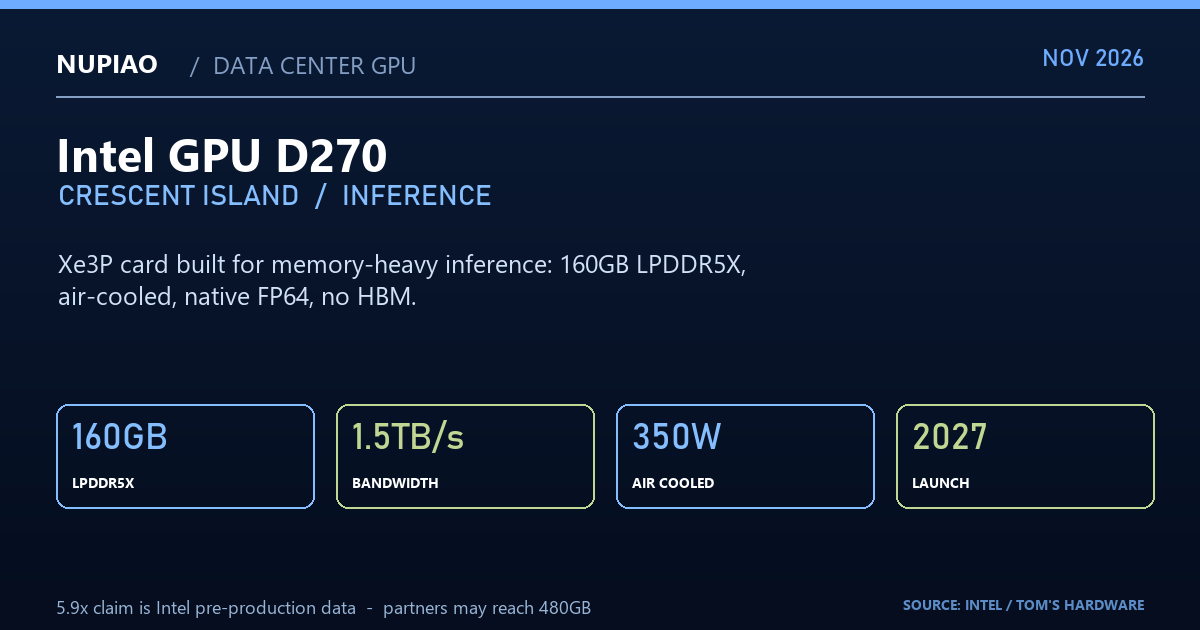
Intel GPU D270, the data-center accelerator once known as Crescent Island, is an inference-first card pairing 160GB of LPDDR5X with a 350W air-cooled PCIe slot and native FP64. Intel showed the board at its Seoul AI summit on November 12, aiming it at long contexts and simulation rather than AI training.
Source note: specifications and claims come from Intel’s own announcements and technical posts, reported by Tom’s Hardware, DoitNews, TechBase and Bomman. Performance figures were produced by Intel on pre-production silicon with named models and comparison systems; they are not independent benchmarks.
What the D270 actually is
D270 is the commercial name for a project that had been circulating under the Crescent Island codename. It is Intel’s first product built on Xe3P, an extension of the Xe3 graphics architecture with the traditional 3D and ray-tracing blocks stripped out. What remains is a matrix engine: 32 Xe cores, 256 XMX engines and 32MB of shared L2 cache, with support running from FP4 at the low end through full-rate FP64 at the top.
That last point is the part Intel is pushing hardest. Most AI accelerators treat double precision as an afterthought because training and inference do not need it. Scientific simulation and financial models do. Each Xe core can perform 64 FP64 fused multiply-add operations, so the D270 can hold a numerical workload in one precision and switch to FP8 or FP4 for inference without moving the data to a second machine. Intel calls this a fit for workflows that now chain simulation, analysis and AI agents together.
Specifications, separated from marketing
Intel-branded boards carry 160GB of LPDDR5X at 1.5TB/s across a 1280-bit bus. Partner designs can go to 480GB, a figure that keeps appearing in coverage and is worth reading carefully: 480GB is a maximum for an ODM configuration, not what ships in an Intel card. Peak FP8 matrix throughput is stated at about 1.3 petaflops. The card is a dual-slot, air-cooled PCIe 5.0 x16 part drawing 350W, which is the dimensional detail that matters most to server buyers.
| Specification | Intel D270 | Note |
|---|---|---|
| Architecture | Xe3P, 32 Xe cores, 256 XMX engines | First Xe3P product |
| Memory | 160GB LPDDR5X, 1.5TB/s | Partner boards up to 480GB |
| Compute | ~1.3 PFLOPS FP8; native full-rate FP64 | Intel figures, pre-production silicon |
| Board | Dual-slot PCIe 5.0 x16, air cooled | 350W, no liquid loop required |
| Availability | Samples to customers; commercial launch expected 2027 | No published price |
Why LPDDR5X instead of HBM
This is the decision that defines the product. High-bandwidth memory dominates accelerator discussions because training throughput scales with it, but HBM is expensive and supply is tight. Intel is betting that inference has a different bottleneck: whether the model weights, KV cache and long context fit in local memory at all. LPDDR5X gives up bandwidth but delivers far more capacity per dollar and per watt, and it comes from a mature supply chain that Samsung and SK Hynix can scale.
Intel’s stated example is a roughly 300-billion-parameter model resident on one card, with eight-card nodes able to host trillion-parameter workloads without slicing them across chassis. Those are capacity claims, not speed claims, and they are more useful to a team serving several tenants than to someone chasing a single benchmark number. Lower power also changes the deployment math: a 350W card fits in an existing air-cooled rack, while a multi-kilowatt accelerator tray can force a facility redesign.
Reading the 5.9x number carefully
Intel’s November 16 post compares a D270 prototype system with one using Nvidia’s RTX PRO 6000 Blackwell Server Edition. On a European Monte Carlo financial model, the D270 system reached up to 5.9 times the throughput; other models showed 5.6x on European Black-Scholes, 4.6x on a binomial model and 1.92x on American Black-Scholes. Power drew about 350W versus 600W for the comparison system. Intel also reported up to 29% lower latency on a decision model and 1.12x output throughput on Qwen3 30B-A3B.
Every one of those numbers comes from Intel, on pre-production silicon, using chosen models and a chosen comparison platform. They do not generalise to all high-performance computing or AI work, and Intel corrected a financial model name in the post a day later. The company also described a split inference setup pairing D270 for prefill with SambaNova SN50 for decode and Xeon CPUs for orchestration, which is an architecture proposal rather than a shipping product. Anyone evaluating the card should wait for production parts and test their own workload.
Software is the real test
Intel is pitching SYCL plus existing MPI, Fortran and C++ tooling as the migration path, and it demonstrated a Viridien seismic imaging environment at SC26 to show that some existing code carries over. An earthquake-imaging demo is evidence of a port, not proof that CUDA applications will move without work. Driver maturity, framework support and partner-board availability are the open questions, and they are the same questions that have slowed Intel’s previous data-center GPU efforts.
There is one commercial signal worth noting. Intel says orders for its AI inference accelerators have passed $2 billion, which it describes as its strongest graphics product by sales and revenue. That is a company figure with no published breakdown, so treat it as a direction of travel rather than a audited result. For buyers, the practical position is simple: the specifications are public, the benchmarks are not independent, and the card is not on shelves yet. If you need a GPU this quarter, our Vera CPU coverage and the News section track the neighbouring hardware market.
FAQ
Is Intel D270 a gaming GPU?
No. Traditional 3D graphics and ray-tracing hardware were removed from the design. D270 is a data-center part for AI inference and high-precision computing, with no display outputs aimed at gamers.
Does every D270 have 480GB of memory?
No. Intel’s own board has 160GB of LPDDR5X. The 480GB figure is the maximum Intel says partners can reach in their own designs, and configurations will vary by vendor.
Can one card run a 300-billion-parameter model?
Intel says the 160GB board can hold and serve roughly that size locally. That is a capacity statement from the company; throughput on a specific model still depends on the workload and software stack.
Is the 5.9x lead over Nvidia confirmed?
It is an Intel result from pre-production silicon on a specific Monte Carlo financial model, with a 350W card against a 600W comparison system. It has not been reproduced independently and should not be read as a general advantage.
When can I buy one?
Evaluation samples have gone to customers and Intel expects commercial availability in 2027. No price or per-configuration ship dates have been published.
Intel’s technical posts are the primary source; independent summaries are available from Tom’s Hardware and TechBase .