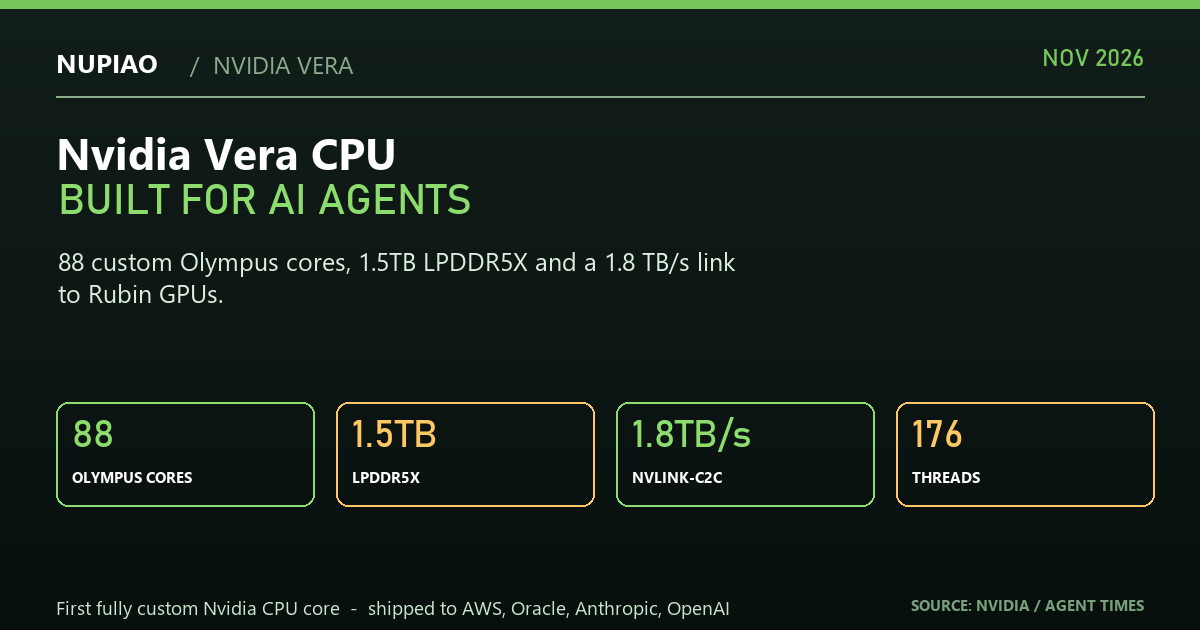
Nvidia’s Vera CPU is a server processor built for one job: keeping AI agents fed with CPU work. Announced at GTC on March 16, 2026 and shipped to its first customers through the summer, Vera pairs 88 custom Olympus cores with up to 1.5TB of LPDDR5X memory and a 1.8 TB/s NVLink-C2C link to Rubin GPUs. It is Nvidia’s first fully in-house CPU core design, and it exists because agents spend far more time on tool calls, sandboxes and retrieval than the GPU alone can handle.
Verification note: core counts, memory capacity, interconnect and early partner results follow Nvidia’s own newsroom posts and developer blog, plus reporting by The Agent Times on March 16 and August 27, 2026 and Prime Reports. Nvidia’s performance claims are self-reported and, as of publication, have not been confirmed by independent benchmarks.
Why a GPU company built a CPU
An AI agent does not run entirely on a GPU. When a model decides to write Python code, fetch a web page, query a database or spawn a sandbox, that is CPU work. As models shift from answering questions to taking actions, those steps multiply, and the processor sitting next to the accelerator starts to matter as much as the accelerator itself. Nvidia calls this a new CPU moment in the AI factory.
Vera is the company’s answer. Earlier Grace CPUs used licensed Arm Neoverse cores and were positioned as companions to GPUs. Vera uses Olympus, a core Nvidia designed itself, and is aimed squarely at agent workloads rather than general-purpose computing. That choice lets Nvidia tune for the branch-heavy, low-latency pattern of tool calls without trying to beat AMD’s EPYC or Intel’s Xeon on conventional benchmarks.
The specifications that matter
| Block | Vera | Why it is there |
|---|---|---|
| CPU cores | 88 Olympus cores, 176 hardware threads | Concurrent agent sandboxes and tool calls |
| Memory | Up to 1.5TB LPDDR5X, 1.2 TB/s bandwidth | Parking KV caches outside scarce GPU HBM |
| Cache / fabric | 164MB unified L3, 3.4 TB/s bisection | Keeps data close to the cores |
| GPU link | 1.8 TB/s NVLink-C2C | Roughly seven times a x16 PCIe Gen 6 link |
| Power | Configurable 250–450W TDP | Trade density for speed per rack |
The memory figure is the one to focus on. A single Vera CPU can address 1.5TB, more than five times the HBM4 capacity of one Rubin GPU. Nvidia’s Dynamo software can move an inactive agent’s KV cache out of GPU memory into Vera’s memory during a tool call, then restore it over NVLink-C2C when the agent resumes. That frees HBM for sessions actively generating tokens and avoids paying for the same prefill twice.
What Nvidia claims
The numbers are large and come with a caveat. Nvidia reports 1.8 times faster single-thread performance on agentic workloads than x86 alternatives, with peak load latency around 40 percent lower. In a 100-megawatt data centre comparison, it measured 1.6 times more agents per watt than the fastest x86 chip and twice the agent speed of the most efficient one. At rack scale, a 256-CPU configuration is said to sustain 22,500 concurrent agent environments.
Those figures are the company’s own measurements, and the workloads are chosen to flatter the design. Independent testing has not yet confirmed them, and Dell, HPE and Lenovo systems using Vera are only now reaching customers. Treat the numbers as a statement of intent until third-party benchmarks arrive.
What early customers report
Early adopter results are more concrete, though still vendor-supplied. Perplexity reported 1.5 times faster agentic coding tasks and plans to deploy Vera in production. DeepInfra measured up to 2.2 times faster agent orchestration than the best x86 processor in its tests. ClickHouse scaled close to linearly across all 176 cores without Vera-specific tuning and topped the ClickBench hardware leaderboard, while Duck Labs reported 1.5 times the median TPC-H SF1000 performance of an Intel Xeon 6 baseline.
Sandbox startup is where the gap looks widest. Daytona cut initialisation time from 88.4 seconds on x86 to 10.8 seconds on Vera and reached 12.7 completed jobs per second at 2,000 concurrent sandboxes. Modal measured up to twice the sandbox throughput per core, with the advantage growing under heavy load. For anyone running thousands of short-lived agent environments, those are the numbers that change the cost model.
Who has the hardware
Nvidia began hand-delivering Vera systems in May 2026. The first recipients were Anthropic, OpenAI, Oracle Cloud Infrastructure and SpaceXAI, with AWS added on August 27 when Ian Buck, Nvidia’s vice president of hyperscale and HPC, delivered a system in Seattle. Meta, Alibaba, ByteDance and CoreWeave are also named among deployment partners. Microsoft Azure and Oracle are preparing Vera-based cloud instances, and system builders including Dell, HPE, Lenovo, Supermicro and MSI are bringing SP7-style rack designs to market.
Broader commercial availability through those partners is expected from fall 2026. Today, Vera remains mostly in the hands of labs and cloud providers evaluating it rather than something a buyer can order off a shelf.
The honest read
Vera is a bet that agent workloads will stay different enough from traditional inference to justify separate silicon. If tool calling, sandbox orchestration and long-context retrieval remain the dominant pattern, a CPU tuned for them has a real advantage. If workloads converge back toward conventional compute, the specialisation becomes a constraint. Either way, the arrival of a purpose-built CPU from the company that owns the GPU stack is a sign of how quickly AI infrastructure is splitting into specialised layers.
FAQ
What is Nvidia Vera?
Vera is Nvidia’s first fully custom server CPU, announced on March 16, 2026 at GTC. It uses 88 Nvidia-designed Olympus cores and is built specifically for AI agent workloads such as tool calls, sandboxes and retrieval.
How much memory does Vera support?
Up to 1.5TB of LPDDR5X per CPU with 1.2 TB/s of bandwidth, along with 164MB of unified L3 cache. That is more than five times the HBM4 capacity of a single Rubin GPU.
Is Vera faster than x86 servers?
Nvidia claims 1.8 times faster per-core performance on agentic workloads and up to twice the agent speed, but those are self-reported figures. Independent benchmarks have not been published as of November 2026.
When can you buy a Vera system?
Hand-delivered evaluation units went to AWS, Oracle, Anthropic, OpenAI and others through 2026. Wider availability through Dell, HPE, Lenovo and Supermicro is expected from fall 2026, with cloud instances following.
Does Vera replace GPUs?
No. It is designed to sit beside Rubin GPUs, handling the CPU portion of agent work and freeing accelerators for token generation. The 1.8 TB/s NVLink-C2C link exists to move data and cached context between the two quickly.
For more hardware coverage, see our News section and the Guides category. Specifications and announcements follow Nvidia , with additional detail from The Agent Times and Prime Reports .