Nvidia’s RTX 50 Super refresh is shaping up to be the most incremental generational update in years, and that is not an insult. According to a detailed leak from Moore’s Law Is Dead published June 12, 2026, the entire Super family — the RTX 5080 Super, 5070 Ti Super, 5070 Super and a new 5060 Super — keeps the same Blackwell GPUs and simply adds a lot more memory plus a little more clock speed. There is no new architecture here, which means the upgrade is easy to understand and easy to dismiss depending on what you already own. Here is what the specs say, what they don’t, and who should actually care.
Verification note: the specifications below come from Moore’s Law Is Dead’s June 12, 2026 leak, reported across HX News, NetEase and China.com the same day. Nvidia has not confirmed any of these models, their specifications or a release date. The 5070 Ti Super’s current retail price above $900 versus a $749 launch price is documented in those reports as market price inflation, not an official Nvidia figure.
The headline change is VRAM, not architecture
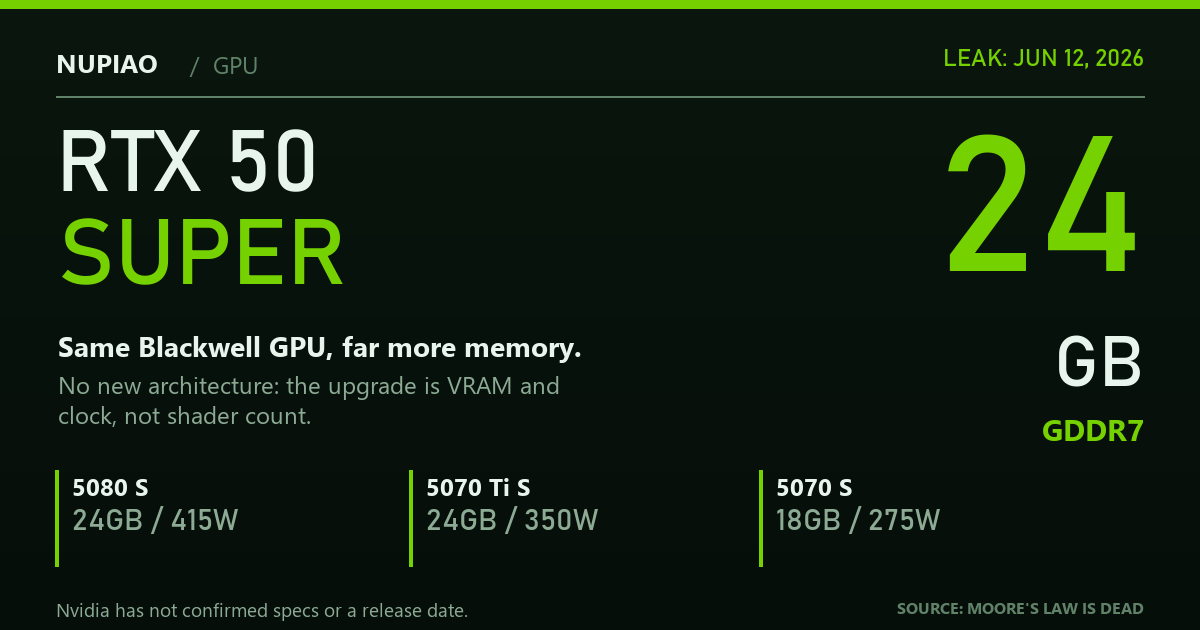
The RTX 5080 Super is said to use the same GB203-450 GPU with the same 10,752 CUDA cores, but its memory jumps from 16GB to 24GB of GDDR7 on a 256-bit bus at 32Gbps. That pushes bandwidth past 1TB/s and lifts the board power from 360W to 415W. Performance is projected at 7 to 14 percent above the existing RTX 5080. The pattern repeats down the stack: same chip, more memory, more watts, a single-digit-to-low-double-digit performance gain.
The three Super cards, side by side
| Model | CUDA cores | Memory | TDP | Projected gain | Leaked price |
|---|---|---|---|---|---|
| RTX 5080 Super | 10,752 (same) | 24GB GDDR7 | 415W | +7 to 14% | $999–$1,199 |
| RTX 5070 Ti Super | 8,960 (same) | 24GB GDDR7 | 350W | +5 to 10% | $749–$799 |
| RTX 5070 Super | 6,400 (+4%) | 18GB GDDR7 | 275W | +8 to 12% | $549–$599 |
| RTX 5060 Super | 3,840 (same) | 12GB GDDR7 | unlisted | memory only | unlisted |
RTX 5070 Super is the odd one out
Of the four, only the 5070 Super gets more CUDA cores, climbing from 6,016 to 6,400, a 4 percent bump. Its memory grows from 12GB to 18GB on a 192-bit bus, board power rises from 250W to 275W, and the projected gain is 8 to 12 percent over the 5070. At a leaked $549 to $599, it is the one most likely to be the value pick of the range, assuming Nvidia actually ships it at that price.
Why the power draw goes up
Because there is no architectural change, every gain comes from larger memory capacity and higher clock speeds, and both cost watts. Board power rises across the whole family, from 40W on the 5070 Super to 55W on the 5080 Super. The RTX 5090 already ships with 32GB, so a 5090 Super is unlikely; there is no memory headroom left to chase. Anyone building a small-form-factor PC or living near a power limit should treat the higher TDP as a real constraint, not a footnote.
Why a memory-only refresh makes sense for Nvidia
There is a clear logic to leaving the GPU die alone. GDDR7 has been getting cheaper as the 50-series ramps, so bolting more of it onto an existing chip is far cheaper than taping out new silicon, and it directly answers the most common complaint about the current cards: 12GB and 16GB simply are not enough for 4K texture packs or local AI models in 2026. A Super that fixes the memory without touching the shader count also lets Nvidia keep selling the original parts to buyers who don’t need the extra headroom, rather than cannibalising its own stack. The risk is that the refresh reads as a stopgap if a rival arrives with something genuinely new in the same window.
Pricing is the catch
The 5080 Super is pegged at $999 to $1,199, which is the same window as the original 5080’s launch price, so you would get more memory and a little more speed for the same money rather than a discount. The 5070 Ti Super at $749 to $799 is the uncomfortable one: its current retail price has already climbed past $900, so the “Super” could actually cost less than today’s inflated 5070 Ti while offering 24GB. The 5070 Super at $549 to $599 is the cleanest story if it holds.
Who should wait and who shouldn’t
If you own a 5070 Ti and run local AI models or push 4K texture-heavy games, the jump from 16GB to 24GB is meaningful and is the single best reason to care about this refresh. If you are happy with what you have, skip it; the rasterised gaming gain is small.
The people who should stay put are 1440p gamers on a 4070-class card or better; the Super gain will be invisible there. The people who might actually benefit are owners of older 8GB and 12GB cards, for whom 18GB or 24GB removes a real bottleneck, and anyone running large language models locally, where the 5070 Ti Super’s 24GB is the headline. For everyone else, an existing 50-series card at a discount is the smarter buy than a Super at launch pricing.
Wait for independent benchmarks before believing the percentage claims, and do not pre-order on a leak. Nvidia has been pulling engineering attention toward data-centre parts, so even if the specs are real, meeting demand is not guaranteed.
FAQ
When does the RTX 50 Super release?
No official date has been announced. The June 2026 leak did not include a launch window, and most speculation points to a 2027 release rather than late 2026.
Is it worth upgrading from an RTX 5070 Ti?
Only if you regularly hit the 16GB memory ceiling in local AI workloads or 4K gaming. The raw gaming performance gain is in the single digits to low teens.
Do the Super cards use more power?
Yes. Board power rises from 40W on the 5070 Super to 55W on the 5080 Super, because the gains come from memory and clocks rather than efficiency improvements.
Will there be an RTX 5090 Super?
Probably not. The 5090 already ships with 32GB of memory, so there is little headroom for a Super variant to add value.
For more hardware coverage, see our News section and the Guides category. The specifications follow the HX News report on Moore’s Law Is Dead’s June 12, 2026 leak.