On September 21, Zhipu (2513.HK), the Hong Kong-listed “first large-model stock,” told NUPIAO that its AI coding tool ZCode will soon be officially open-sourced and that it has invited the China Academy of Information and Communications Technology (CAICT) and NSFOCUS to carry out a security audit. This marks Zhipu’s third public response to the data-privacy controversy, after its first apology on September 18 and the release of a fix on September 19.
Zhipu said it had invited two authoritative third-party institutions, CAICT and NSFOCUS, to complete a first round of checks. CAICT’s technical assessment confirmed that the Alibaba Cloud OSS bucket involved, zcode-prod, currently has zero data in the cloud; NSFOCUS’s review found that all data objects in the bucket and the bucket itself had been deleted, and that the updated ZCode v3.14.0 client had been fully remediated: the Repo Wiki entry point and its related generation pipeline had been removed, and no functional path that could trigger local repository snapshots or file outbound transfers was found.
Zhipu also said the open-sourcing is the first step in addressing outside concerns about how ZCode handles data. Going forward, it will set up a regular security-operations mechanism, publish code security audit reports every month, and launch a public product-security vulnerability reporting mechanism. It also aims to push the product further toward community-driven development, letting developers freely download and inspect the core code and take part in improving both security and features.
The storm first broke on September 18, when tech blogger ferstar disclosed it on a personal blog. While cleaning up a local disk, ferstar unexpectedly found that Zhipu’s ZCode desktop client, when a user was logged in, automatically packaged and encrypted the entire workspace code and uploaded it to Alibaba Cloud OSS. According to reverse-engineering analysis, the uploaded package contained not only the current project’s source code but also the full Git version history, LFS large-file cache, reflog records, and some global development configuration files—covering nearly all of a project’s core development assets.
What angered the developer community even more was that the upload mechanism was on by default, and users could not find a corresponding off switch in the client settings. The RSA public key used for encryption was dynamically issued by the server, while the private key was kept only in the cloud, so users could not decrypt the encrypted data packages generated locally. The disclosure quickly spread through tech circles, with many enterprise users worrying about the security risks to their code assets and trade secrets; some developers even temporarily stopped using the tool to check for possible data leaks.
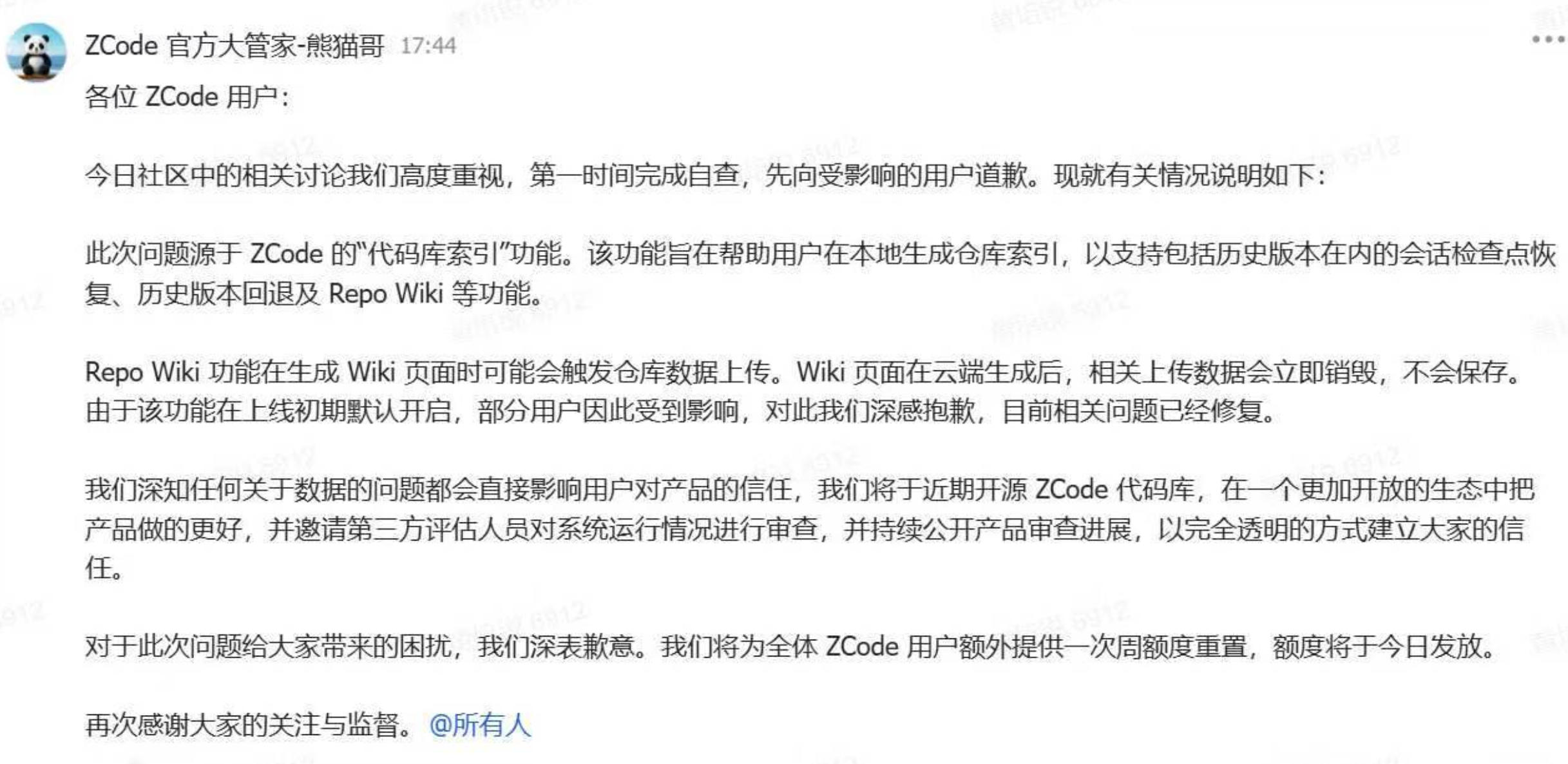
That evening, Zhipu posted an apology statement in the ZCode official user group, giving its first official explanation of the incident. Zhipu said the data upload came from a built-in “codebase indexing” feature designed to support historical version rollback, session checkpoint recovery, and RepoWiki code knowledge-base generation; the RepoWiki feature triggered repository data upload when generating pages in the cloud.

Zhipu stressed that all uploaded data was used only to generate Wiki pages, would be destroyed immediately after completion, and would not be retained in the cloud. As for the feature being on by default and impossible to turn off, Zhipu admitted that when the feature first launched it did not fully inform users or provide a manual off switch; it said it had completed technical remediation as soon as possible and removed the related upload pipeline. Zhipu also announced three initial remedies: open-sourcing the ZCode codebase, accepting community oversight, and inviting third-party professional institutions to conduct security reviews of system operations and publish progress; it also gave all ZCode users an extra weekly quota reset as compensation.
The next day, ZCode pushed out version v3.14.0, with a changelog stating “fixed the issue of abnormal uploads by Repo Wiki.” But the incident did not die down. On September 19, Taiyuan Chengming Technology Co., Ltd. formally sent a letter to Beijing Zhipu Huazhang, demanding written explanations on issues including data deletion, private-key custody, and whether any cross-border transfer had occurred, while reserving the right to claim damages and take legal action.
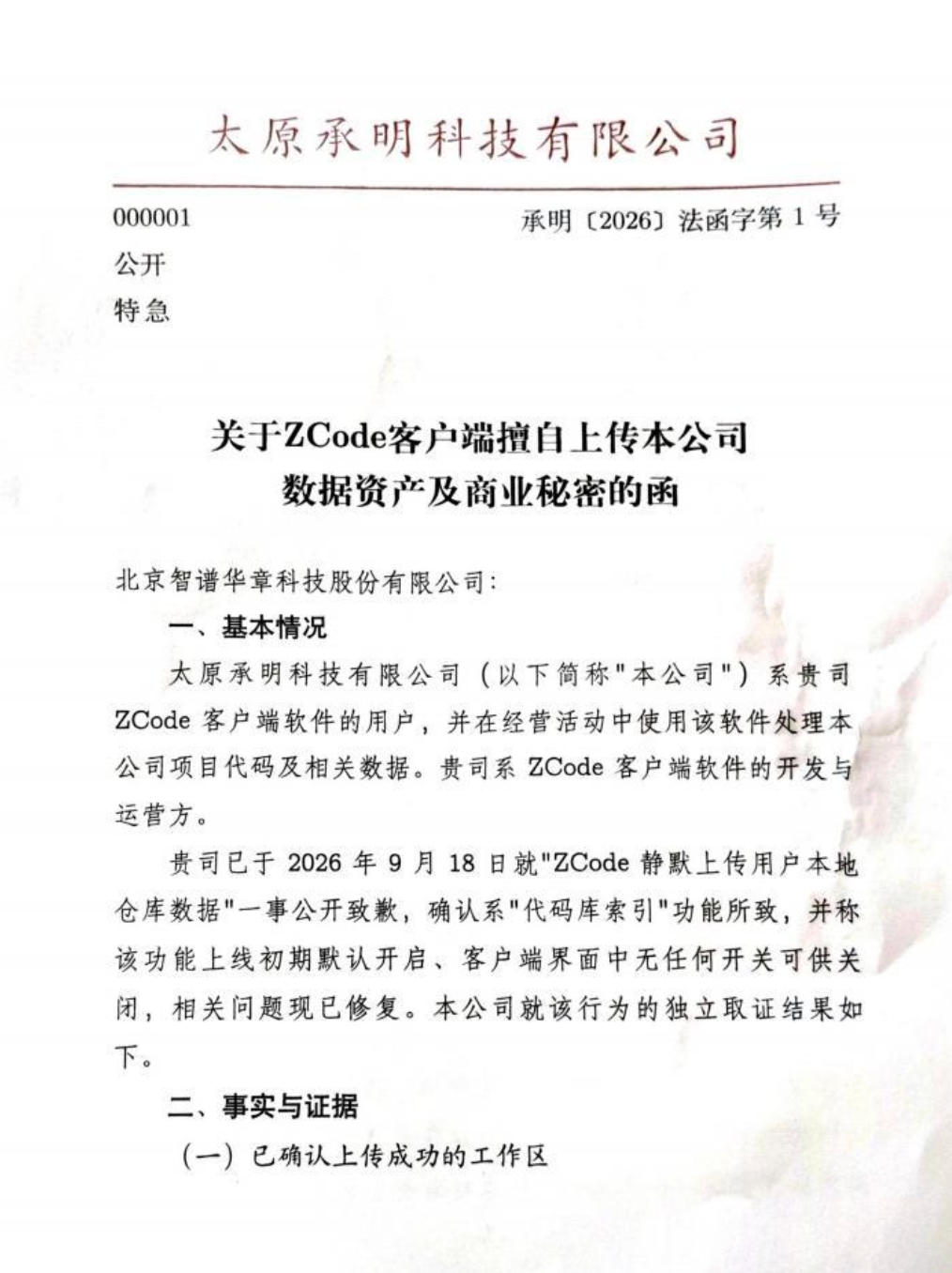
Chengming Technology said its own technical department had independently gathered evidence confirming that ZCode’s uploads were automatically triggered and occurred in batches. The data involved went far beyond ordinary “code snippets”: it included complete project source code, system architecture designs, the full version-control history, database access passwords, cloud-service permission credentials, employee personal information, and other complete archived files—clearly exceeding the collection scope stated in ZCode’s Privacy Policy.
Chengming Technology argued that although Zhipu claimed the issue had been fixed on September 18, upload activity was still detected in the early hours of that day, so it questioned the actual effectiveness and thoroughness of the remediation. In its letter, Chengming Technology made 12 specific requests for answers, including publishing a complete list of uploaded data, providing proof that all uploaded data had been destroyed, disclosing the qualifications and audit scope of third-party auditors, and giving enterprise users a risk-investigation plan. It also explicitly reserved the right to take further legal action.
As a leading domestic large-model company, Zhipu recently completed a new funding round and ranks among the industry’s top players by market valuation. ZCode is one of its core products for developer scenarios and has built up a large base of individual and enterprise users with features such as whole-project code understanding, intelligent completion, and debugging assistance. For this client product, which carries the daily code assets of millions of developers, data-processing transparency is directly tied to the foundation of Zhipu’s reputation.
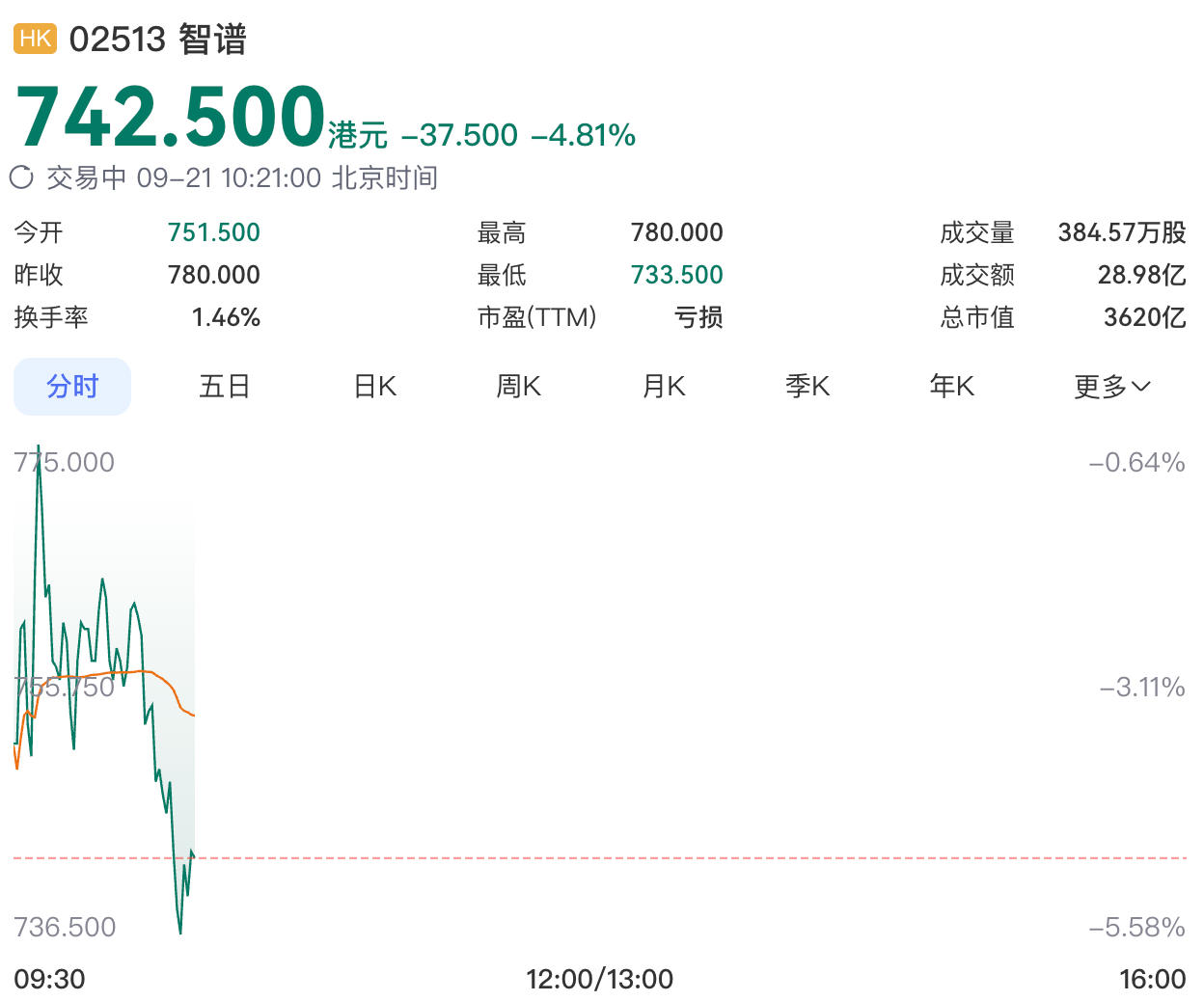
Affected by the incident, Zhipu’s Hong Kong stock opened lower and fell further today. As of publication, the company’s shares were down more than 4% at HK$742.5 per share, with a total market value of HK$362 billion.