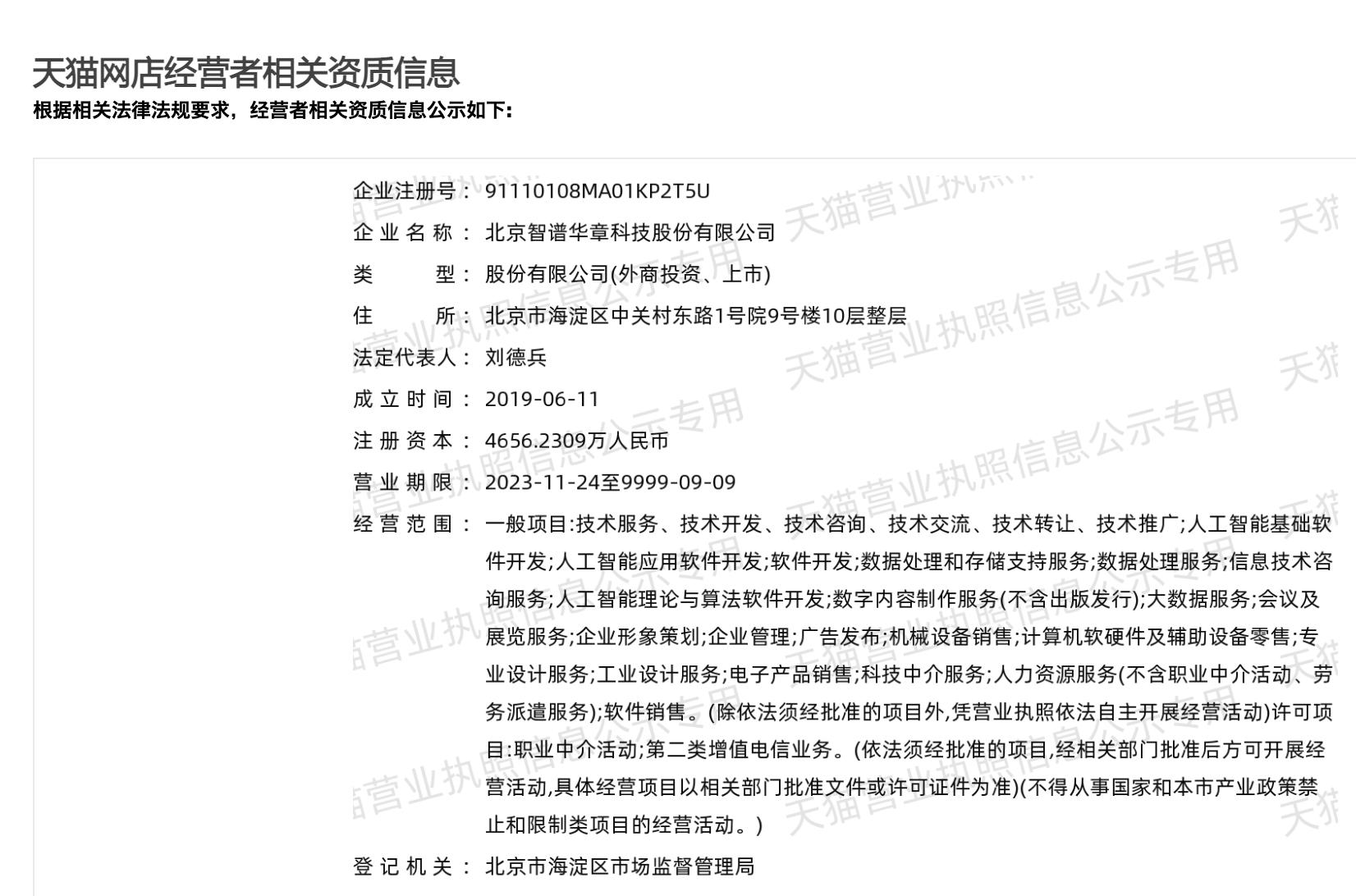
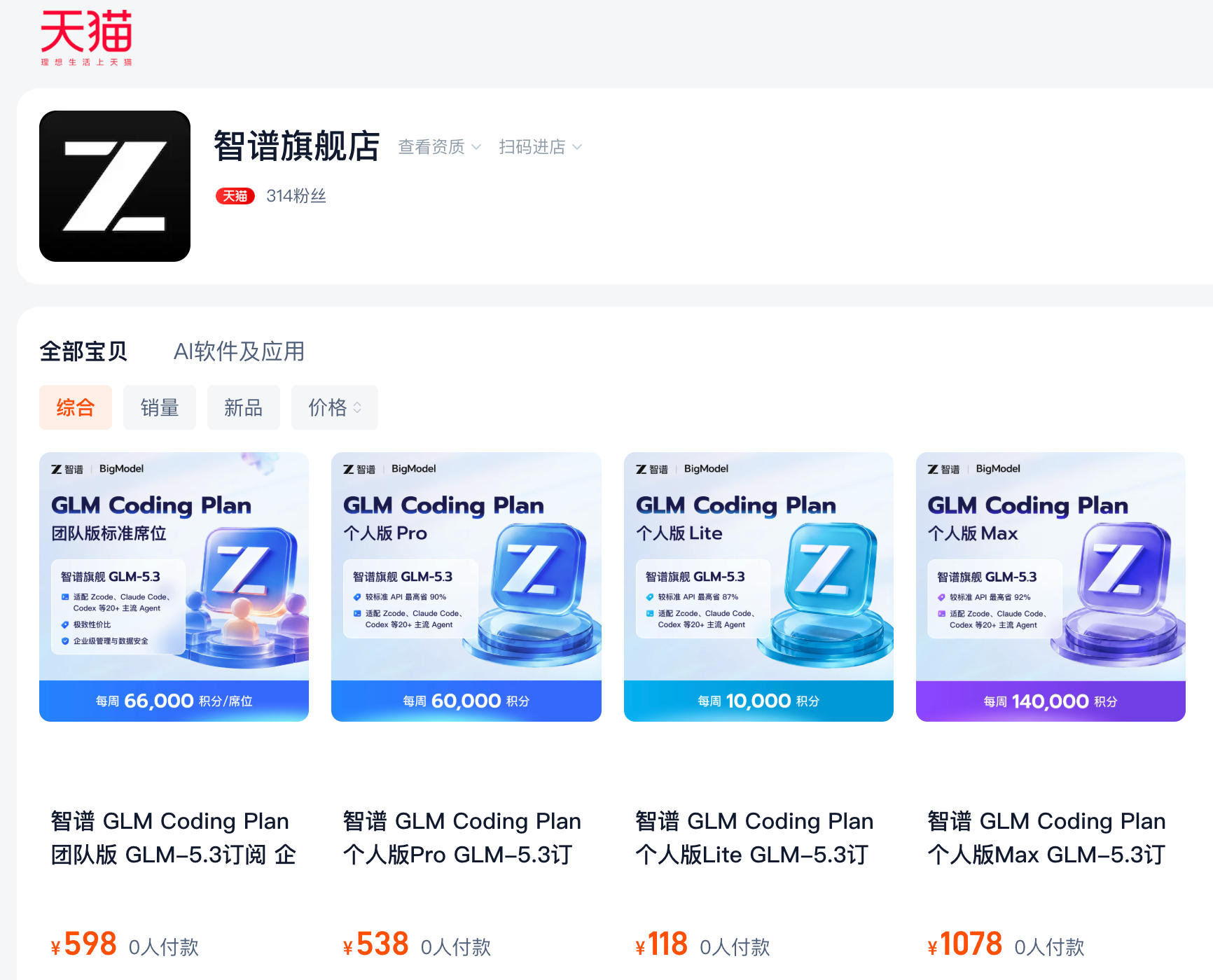
On September 2, Chinese large-model company Zhipu opened an official flagship store on Tmall and began selling products such as the GLM Coding Plan subscription package online. Business registration details on the Tmall store show that the shop operator is Beijing Zhipu Huazhang Technology Co., Ltd., the operating entity behind Hong Kong-listed Zhipu (02513.HK). The current listings include Personal Lite, Pro and Max plans, plus a Team Standard Seat tier, with monthly, quarterly and annual subscription options.
On pricing, the GLM Coding Plan packages now listed on Tmall match the latest versions on Zhipu’s official website. Personal Lite is ¥118 per month with 10,000 credits per month; Pro is ¥538 per month with 60,000 credits; Max is ¥1,078 per month with 140,000 credits. The Team Standard Seat costs ¥598 per month with 66,000 credits, and the minimum purchase is two seats.
It’s worth noting that these prices are a big step up from the versions launched earlier this year. Previously, the monthly fees for Zhipu CodingPlan’s Lite, Pro and Max tiers were ¥49, ¥149 and ¥469, respectively. Pro saw the sharpest increase, jumping from ¥149 to ¥538 — 3.6 times the old monthly price. Zhipu says the new plans use a credit system based on token consumption, making quota calculation more transparent and predictable. Users can also get a 50% credit discount during off-peak hours, and the model has been upgraded from GLM-5 to the latest GLM-5.3, with clear gains in core abilities such as coding and reasoning.
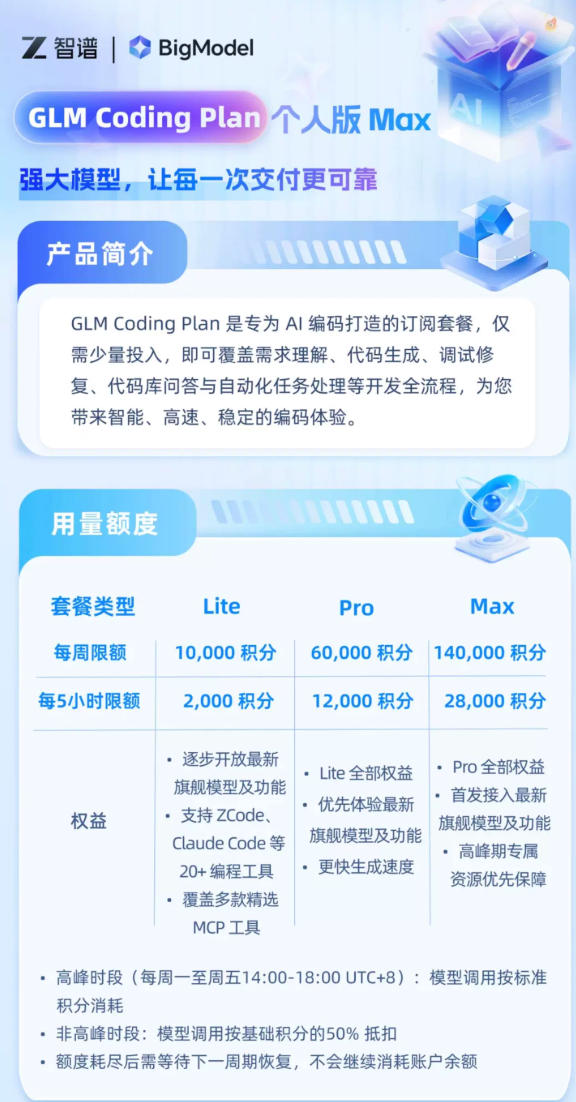
The GLM Coding Plan now available in the Tmall flagship store is built on the latest GLM-5.3 model and works with more than 20 mainstream agentic coding tools, including ZCode, ClaudeCode and Codex. After purchase, users get a corresponding API call quota for coding scenarios such as code generation, debugging and refactoring. They can use it freely within the quota; usage beyond that is billed at standard API prices. The model feels a lot like a mobile phone plan, and for heavy users it can be a more cost-effective choice.
As of publication, none of the four products in Zhipu’s flagship store showed sales figures, and the store’s follower count was not high. Still, from an industry perspective, opening this store matters more for its symbolic value than for short-term sales. It signals that large-model companies are formally turning “selling tokens” into a retail business aimed at everyday consumers.
As the “world’s first listed large-model company,” Zhipu began trading on the Hong Kong Stock Exchange on January 8 this year at an issue price of HK$116.2 per share, becoming the first listed company globally whose core business is general artificial intelligence foundation models. After listing, Zhipu’s stock was hot with the market and once hit HK$2,980 per share intraday — more than 24 times the issue price — with its total market value briefly topping HK$1 trillion.
However, as market sentiment cooled and the valuation logic for the large-model industry adjusted, Zhipu’s share price later pulled back significantly, with more than HK$500 billion in market value wiped off from its peak. Against that backdrop, speeding up commercialization and scaling revenue have become Zhipu’s new strategic priorities.
Its 2026 interim report shows that Zhipu’s first-half revenue reached RMB 954 million, up 399.7% year on year. Revenue from the open platform and API business was about RMB 825 million, up 2,735.7% year on year. The share of open platform and API revenue jumped from 15.2% in the same period last year to 86.5%. The growth driver is Zhipu’s shift from one-off “model selling” to ongoing “usage selling” — moving from early project-based, customized delivery toward standardized API calls and subscription services. By packaging token quotas and model capabilities into fixed monthly fees, it lowers the decision barrier for developers and enterprise users while giving Zhipu recurring revenue.
Right now, the token economy around large models is booming. Data from the China Development Forum shows that domestic daily token consumption has topped 140 trillion, more than 1,000 times the 100 billion seen in early 2024. As the “digital fuel” of the large-model era, token consumption has become a core gauge of how hot the AI industry is running.
With demand expanding fast, token sales models are also being reinvented. In May this year, the three major telecom carriers rolled out token packages, using their network infrastructure and huge user bases to act as token retailers at the infrastructure layer. Alibaba set up an independent business group called Alibaba TokenHub; Tencent Cloud upgraded its all-domain TokenHub platform; and Baidu, ByteDance and others have also moved into token distribution. All of a sudden, “selling tokens” became one of the hottest businesses in the AI supply chain. By opening on Tmall, Zhipu can tap the e-commerce platform’s traffic and payment convenience to reach more individual developers and small and mid-sized teams.
Looking ahead, as more large-model companies join e-commerce platforms and promotional events such as “Double 11” arrive, large-model subscription services could become a new hot category on e-commerce platforms. And ordinary users will be able to enjoy the convenience of AI technology at a lower cost.