On September 2, Lei Jun dropped a real-device demo video on his personal social accounts, giving the world its first full look at the Xiaomi 18 Fold. The official Xiaomi phone Weibo account pushed out a teaser trailer at the same time, and Xiaomi Phone president Lu Weibing followed up with a post explaining exactly where the device sits in the lineup. It’s the first time Xiaomi has shown off the full design and core specs together — and the first time it has formally branded the form factor a “mid-fold.”
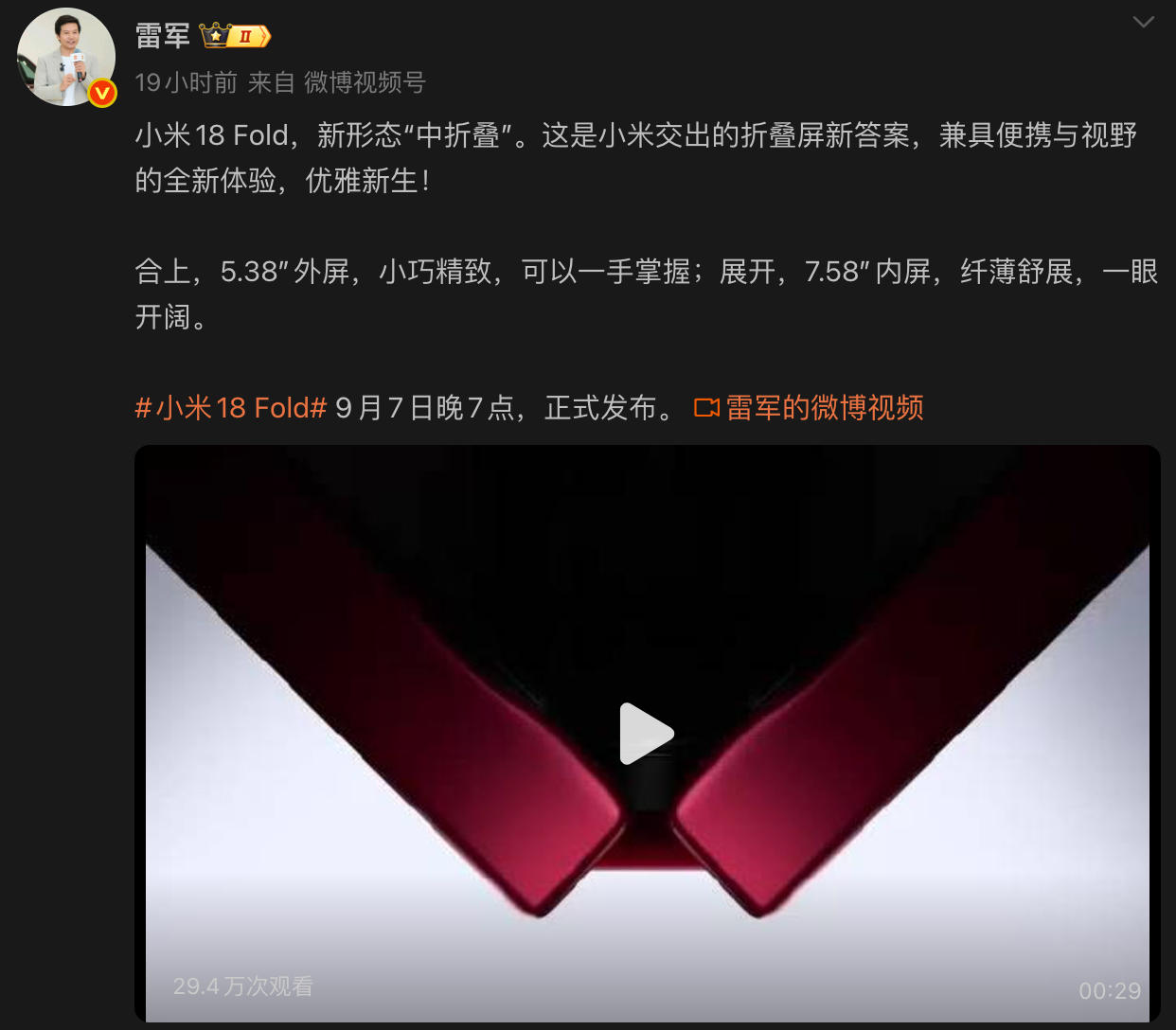
According to the official timeline, the Xiaomi 18 Fold takes the stage at Xiaomi’s autumn flagship launch event on September 7 at 7 p.m., sharing the spotlight with the Xiaomi Pad 9 Pro Max and the new Xiaomi Pengcheng series car, among other products. The foldable also gets its global debut a few days earlier, at IFA 2026 in Berlin on September 4.
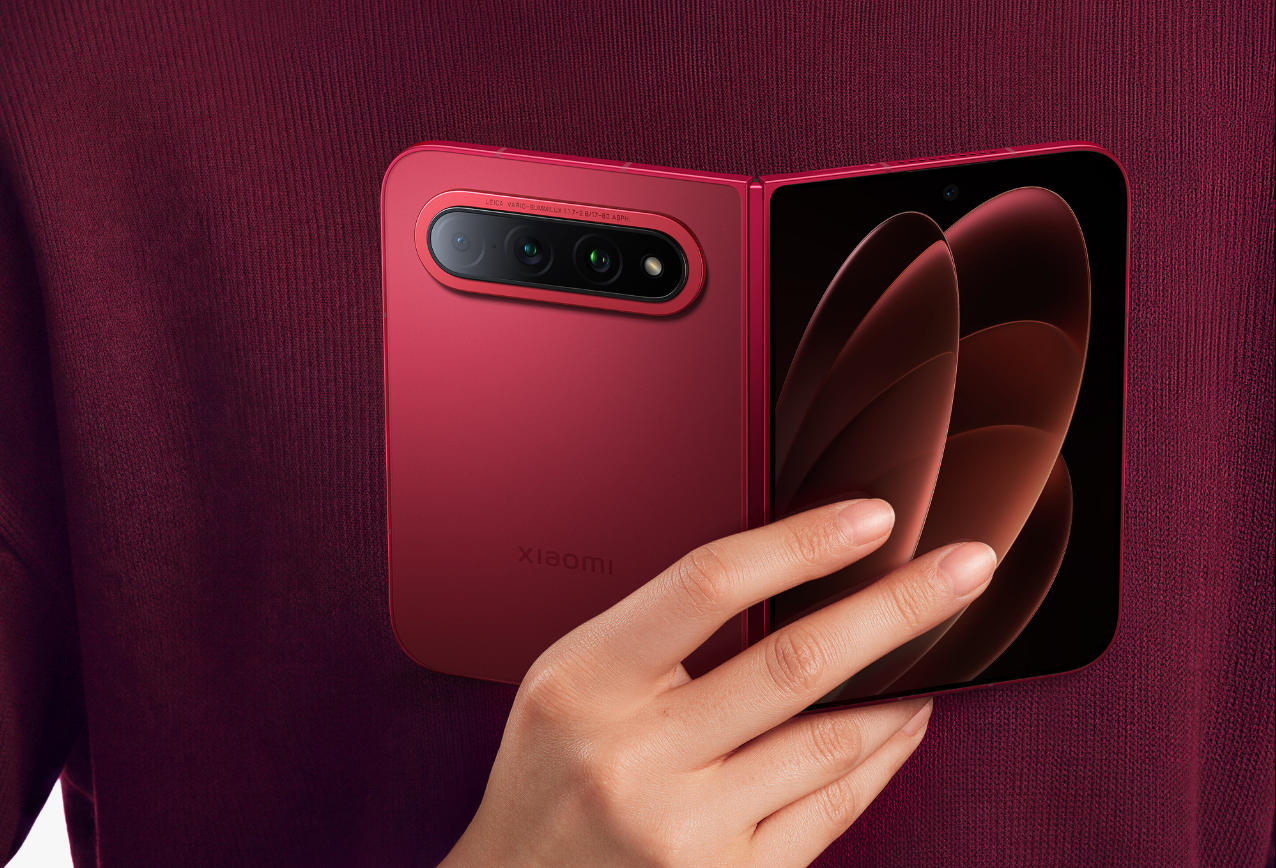
Going by the official renders and the teaser, the 18 Fold lines up closely with what the rumor mill had been sketching. The hero color is called “Westfield Red,” inspired by autumn hillsides and built on a warm brown-red base. Up front you get ultra-narrow, perfectly even bezels with big squircle-style rounded corners. Around back, the eye-catcher is a horizontally set racetrack camera Deco, with three lenses and the flash stacked vertically near the top. The imaging setup continues the Xiaomi-Leica co-development arrangement, and the sides get a flat, wrap-around metal frame. Xiaomi even posted a cutaway render showing the hinge, mainboard, battery and other core hardware.
On the display side, the 18 Fold carries a 5.38-inch cover screen when closed and opens up to a 7.58-inch inner panel. “The Xiaomi 18 Fold uses roughly a √2:1 paper ratio on both screens, and it’s just right,” Lei Jun said. “Reading feels as natural as a book; movies fill the frame with no cropping; documents need no zooming — everything is right there.”
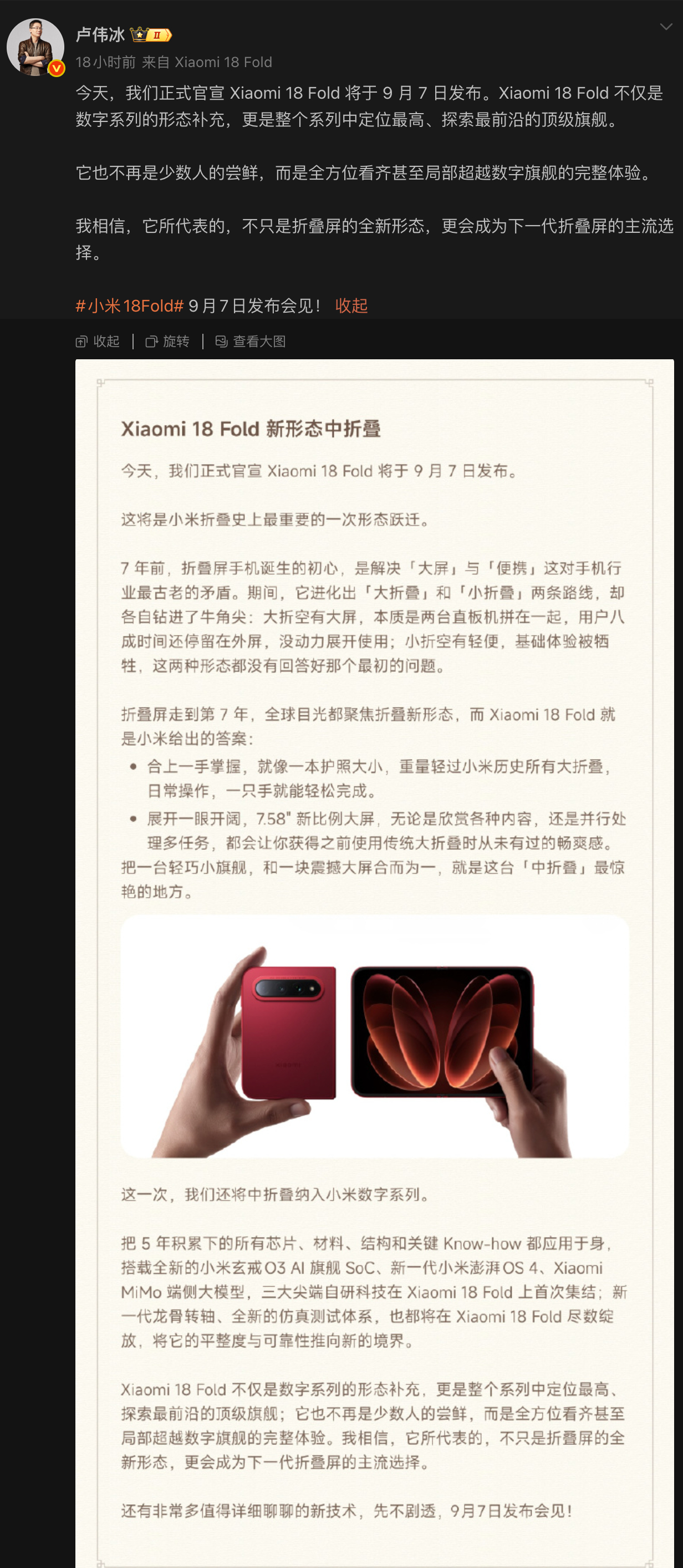
The Xiaomi 18 Fold jumps out of the old MIX Fold line entirely and slots straight into the numbered flagship series. Lu Weibing calls it the most important form-factor leap in Xiaomi’s foldable history — not a “big fold,” not a “small fold,” but a brand-new “mid-fold.”
His reasoning: a big fold is basically two slab phones bolted together, and most people end up living on the cover screen anyway, so the unfolded display rarely earns its keep. A small fold is pocketable but gives up too much of the basic everyday experience. The 18 Fold’s brief is to merge a light, nimble little flagship with a genuinely impressive big screen. His prediction: “What it represents isn’t just a new foldable shape — it will become the mainstream choice for the next generation of foldables.”
Under the hood, the 18 Fold is the launch device for the Xuanjie O3 AI flagship chip. Built on TSMC’s 3nm process, this in-house SoC packs 24 billion transistors, with a ten-core, all-big-core CPU topping out at 4.35GHz — the highest clock speed Xiaomi has ever put in a phone. On GeekBench 6 it posts a multi-core score of 15,221, a 60% jump over the previous generation, while its AnTuTu composite score breaks 5.22 million, making it the industry’s first mobile flagship platform to clear the 5 million mark.
On graphics, the Xuanjie O3 debuts a 16-core G2-Ultra NX GPU: 85% better traditional rendering, 182% better ray tracing, and up to 64% lower power draw at the same performance. Worth noting, it’s the world’s first mobile processor with native LPDDR6 support, and the 18 Fold is the first phone anywhere to ship with LPDDR6 memory produced by CXMT, peaking at 12,800Mbps with up to 113.8GB/s of memory bandwidth.
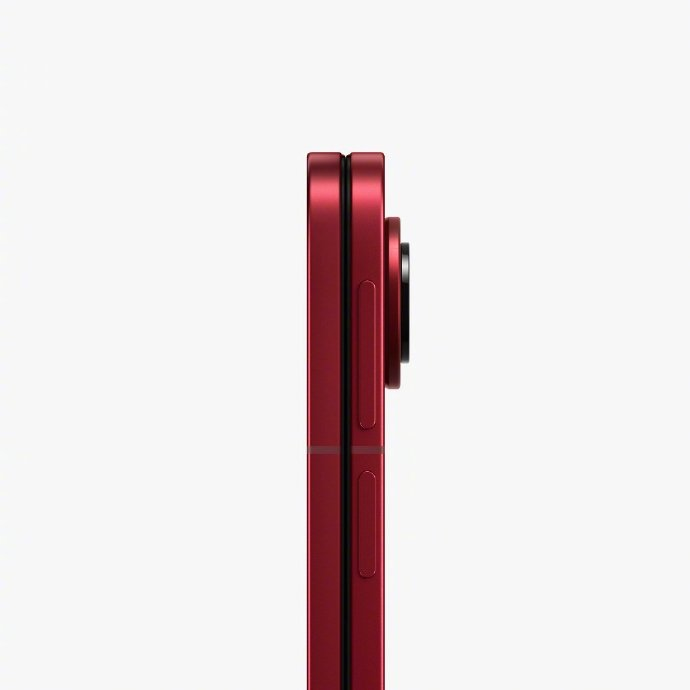
On structure and materials, the 18 Fold uses the new-generation Xiaomi Dragon Spine hinge with a natural teardrop shape, and a three-stage linkage structure that keeps everything fully flush and protected, which gives the foldable a real boost in lifespan and stability. The screen gets a new dual-layer UTG ultra-thin glass that substantially raises strength and impact resistance. The body is clad front and back in Xiaomi Dragon Crystal Glass 3.0, with an aerospace-grade 7-series aluminum alloy frame.
On the software side, the 18 Fold debuts the new-generation Xiaomi HyperOS 4 along with the Xiaomi MiMo on-device large model. MiMo handles complex AI inference right on the phone — no connection required, which keeps your privacy locked down and the response time low. There’s also a new interaction called “Xiao Ai Inspiration Ball”: one easy drag to identify text or images with precision, one simple sentence to knock out a complex task. HyperOS 4 has more than 200 dedicated adaptations for the wide-screen form factor, with split-screen, hover mode and cross-app drag-and-drop all fully optimized.
Xiaomi hasn’t announced pricing yet, but according to multiple outlets and channel partners, rising costs for in-house chips, the all-new form factor and premium components will likely push the Xiaomi 18 Fold’s starting price past 10,000 yuan, with the base version landing around 12,000 yuan. That would make the Xiaomi 18 Fold the first phone in Xiaomi’s history to start above 10,000 yuan. Full performance figures, detailed camera specs, battery and charging numbers — all of that waits for the September 7 launch event.
Since launching the first MIX Fold back in 2021, Xiaomi has poured five years into foldables, running both big-fold and small-fold product lines and gradually building out key tech like the Dragon Spine hinge, UTG ultra-thin glass and Dragon Crystal Glass. But the big-fold line hasn’t been refreshed in two years — the MIX Fold 4 from 2024 is still the mainstay. And with the Xiaomi 18 Fold landing close to new launches from Apple and Huawei, the premium-market showdown is clearly on.