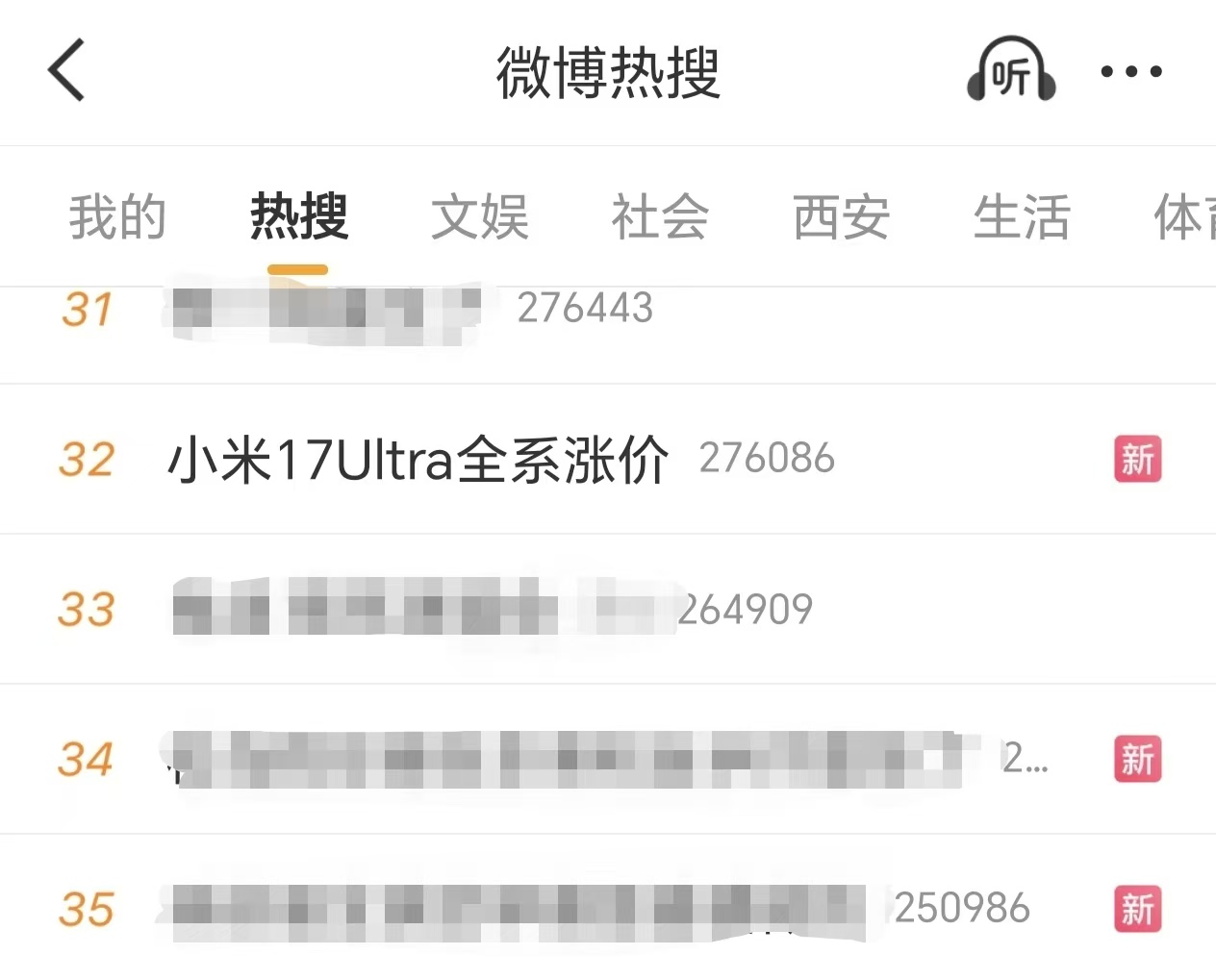
On October 9,according to a digital blogger’s tip,“Xiaomi17 Ultrais raising prices across the entire lineup,” setting off a wave of attention and pushing the topic onto Weibo’s trending list.
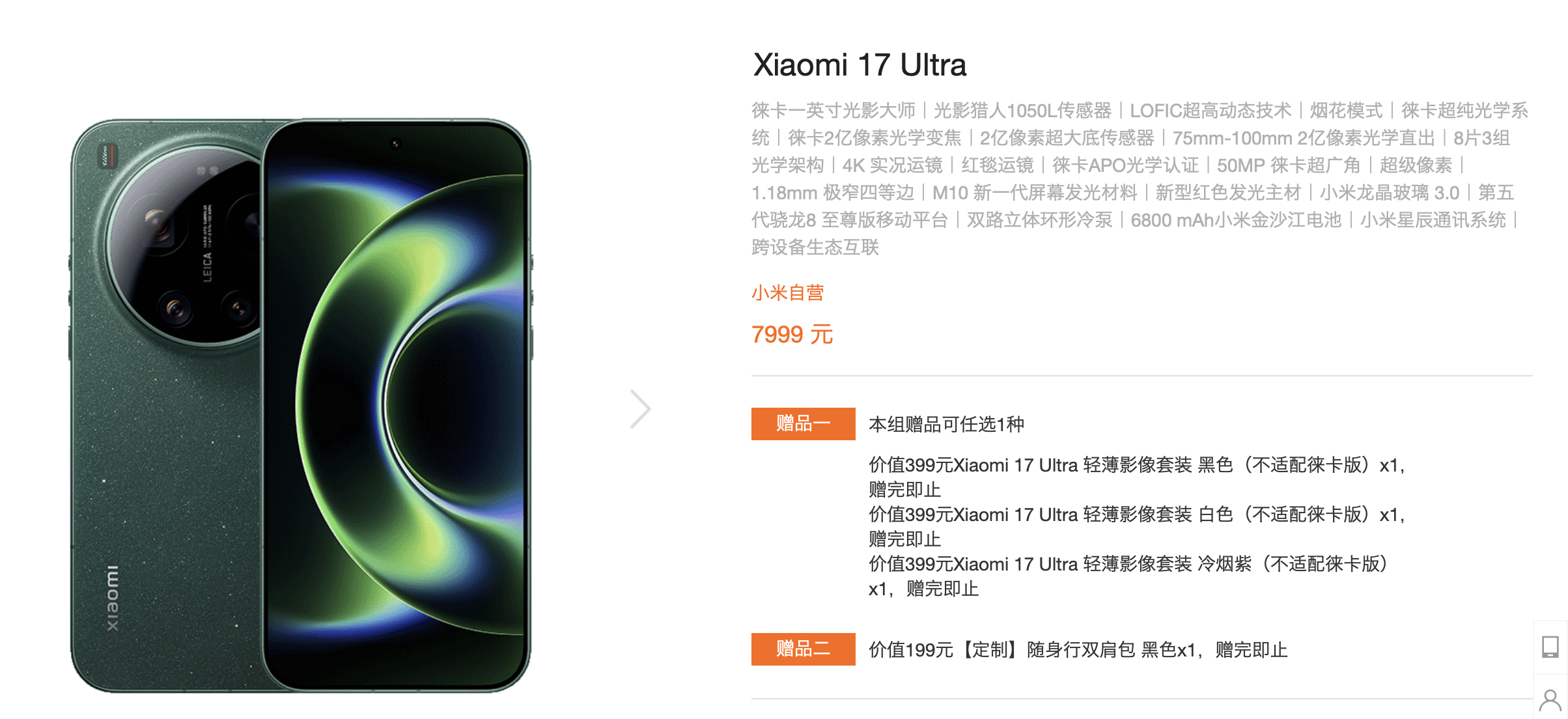
NUPIAO checked Xiaomi’s official website and found that the current Xiaomi 17 Ultrastandard edition12GB+512GBis priced at7,999 yuan,16GB+512GBis priced at8,499 yuan,16GB+1TBis priced at9,499 yuan.
The same day, NUPIAO contacted Xiaomi’s official customer service as a consumer. A staff member said the backend could show earlier data:17 Ultrastandard edition12GB+512GBhad an official launch price of 6,999 yuan,16GB+512GBwas7,499 yuan,16GB+1TBwas8,499 yuan. The staff member said the market retail price should follow the current official website. That means the current price on Xiaomi’s official website is 1,000 yuan higher than the original price across the board.
In addition, NUPIAO verified that17 UltraLeica Edition16GB+512GBhas risen from7,999 yuanto8,999 yuan,16GB+1TBprice has gone from8,999 yuanto9,999 yuan.
As for why prices went up, Xiaomi customer service said the main reason is higher procurement costs for core components. They said, “Although we have been trying to hold back memory price increases, the rise has still exceeded expectations,” so the retail prices of phone products were raised by a certain margin.As for when the adjustment happened, Xiaomi customer service said the backend cannot check the exact timing.
Since the start of this year, phone makers have raised prices several times. On September 1, Xiaomi, Honor, OPPO and vivo had already made a round of concentrated price adjustments. The Xiaomi 17 series went up by 200 to 500 yuan, while the Honor Magic8 rose by 300 to 500 yuan.
According to Daily Economic News,on August 2, Xiaomi Mall listings showed that several Xiaomi phoneshad previouslygone up in price. According to Xiaomi’s official mall, the Xiaomi 17 series had already been raised by 300 to 500 yuan per unit; the REDMI K90 and Turbo 5 series were up by 300 yuan per unit.
On July 23, according to CCTV Finance, during the summer consumption peak, many new and existing models from major brands raised prices, mostly by 300 to 1,000 yuan, with some high-end models climbing by more than 1,000 yuan. Brand stores are relying on policies such as the national trade-in subsidy to lower the barrier to buying a phone.
According to the latest Global Smartphone Price Trend Tracker from Counterpoint Research, since 2026, the average retail price of smartphones sold worldwide has risen 15%, with some models nearly doubling in price. Price-sensitive markets are under more pressure than markets with a higher share of premium models. Newly launched smartphones are also priced higher than their predecessors, showing that global smartphone prices are on a broad upward trend.
Rising memory chip prices are the direct trigger for price changes in the phone market. Massive demand for AI server computing power has created a strong siphon effect: Samsung, SK Hynix and Micron, the three major memory makers, have shifted 70% to 90% of their advanced capacity to higher-margin HBM high-bandwidth memory. Consumer DRAM and NAND flash capacity keeps getting squeezed, and the supply-demand gap continues to widen.
Nabila Popal, senior research director for worldwide consumer devices at IDChassaid memory costs are up nearly 300% year over year and account for more than 65% of the total bill of materials in low-end phones, making it increasingly hard for vendors focused on low-end products to keep going.
Some analysts believe thatas long as the memory supply-demand problem remains unresolved, phone price increaseswill bea phenomenon that continues for the next two to three years. That’s because chipmakers also need a relatively long time to expand production.
The memory crisishas alreadyhit phone makers’ end-market sales directly, and the market is becoming more polarized. IDC data shows that global smartphone shipments in Q2 2026 were 277.5 million units, down 6.7% year over year—the second consecutive quarterly decline. In China, Q2 smartphone shipments were about 66.01 million units, down 4.3% year over year and the fifth straight quarterly drop. IDC expects China’s smartphone shipment decline to widen to around 20% year over year in the second half of 2026.
The firm said thatlooking ahead to 2027, memory prices are unlikely to fall significantly, and the overall market will still face severe challenges. It expects that by 2028 to 2029, with a new replacement cycle, the market may see a recovery.