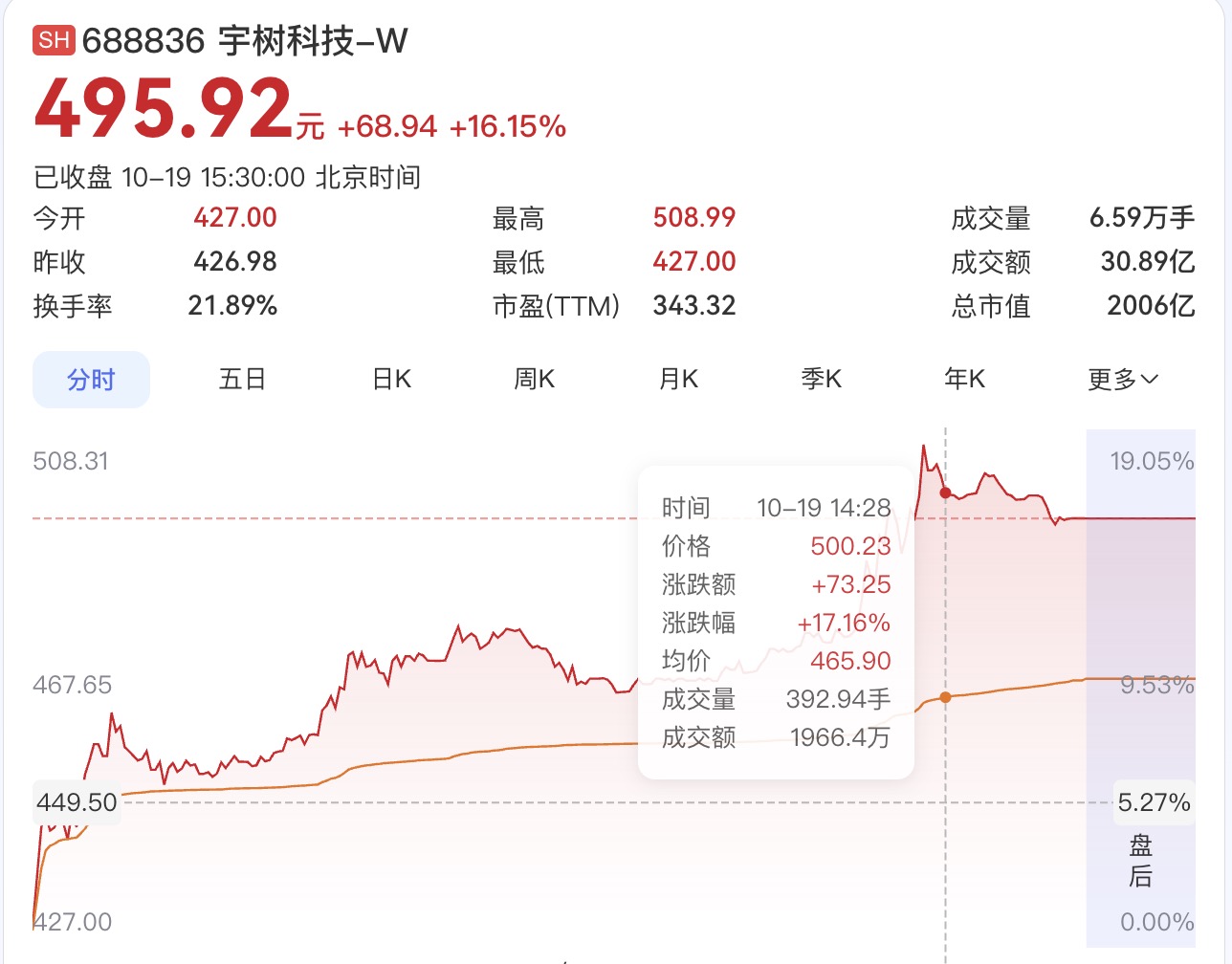
On October 19, robotics leader Unitree Robotics-W (688836.SH) kept rebounding through the afternoon, climbing more than 16% and pushing its total market value back above the 200 billion yuan mark.
At the close, Unitree Robotics stood at 495.92 yuan per share, up 68.94 yuan, or 16.15%, from the previous trading day, for a total market value of 200.582 billion yuan. The stock opened at 427.00 yuan, touched an intraday high of 508.99 yuan, and logged its biggest single-day gain since its August 19 STAR Market listing — excluding IPO day.
On October 19, A-share robotics stocks burst higher in the afternoon and traded firm. Besides Unitree’s big jump, Shangwei New Materials touched 120 yuan intraday and closed at 116.16 yuan, up 9.27%; the underlying index of China Merchants Robot ETF (560770) climbed 3% on heavier volume; and constituents including Shuanghuan Driveline, Bochu Electronics, Leaderdrive, Hengli Hydraulic, SUPCON Technology and Orbbec-W led the advance.
On the news front, on October 19, the Ministry of Commerce and nine other departments jointly released the “Opinions on Accelerating the Promotion of Technology-Empowered Commerce.” The document calls for leveraging AI, big data, the Internet of Things and embodied intelligence to upgrade commerce, and explicitly seeks a richer supply of smart goods — smartphones, computers, home appliances, wearables and robots. It also aims to push embodied intelligence into commerce, expand use cases in home services and trade logistics, and cultivate healthy, well-regulated new smart services such as robot companionship. It promotes implementation of the national “Artificial Intelligence Terminal Intelligence Grading” standards and seeks to speed the market conversion of frontier technologies including brain-computer interfaces and embodied intelligence.
Industry analysts point out that earlier robot policies were mostly focused on the industrial side. This is the first time demand-side room has been opened for robots from the angle of boosting consumption and commerce circulation — and home services and trade logistics are among the most promising scenarios for large-scale humanoid robot deployment.
Separately, on October 15, the State Administration for Market Regulation approved and released the first six national standards for humanoid robots (five technical requirements plus a simulation testing platform specification), set to take effect on April 1, 2027. The market read the arrival of unified industry standards as an important signal that the sector is moving from fragmented R&D toward large-scale commercial use. Unitree founder Wang Xingxing was one of the drafters of the “Humanoid Robot Technical Requirements.”
On October 19, the National Bureau of Statistics released economic data for the first three quarters. Preliminary calculations put GDP at 107.1071 trillion yuan, up 4.6% year on year. Equipment manufacturing and high-tech manufacturing provided notable support, with industrial robot output rising 29.1% from a year earlier.
Overseas, OpenAI CEO Sam Altman confirmed on October 18 that the company will develop humanoid robots, with a demo prototype expected in 2027. Add Tesla’s Optimus mass-production expectations and Nvidia’s upcoming GTC Berlin conference, and expectations for the global embodied intelligence track are heating up — creating a domestic-international resonance with China’s humanoid robot standards and industrial policy that has lifted sector sentiment.
To date, Unitree’s listing day remains its largest single-day gain on record. The stock shot to 1,100 yuan per share right at the open, valuing the company at 444.9 billion yuan — a blistering record for a registration-based IPO open — with a single winning lot showing a paper gain of nearly 475,000 yuan at the peak. It closed its first day up 460.34%, after gaining as much as 629.44% intraday, at 845 yuan per share.
But the stock then pulled back for several straight sessions. By the A-share close on August 26, Unitree Robotics stood at 591.53 yuan per share, down 1.87%, with market value down to 239.3 billion yuan — a drop of more than 200 billion yuan in a week.
Before the 16.15% surge on October 19, Unitree’s biggest single-day gain after listing (excluding IPO day) had been on September 17, when it closed up 6.11% at 503.26 yuan after rising as much as 7.32% intraday. The move was fueled by chatter around Lei Jun’s visit to Unitree’s headquarters, combined with news on Tesla’s Optimus progress that revived sentiment across the humanoid robot sector.
According to a Frost & Sullivan report, global humanoid robot sales reached 36,000 units in the first half of 2026, and the top five by revenue were all Chinese companies.
As of June 2026, eight embodied intelligence companies in China had reached a valuation of 20 billion yuan, known as the “20-billion-yuan club”: Unitree Robotics, AgiBot, Galbot, Galaxea AI, Qianxun Intelligence, X Square Robot, AI2 Robotics and Lingxin Qiaoshou.
Its prospectus shows that from 2023 to 2025, Unitree sold more than 30,000 quadruped robots in total; in 2025, revenue reached 1.699 billion yuan and humanoid robot shipments topped 5,500 units, while third-party industry statistics put its 2025 global humanoid robot market share at 32.4%, according to the fundraising plan in the prospectus, once the intelligent robot manufacturing base project is completed, it is expected to have annual capacity of 75,000 humanoid robots and 115,000 quadruped robots, with a two-year construction period.
Tianyancha app shows that on September 14, Unitree Robotics Co., Ltd. underwent a business registration change, raising its registered capital from about 364 million yuan to about 404 million yuan, an increase of roughly 11%.
Next, the market will be watching two big events for the company. On October 22, the 2026 World Physical AI Conference and Unitree Partner Ecosystem Conference will be held in Hangzhou; then, on October 29, Unitree Robotics will release its first third-quarter report since landing on the STAR Market.
2026 marks Unitree Robotics’ 10th anniversary. On October 12, at the opening ceremony of the 26th China International Industry Fair, Unitree founder Wang Xingxing said the recent release of GPT-6 had a major impact on how the embodied intelligence industry sees things, and his team had also deployed it on robots for task testing, with pretty good results. In his view, the tipping point for the embodied intelligence industry will arrive fairly soon — possibly within one or two years if things move fast. He also said, “My personal faith in AI has only grown. The biggest mistake I made over the past decade or so was not trusting AI enough. Even now, many people still haven’t fully used or embraced AI.”