By
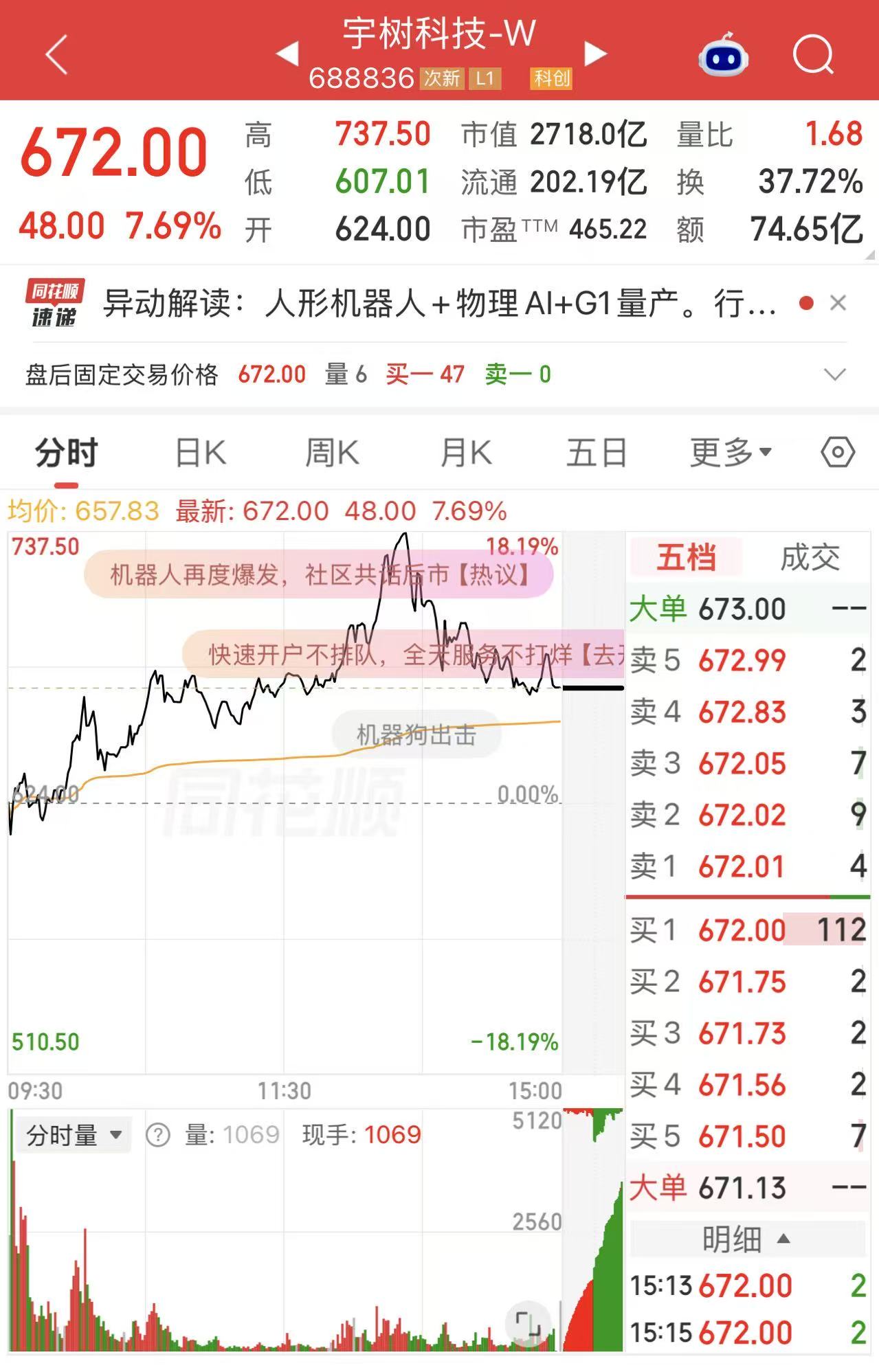
In the afternoon of October 26, A-share humanoid robot leader Unitree Robotics(688836.SH)saw its stock keep climbing. By today’s close,it stood at RMB672 per share,up7.69%,with a total market cap ofRMB271.8billion. Over the seven trading sessions since October 16, Unitree Robotics has rebounded65.89%.
On the news front, at the 2026 World Physical AI Conference and Unitree Partner Ecosystem Conference, Unitree founder Wang Xingxing said the world still does not pay enough attention to—or have enough faith in—AI, and he is no exception.
He noted that with the launch of GPT-6, physical AI is already showing signs of a breakthrough, and embodied intelligence could reach a ChatGPT-like critical point in the next one to three years. The industry’s biggest challenge right now is aligning AI model inputs and outputs with physical robots. On commercialization timing, he expects commercial service scenarios to move faster than home and industrial applications.
He thinks commercial services will land faster than home and industrial sectors.

As“the first humanoid robot stock“, Unitree Robotics listed on the STAR Market in August 2026 at an issue price of RMB150.8, corresponding to an issue P/E of 219 times.On August 19, its first trading day, Unitree opened up 629.44% at RMB1,100 per share, then continued to weaken; by the close it stood at RMB845 per share, up 460.34%.
In the two-plus months since listing, the stock has seen big swings as market sentiment and industry news alternated in driving it, and on October 15 it hit a recent low of RMB404.03 per share. Since October 16, the stock has started to rise. In the secondary market, Unitree Robotics gained 29.85% cumulatively over the three trading days from October 16 to 20.
On October 20, Unitree Robotics issued an announcement on abnormal stock trading fluctuations, reminding investors to watch investment risks. The announcement noted that the humanoid robot industry is still in an early commercialization stage, with uncertainties in technology maturity, downstream market demand cultivation, and supply chain support capabilities.
On the industry outlook that the market is watching, Unitree warned that if large-scale commercialization of humanoid robots falls short of expectations, the company’s future revenue growth and earnings release could be hurt, and investors should also watch for valuation mean-reversion risk. The company urged investors to make prudent decisions and invest rationally.
On the evening of August 17, Unitree Robotics updated its key first-half 2026 results in its IPO listing announcement for the STAR Market.
In January-June 2026, Unitree Robotics posted operating revenue of RMB1.152 billion, up 48.54% year on year; net profit attributable to shareholders was RMB274 million, versus -RMB32.0245 million a year earlier; non-GAAP net profit was RMB244 million, down 19.34% year on year.
Unitree said the revenue increase mainly came from gradually richer downstream use cases for humanoid robots and continued strong market demand, which kept its humanoid robot product revenue growing relatively fast. At the same time, as its revenue base has risen sharply, industry hype has cooled somewhat, and competition has intensified, the year-on-year growth rate of first-half revenue was lower than its annual compound growth rate.
With the stock swinging sharply, major foreign banks have recently shown clear differences in their views on Unitree. On October 25, JPMorgan upgraded Unitree two notches straight from “Underweight” to “Overweight,” and sharply raised its target price from RMB300 to RMB995. The core basis: Unitree founder Wang Xingxing has shortened the expected timeline for a physical AI industry breakthrough from “up to 10 years” to “2-3 years, or even 1-2 years,” suggesting the industry’s sales S-curve will shift forward significantly.
However, JPMorgan did not raise its 2026 humanoid robot sales assumption for Unitree—it stays at 14,163 units—but lifted its 2027 forecast from 26,226 units to 31,701 units and its 2028 forecast sharply from 41,552 units to 111,554 units.
Recently, BofA Securities issued an “Underperform” rating with a RMB350 target price; its reasoning: apart from valuation, the fundamentals are broadly good, but the current valuation is too high.
While major foreign banks’ views on Unitree differ, still, most institutions are basically bullish on the humanoid robot sector.
“Humanoid robots are one of the best real-world landing scenarios for AI and the physical carrier of the AI era; in the internet era, the terminals were PCs and smartphones, and in the AI era, the terminal is the humanoid robot.This is a long-runway, thick-snow type of industrial investment opportunity with huge long-term growth space.“Yang Delong, chief economist at Qianhai Open Source Fund, told NUPIAO.
Zheshang Securities believes global humanoid robot shipments are expected to rise to nearly 60,000 units in 2026 and could reach 500,000 units by 2030. The industry is moving from small-batch validation to large-scale deployment, which should accelerate demand for core components.
CITIC Securities said in a research note that general large models are extending from high-level task planning for robots into motion generation and execution control. Looking to 2027, general models entering embodied tasks will become the AI industry’s next core investment direction; in the near term, general and specialized models are more likely to divide work and collaborate, and physical AI has already reached a major industrial inflection point.