Reporter |
Editor | NUPIAO
Intelligent driving in China has landed in a slightly awkward place.
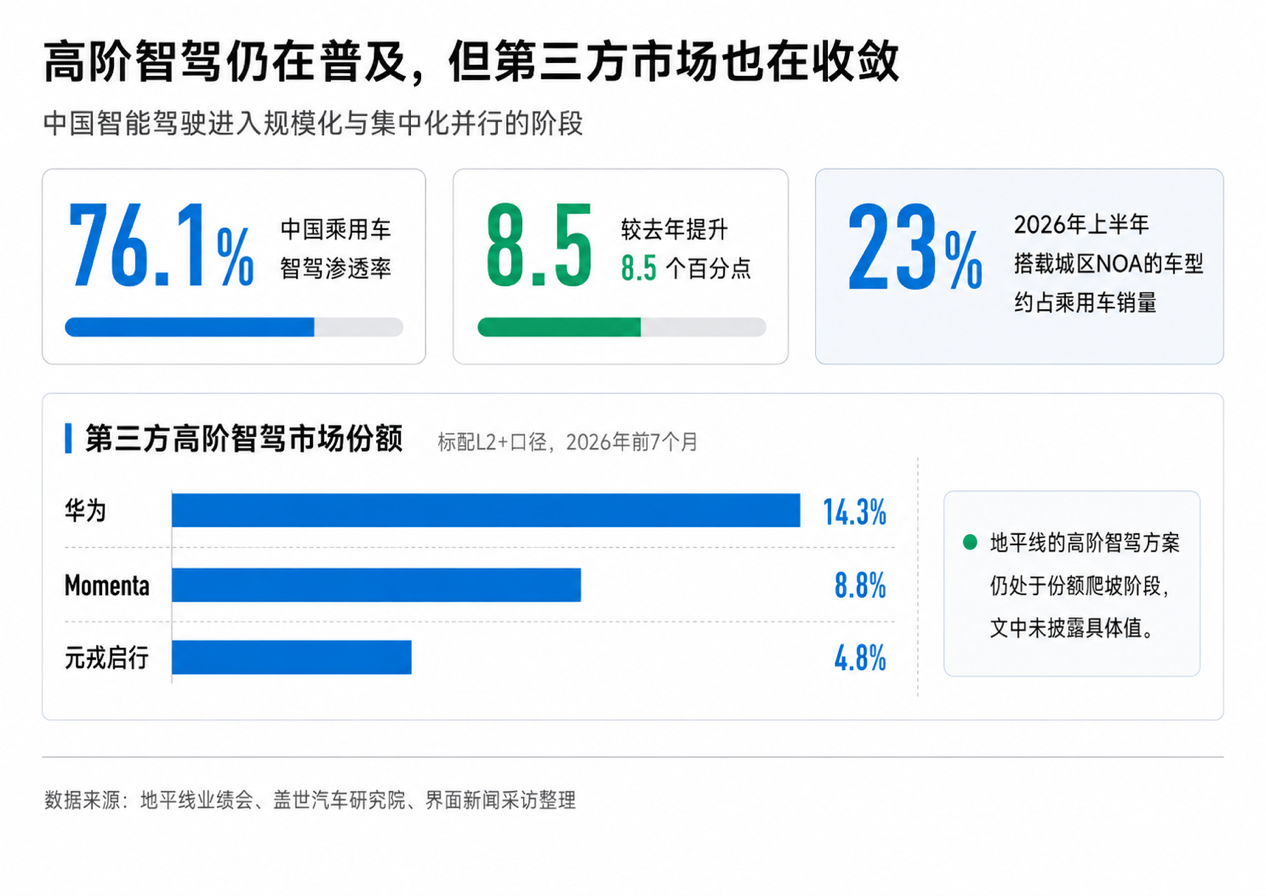
High-level ADAS is still spreading fast. Horizon Robotics disclosed at its latest earnings call that ADAS penetration in China’s passenger cars has already reached 76.1%, up 8.5 percentage points from a year ago. In the first half of this year, models carrying urban NOA made up roughly 23% of China’s passenger vehicle sales. The scale that autonomous driving companies have waited years for is, at least at the vehicle-installation end, finally coming into focus.
But that hasn’t made the business any easier. Entry-level ADAS packages bring volume but thin margins, and high-level ADAS suppliers are themselves going through a shakeout.
An analyst at Gasgoo Automotive Research Institute told NUPIAO in an interview that the first batch of long-unprofitable ADAS algorithm suppliers has gradually faded out, and with leading automakers doubling down on in-house development, the number of third-party high-level ADAS players has clearly shrunk. On its standard-fit L2++ basis, Huawei, Momenta and DeepRoute.ai held 14.3%, 8.8% and 4.8% share respectively in the first seven months of this year, while Horizon’s high-level solutions are still in the share-climbing phase.
On August 31, China’s two leading smart-driving companies, Momenta and Horizon Robotics, reported their 2026 interim results one after the other. They sit at different points along the intelligent driving value chain, yet both are now answering the same question: once installation volume keeps expanding, how do you turn that scale into actual revenue and profit?
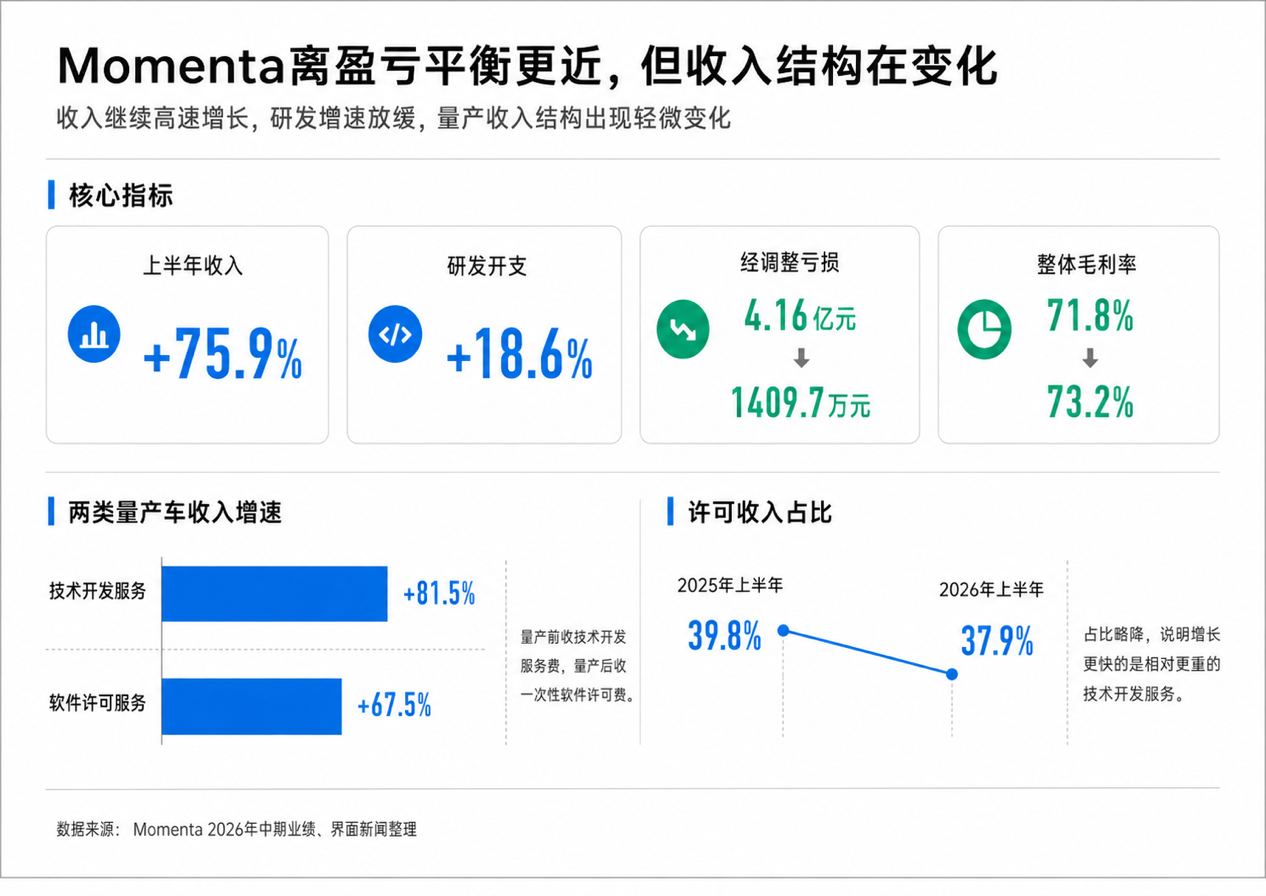
Momenta’s first half-year report since going public already shows some movement. Revenue came in at 1.6 billion yuan, up 75.9% year on year, with R&D spending up 18.6%. Adjusted loss narrowed to 14.097 million yuan from 416 million yuan a year earlier — early signs of edging toward break-even.
Overall gross margin rose from 71.8% to 73.2% in the first half, but the revenue mix that powered those rapid margin gains over the past few years has shifted. Momenta’s production-vehicle revenue mainly comes in two parts. Before a model reaches mass production, the company charges automakers a technology development service fee to complete software and hardware adaptation, testing and validation; after SOP, it collects a one-time software license fee based on actual installations, which usually carries a higher margin.
Over the past three years, a rising license revenue share was a key reason Momenta’s gross margin climbed. But in the first half of this year, it was the relatively heavier technology development service that grew faster: revenue there rose 81.5%, ahead of 67.5% for license services, and the license share slipped from 39.8% to 37.9%.
That margin improvement more likely reflects better delivery efficiency on the technology development projects themselves. Momenta credits the “mainline platform” it has hammered on about for years — every time it enters a new project, the ADAS stack needs re-adapting. Momenta wants to push engineering standardization as far as it can to reach economies of scale.
But once scale grows, there are two other sets of numbers to work out.
The first is price. Momenta co-founder Sun Huan acknowledged at the earnings call that with the price war among domestic automakers, the supply chain can’t sit on the sidelines, and the average per-vehicle price of its systems will adjust going forward. His explanation: as installation volume grows, costs come down, and Momenta shares part of that scale benefit with automakers through tiered pricing.
The other question is where that scale actually comes from. Founder and CEO Cao Xudong repeatedly invoked the “law of large numbers” on the call. In his view, the auto market is moving so fast that even automakers themselves struggle to predict how many units a new model will ultimately sell, so Momenta’s strategy is to cover as many automakers and models as possible rather than betting on a handful of hits.
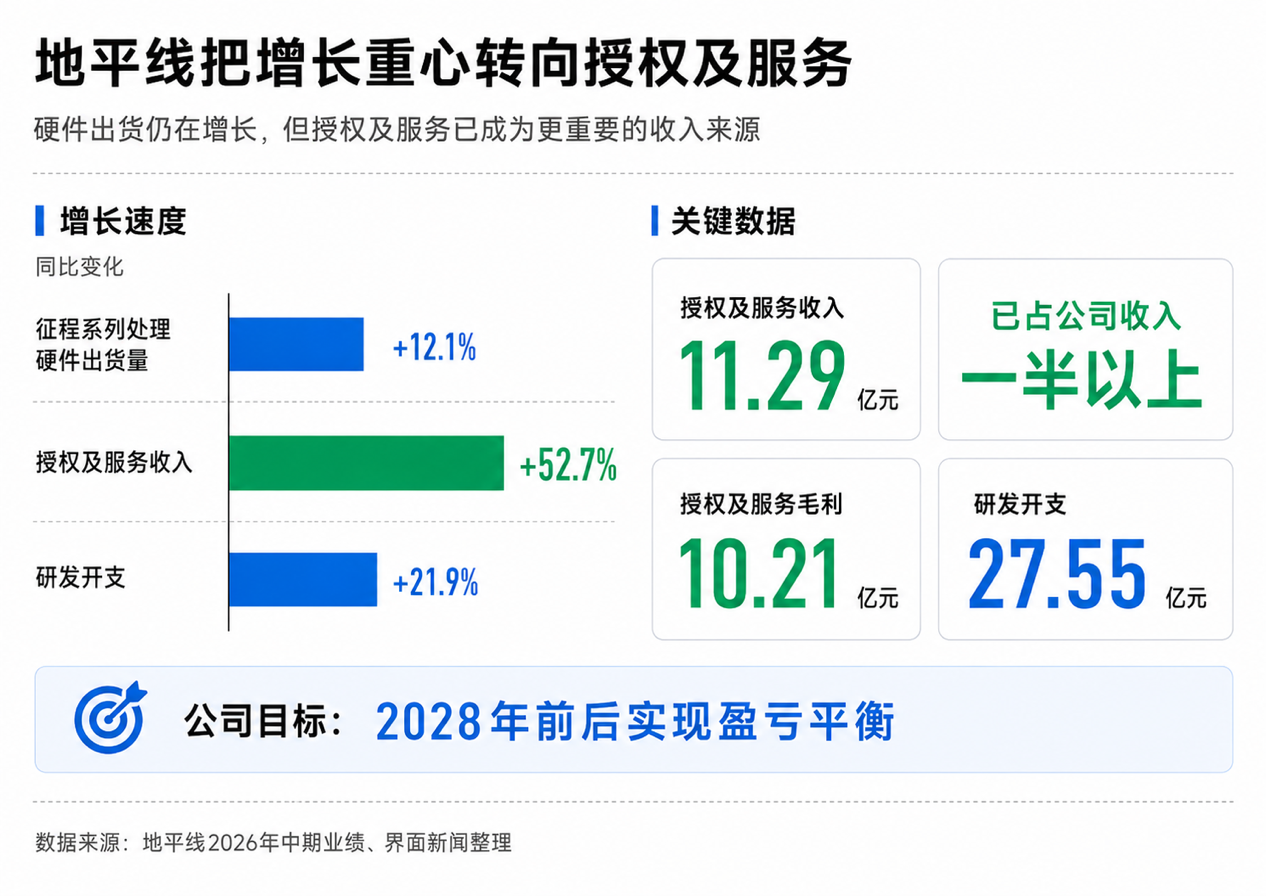
Horizon’s answer looks different. The company has already put millions of Journey chips into cars, but it has also started changing its model. In the earnings report, Journey-series processing hardware shipments rose 12.1% year on year, while licensing and services revenue jumped 52.7% to 1.129 billion yuan — now more than half of the company’s total revenue.
That’s the backdrop to founder and CEO Kai Yu’s recent, repeated explanations of the “ARM+Android” model. In the past, Horizon more often described its business model as “Wintel”: earning revenue by selling chip hardware while also selling its urban NOA solution, HSD.
“ARM+Android” reaches one layer further out. As some leading automakers pull chip and algorithm capabilities back in-house, Horizon hopes customers can still use its BPU architecture, foundation models, software and toolchain to build their own — even if they don’t buy its full product.
But this isn’t an incremental business without a cost. The analyst argues that what really needs watching is whether revenue from IP and follow-on upgrade services can offset the loss of chip sales, and whether automakers, once they hold more of the underlying capability, will eventually swap out Horizon’s BPU architecture. Still, in-house smart-driving chips will stay a minority in the short to medium term.
In the first half, Horizon’s licensing and services segment generated 1.021 billion yuan of gross profit. But the new revenue hasn’t changed the company’s heavy-spend financial structure: R&D expenses still hit 2.755 billion yuan, up 21.9% year on year.
Yu isn’t about to slow the spending. He sees intelligent driving as an industry that demands long-term investment and says Horizon will keep up a “high-intensity, saturation” R&D pace. His read: as the industry matures, only the top 20% to 30% of automakers will be able to sustain in-house smart-driving development over the long haul, and most others will ultimately lean more on outside suppliers; the company is targeting break-even around 2028.
Momenta’s and Horizon’s two business models eventually run into each other on the same automaker.
That company is BYD. It’s both China’s largest new-energy vehicle maker and one of the most important growth markets as high-level ADAS pushes into mass-market price bands; at the same time, BYD is bringing more and more smart-driving capability into its own hands.
Momenta and BYD have partnered for years. The two once set up DiPai Zhixing to develop smart-driving solutions, and BYD later became a strategic investor in Momenta. Today BYD is also one of the most important sources of Momenta’s installation growth. According to industry outlet D1EV, in July Momenta’s urban NOA solution covered 51 models, yet BYD accounted for 52.4% of installations; from March to July, 75.5% of Momenta’s new installations came from BYD.
That gives Momenta’s so-called “law of large numbers” two faces. BYD’s enormous volumes can quickly push Momenta’s software to a much bigger installed base, especially as high-level ADAS reaches down into the 100,000 to 200,000 yuan segment; but if one automaker accounts for more than half of recent installations, the “large numbers” Momenta wants in order to spread risk across enough customers and models haven’t fully taken shape — at least not yet.
What’s more troublesome is that this big customer is increasingly capable of doing the work it used to hand to suppliers. Over the past two years, BYD has kept expanding its algorithm team, and this year it launched its own smart-driving chip, Xuanji A3.
Horizon feels the shift just as sharply. The two sides’ first large-scale collaboration happened at the chip level. In 2024, Journey 6 won a platform-wide design win at BYD; in February 2025, Journey 6 went into production with “God’s Eye C,” and Horizon publicly called itself “one of BYD’s two core partners for in-vehicle intelligent computing solutions.”
So when BYD rolled out Xuanji A3, its in-house 4nm automotive-grade high-compute smart-driving chip, this year, the market naturally asked how much business would be left for outside chip suppliers.
Yu didn’t name BYD directly on this earnings call, but several of his data points were clearly aimed at it. He said Journey 6M had already entered “the largest domestic new-energy vehicle maker” last year and is expected to make up 70% to 80% of that customer’s entry-level assisted-driving shipments in the second half of this year; Journey 6P, 6H and HSD have also won high-level smart-driving platform design wins at this customer and will begin production this year. Turning to “ARM+Android,” Yu added that Horizon is licensing technology to customers including “the world’s largest new-energy vehicle maker,” supporting them in developing their own chips and software.
One thing is at least clear: since starting in-house chip development, BYD hasn’t stopped buying outside chips and software. For now, automaker self-development and third-party supplier expansion aren’t a simple zero-sum trade-off.
“Any automaker doing in-house smart-driving chips right now is definitely losing money — it’s just a question of how much,” the Gasgoo analyst told NUPIAO. Automakers that can truly pull off full-stack in-house development in an economic sense will remain few; most will likely end up with a long-term mix of self-development, joint development and external sourcing. Beyond cutting the cost of buying Nvidia’s flagship chips, in-house players like NIO, XPeng and Li Auto can also improve software-hardware adaptation and scheduling efficiency, and tell a better story to capital markets.
For Momenta and Horizon, though, grabbing more share in the assisted-driving market probably isn’t the endgame for their business models. What could genuinely rewrite the math is the leap from L2 to L3 and L4.
Pricing at the assisted-driving stage is relatively straightforward. Momenta mainly charges automakers technology development fees and per-vehicle software license fees; as urban NOA reaches cheaper and cheaper models, installation volume grows but per-vehicle ASP is bound to come under pressure.
L3 offers another possibility. Momenta is working with automakers on L3 autonomous driving, with the SAIC Audi E7X set to be the first production model to carry it. Cao says L3 vehicles will start production in 2027, provided the regulatory conditions are in place.
The analyst argues that L3 isn’t a simple upgrade from L2++; the way it’s charged will likely shift from one-off solution delivery toward a combination of “hardware + software licensing + development fees + ongoing service or subscription.” That’s exactly the direction Momenta is testing now. Sun Huan says the company is discussing consumer-facing subscription models with automakers; as the driving experience and liability boundaries evolve further, Momenta wants its revenue model to stretch from one-time per-vehicle licenses toward recurring subscriptions.
Momenta has also put a foot into L4. As of the first half, the company was testing or operating robotaxis in six cities across three countries. Its first production Robotaxi is slated for launch in the fourth quarter of this year, with hundreds deployed domestically and overseas by year-end and permits secured in more than 10 cities. Cao’s timeline: grow the fleet to thousands of vehicles across 30-plus cities worldwide in 2027, and push into large-scale L4 operations in 2028.
He expects the global Robotaxi market could reach 1 million to 1.5 million vehicles by around 2031, and offers a long-term estimate of $10,000 in gross profit per vehicle per year.
Horizon is also stretching its existing tech stack toward higher levels of autonomy, though its role stays closer to that of a chip and platform supplier.
It’s developing Journey 7 for L3 and L4, with SoC tape-out expected in early Q2 2027; it has already licensed AI foundation models to customers under the “ARM+Android” model to support automakers building conditional and highly automated driving systems. Horizon also plans to kick off an L4 Robotaxi pilot this year with a leading retail-tech and supply-chain company.
Regulators, too, are turning this technology path into a clearer set of industry rules.
In June and July 2026, the Safety Requirements for Combined Driving Assistance Systems of Intelligent Connected Vehicles and the Safety Requirements for Automated Driving Systems of Intelligent Connected Vehicles were issued, to take effect in January and July 2027 respectively. The first brings what the industry commonly calls high-level assisted driving under the “navigated combined driving assistance” regulatory umbrella; the second requires automated driving systems to be at least as safe as “a competent and attentive human driver,” and to complete simulation, proving-ground and road testing plus third-party certification before mass production.
The analyst told NUPIAO that L3’s early-stage redundant hardware, testing compliance, long-term maintenance and product liability costs are high, so a higher ASP won’t necessarily bring profit growth in step. Only after the solution can be replicated as a platform and liability boundaries are clearly defined can L3’s higher value content turn into higher margins.
Assisted driving is becoming a business with more scale — and far more math around price, cost and customer relationships. L3 and L4 may reshape how that value gets divvied up. For Momenta and Horizon, scale is no longer the only question. What matters more is how much value they can still capture inside every increasingly intelligent car of the future.