NUPIAO Reporter |
NUPIAO Editor | NUPIAO
The first shot of this year’s Double 11 has already been fired. At 8 p.m. on October 15, Tmall officially opened pre-sales, while JD.com jumped the gun on October 12. Yet both companies’ Double 11 launch events landed on the same day—October 15.
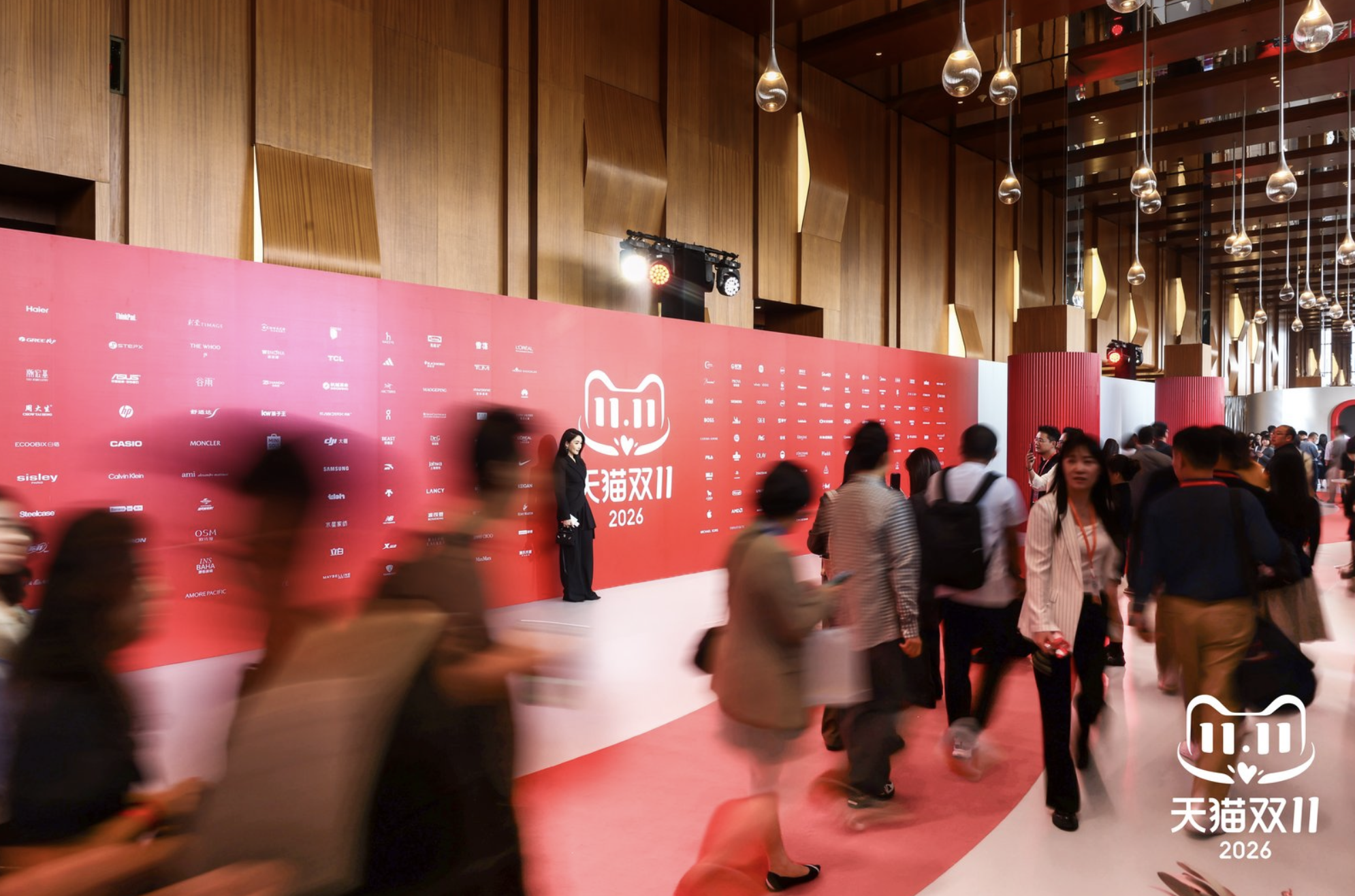
This year’s Tmall Double 11 launch was packed, with hardly an empty seat. As the event opened, the screen rolled out a long lineup of merchant brands—it felt more like a launch built for brands than for shoppers. In his speech, Tmall President Jialuo repeated one point: the platform wants to help merchants achieve higher-quality growth.
In past years, Double 11 pep talks mostly revolved around discount intensity, price deals and traffic resources. This year, however, the platforms didn’t dwell much on “low prices.” The signal they sent was clear: even with a still-challenging consumer environment, brands can still find new customers and new growth.
Right now, China’s consumer market still faces challenges, and overall consumer confidence remains cautious. Take government subsidies: in 2025, trade-in programs pushed home appliance and 3C growth to a high level. But in 2026, the subsidy scope has changed, and the industry widely expects home appliances and computers to face high-base pressure in Q4.
Facing those market challenges, Jialuo didn’t deny the pressure. Some categories are growing, and naturally others are under strain, he said, but the platform is focusing more on opportunities in “structural growth.”

One incremental opportunity comes from extending categories among existing shopper groups. Jialuo noted that on Tmall, active consumers buy about 15 categories a year on average, while 88VIP members buy around 30. Yet the platform actually operates more than 100 categories. In fast-moving consumer goods, for example, users who buy shampoo on Tmall account for only a little over 30% of the platform’s FMCG users. More than 60% of FMCG shoppers have never bought shampoo on Alibaba’s platforms at all.
The second incremental opportunity comes from changes in users’ social roles. Students buy only 8 to 10 categories on average. Once they start a job, get a pet or have a child, they enter the potential buyer pool for home appliances, home furnishings, jewelry and clothing. The third opportunity is using services to drive physical-product growth. This year, Tmall upgraded its integrated “unpack, deliver, install and remove” service to self-operated fulfillment, and big-ticket items such as toilets and fingerprint door locks can clearly lift growth.
These numbers show that even brands that already look mature still have huge room for online penetration. In a post-event interview with NUPIAO and other media, Jialuo said Taotian currently serves nearly 1 billion consumers a year. At that scale, it’s hard to grow simply by looking at total consumer numbers; the focus should be on “how much more one person can buy”—in other words, raising ARPU and making better use of the platform’s existing 1 billion-user traffic pool.
“People used to focus on whether traffic was big or small. Now that’s not really the issue anymore,” Jialuo said.
But that raises a question: why haven’t consumers bought these products on the platform? Is it because they don’t need them, because rivals took them away, or because the demand simply hasn’t been discovered yet?
Tmall wants to use AI to solve the latter problem. Jialuo remains confident about consumer growth this year. In his view, demand is merely asleep and hasn’t been awakened. AI’s value lies in matching the platform’s rich supply with user demand more precisely.
Jialuo noted that over the past decade or so, Alibaba’s search-matching algorithms have improved quickly. But AI brings another huge shift: even before a user searches, AI has a chance to identify latent intent. E-commerce platforms have accumulated massive transaction, search, browsing and fulfillment data, along with mature recommendation systems. On top of that, AI can better understand complex intent, spot connections between shopping scenarios, and try to recommend long-tail supply to potential users.
For example, if a consumer buys a plane ticket through Fliggy to watch the World Cup, even if they haven’t searched for anything related on Taotian, the platform can infer a potential interest in sports and then recommend football and other sports categories. Jialuo said conversion among this group is three times higher than usual.
But this is exactly what Alibaba’s AI e-commerce strategy still needs to prove: can AI actually create new demand, or does it merely redistribute existing traffic? So far, Taobao and Tmall have not disclosed the overall new transaction scale generated by AI, nor have they provided data measuring incremental cross-category spending.
Another change is that AI is extending from a platform tool into merchants’ own operations. In a post-event interview, Jialuo said that over the past year, AI has been applied across many platform scenarios, including merchant product selection, content operations, ad placement, data analysis and consumer communication. This year, Tmall went further by launching the Qwen Office E-commerce Edition , hoping to bring AI capabilities inside merchant companies and into the workflows of different departments.
Jialuo expects AI adoption on e-commerce platforms to be much faster than in traditional channels. In the future, AI applications on the platform side and inside companies will form a two-wheel drive.
Even though Tmall kept stressing growth confidence and AI to merchants, Alibaba’s No. 1 KPI for this year’s Double 11 is still consumer experience. Unlocking consumer demand is, in fact, a shared challenge for the entire e-commerce industry.
JD.com is focusing this Double 11 on “buy more, get more back” and service upgrades, but it must face the high base from government subsidies. Pinduoduo is still defending lower-tier markets with its tens-of-billions subsidy program and group buying, setting up two diverging paths from Tmall’s emphasis on 88VIP user operations. Douyin e-commerce continues to lean on algorithmic recommendation and content. Tmall, meanwhile, is holding on to core merchant brands and core user groups.
You can see that each platform is playing to its strengths. On the supply side, Tmall stressed that more new products from brands including Apple and Alo are joining the platform. AI services will also join Tmall Double 11 for the first time, with model providers such as Zhipu, MiniMax and Qwen all setting up shop on the platform and launching promotional packages.
This year’s Double 11 once again uses the simple “instant discount” mechanism. Cross-store threshold discounts were scrapped last year. This year, the number of participating merchants hit a new high of one million, and the core requirement for 70 million products was instant discounts. That matches what brokerages observed in their Double 11 preview reports. Instant discounts have replaced cross-store threshold discounts as the mainstream model: subsidies borne by merchants are falling, while platform subsidies are giving sales an extra push.
Double 11 has now reached its 18th year. Looking back a decade, the internet digital dividend was still being released, the market was growing fast, and a shopping festival that exploded in one night is still missed by many on social media. But today, consumers feel less and less excitement, and big promotions have become routine. When asked whether Double 11 could return to the early days of blunt 50%-off deals across all platforms, Jialuo told NUPIAO and other media plainly: “Impossible.”
Jialuo explained that the old blunt 50%-off model mainly meant limited quantities sold out, and many merchants were essentially clearing inventory. Today, the event has grown into a promotion involving hundreds of millions of consumers and one million merchants. Pure 50%-off is no longer realistic, but merchants are still required to offer their lowest genuine discounts of the year.
Competition around Double 11 remains fierce. What platforms need to work on now is whether they can wake up users’ sleeping demand and help merchants achieve commercial growth.