Reporter |
Editor | Wen Shuqi
Nearly half a year after WorkBuddy hit the market, Tencent is now building an ecosystem around it.
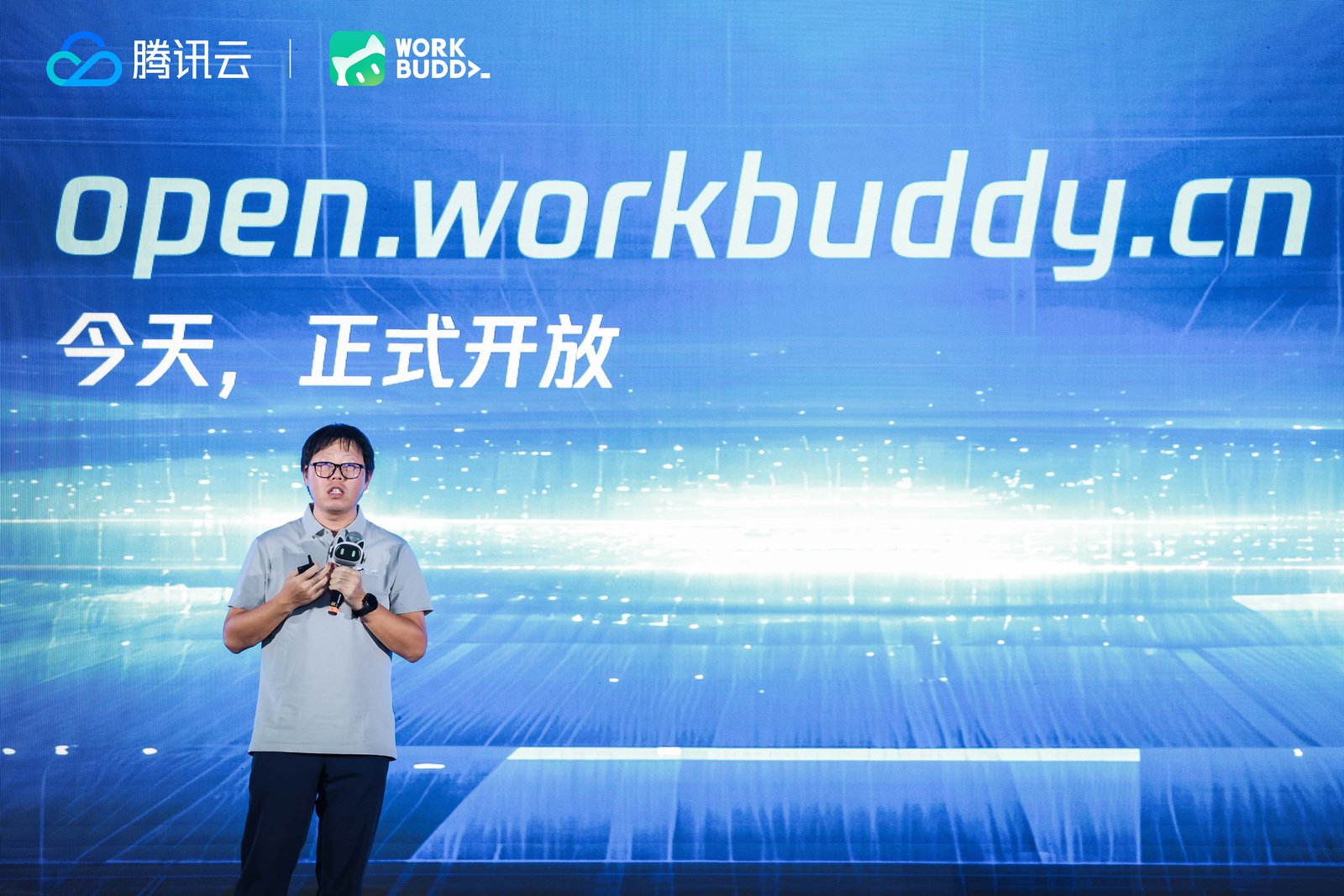
On September 2, Tencent held the first-ever launch event for WorkBuddy, announcing the official rollout of its open platform—opening up its underlying Agent capabilities to smart hardware makers, industry applications, and developers. So far, the WorkBuddy open platform has brought in over 100 ecosystem partners, including software and hardware players like Plaud, Rokid, Insta360, iFlytek, Beisen, and Fanruan.
When it launched back in March, WorkBuddy’s big selling point was getting work done directly. You hand it a batch of files, it breaks down the task, and then generates the output you asked for. The open platform extends that capability to third-party products.
Take Rokid Glasses, the AI glasses, as an example. When wearing them, users can wake up WorkBuddy by voice, snap a photo of what’s in front of them, and hand it over to the Agent for processing. Once you’re in a meeting, the glasses capture the on-site info, and WorkBuddy can then organize the minutes and generate to-dos or follow-up emails.
WorkBuddy is the product Tencent cares about most in the current internet AI battle.
During the Q2 earnings call, Tencent Chief Strategy Officer James Mitchell noted that after the company spotted explosive growth in WorkBuddy, it significantly ramped up funding for it while cutting back on ad budgets for other AI products. Internally at Tencent, WorkBuddy is seen as the next strategic-level product after QQ and WeChat. Pony Ma personally sits in on product meetings, and most requests for computing power and marketing resources get approved fast.
With Tencent’s saturation-style promotion—rare for the company in recent years—WorkBuddy quickly became the most-visited office Agent in China. A report from Analysys shows that in June, the total visits across 17 mainstream desktop AI office agents in China exceeded 60 million. WorkBuddy alone hit 20.97 million, more than the second and third places combined.
But this is only the opening act in the AI office competition. On the other side, Alibaba and ByteDance are equally eyeing this market.
In August, Alibaba and ByteDance rolled out Qwen Office and Doubao Work in succession. According to media reports, Alibaba has positioned Qwen Office as a company-level strategic product for the second half of 2026 and a key SaaS product pushed by DingTalk and Alibaba Cloud; Doubao Work is likewise seen as a core business line to cultivate after Douyin.
Since regular users are quite sensitive to subscription prices, the fight for users in China’s AI office platforms still relies heavily on free quotas at this stage. By contrast, the enterprise-facing B2B market has a clearer payment logic—switching costs are higher once companies are onboarded, and it can drive related revenue like cloud services, making it a must-win battleground for the big players.
That’s exactly why WorkBuddy is building an ecosystem. When an office Agent takes on a task, it needs to read enterprise data and get into business systems to complete operations. A general-purpose model doesn’t understand a company’s permission rules, nor does it grasp the execution workflows of the finance, tax, or legal industries. Tencent can’t fill these gaps all by itself—otherwise development cycles would drag on and customer delivery would get heavier.
External partners, meanwhile, already have ready-made business systems. More importantly, they’ve accumulated industry-specific know-how across sectors and built up customer relationships over years.
And when ecosystem partners team up with Tencent, the first thing they’re after is customer acquisition.
Xiao Feng, Vice President of Technology at Weimob Group, told NUPIAO that WorkBuddy is a potential B2B super entry point. The goal of the partnership is to reach customers that were hard to access before. He noted that simply aggregating capabilities or sharing Token revenue has limited appeal for mature SaaS vendors—they care more about whether WorkBuddy can bring in new business.
Wang Lu, Vice President of Beisen and General Manager of its South China region, also mentioned that enterprise software used to be sold through headcount and field sales, with high customer acquisition costs. Traffic coming from an Agent platform has the potential to bring those costs down.
Hardware makers, on the other hand, are eyeing the task entry point. Sun Chi, Partner and Head of Asia-Pacific Business at Plaud, told NUPIAO that after integrating with WorkBuddy, meeting content captured by Plaud devices can flow into subsequent tasks, and the Agent can use it to produce materials or drive follow-ups. Plaud’s choice of WorkBuddy also factored in its existing user scale and product reputation.

For now, this kind of ecosystem collaboration hasn’t yet formed a mature revenue-sharing mechanism.
Wang Lu noted that the first step in working with WorkBuddy is validating user value. Without users, even the most attractive revenue split means nothing. Shen Tao, Strategy Vice President at Fanruan, also defines the current stage as a market education period. In internal pricing discussions, he advocated opening it up for free use first.
“Let users enjoy the freebies for now—losing tens of thousands a month is a happy problem for us. Seriously talking about payment is for the next stage, and ultimately we’ll follow WorkBuddy’s revenue policy,” Shen Tao said.
The rise of office Agents has also sparked concerns about whether enterprise software will depreciate. Once Agents operate on behalf of users, some software capabilities get broken into Skills for the platform to call, software display rates drop, and the customer relationships traditional SaaS built through accounts may loosen. That’s why Tencent launched “Buddy Apps”—partners can keep their own branding and build independent industry workbenches on top of WorkBuddy, so they can continue running their own product formats.
Lin Zuolu, who leads Tencent’s WorkBuddy ecosystem, said in an interview that each Buddy App requires users to actively bind and authorize, and partners can still connect with their own customers within WorkBuddy. Partners also don’t need to move all their features onto the platform—they can just open up the capabilities suited for natural language calls.
As for the future roadmap of the WorkBuddy ecosystem, Lin Zuolu said the standard for measuring the platform comes down to whether industry applications are being used frequently and whether partners can gain development revenue. Only then does WorkBuddy have a shot at turning traffic into Tencent’s new entry point in the AI era.