NUPIAO News | NUPIAO
On October 21, Tencent Holdings closed Hong Kong trading below HK$400 at HK$393.8, marking a fresh one-year low after a 4.04% drop. Earlier this year, the stock had climbed to around HK$633.7, giving it a market value of roughly HK$5.76 trillion. It now sits at HK$3.58 trillion, down almost 40% year to date.
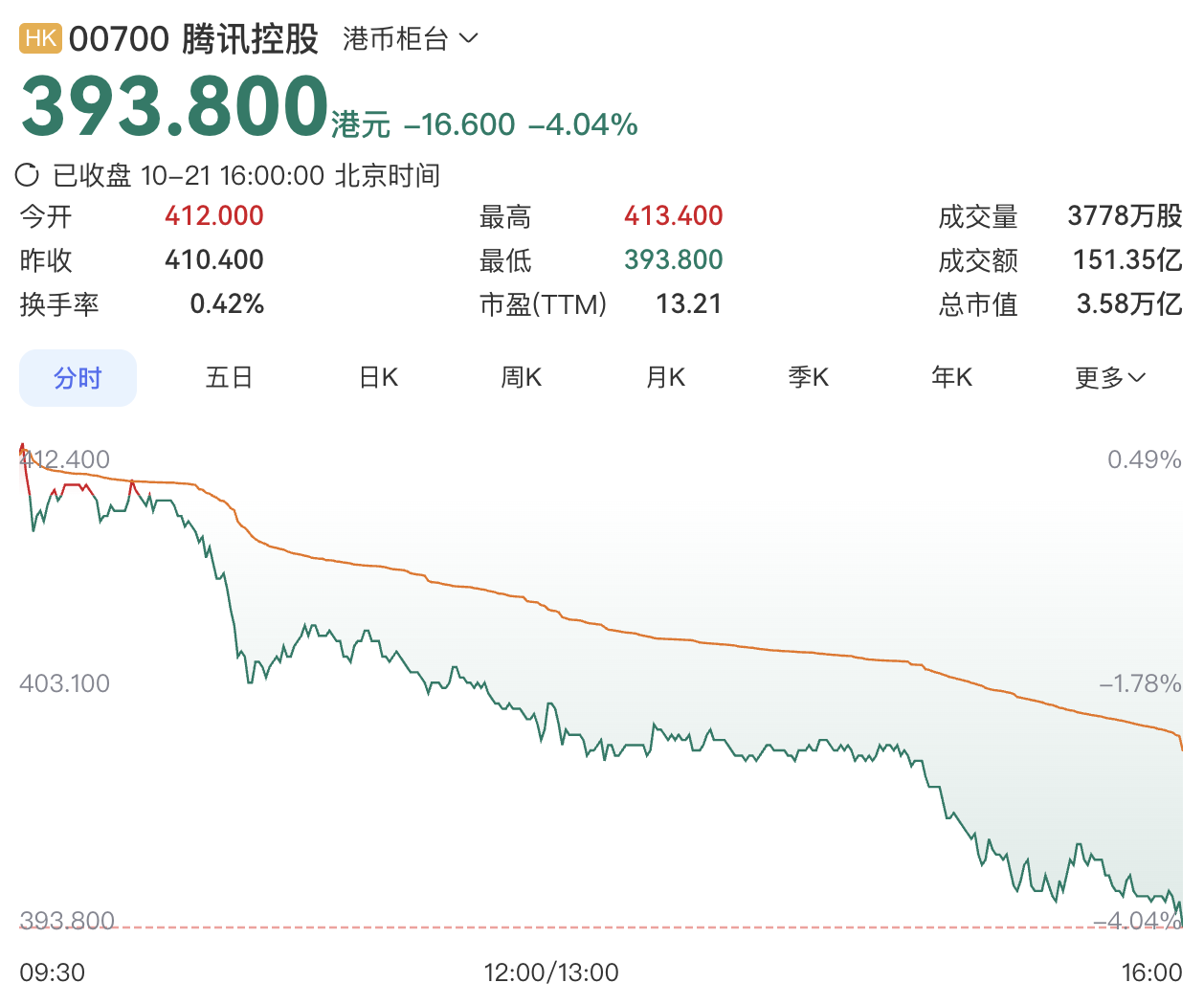
Weak overall liquidity in Hong Kong stocks and lower risk appetite for the tech sector have been the external drags on Tencent. On top of that, shifting earnings expectations are also shaping how institutional money moves.
In its latest research note, Haitong International slightly cut its target price for Tencent by 2% to HK$470 to reflect lower earnings-per-share forecasts, while keeping an “Outperform” rating. The brokerage expects Tencent’s third-quarter revenue to reach RMB210.2 billion, up 9% year on year. Adjusted operating profit is forecast at RMB68.8 billion, down 5% year on year, mainly because AI-related depreciation and product investments are flowing through cost of revenue and operating expenses.
For the full year 2026, Haitong International forecasts Tencent’s annual revenue at RMB823.3 billion, up 10% year on year, with adjusted net profit at RMB265.5 billion, up 2%.
On gaming, the brokerage notes that domestic games remain Tencent’s foundation and should continue to lead the market. Sensor Tower ranked Tencent’s Honor of Kings as the world’s top-grossing mobile game in July, August and September 2026, with five Tencent games landing in the global top 10 for revenue growth in August.
That said, Haitong expects Tencent’s international gaming revenue to fall 6% year on year in the third quarter to RMB19.5 billion, citing fewer new game launches and a high base. Grand Theft Auto VI, scheduled for November 2026, could intensify the fight for players’ attention and spending. In the third quarter of 2025, international gaming revenue jumped 43% year on year, driven by Supercell titles and sales of Dying Light: The Beast.
For marketing services revenue, Haitong believes WeChat Channels will remain the driver, though growth may slow as Miniclip’s in-app advertising contribution fades from the prior quarter and the macro backdrop stays soft. Payment business is also expected to remain weak, with macro conditions weighing on transaction volumes. Enterprise services, however, should get a lift from stronger cloud demand and a positive pricing environment, partly offsetting the pressure.
Haitong stresses that AI remains Tencent’s strategic investment priority. Near-term depreciation will weigh on financials, but the company prefers disciplined deployment rather than automatically ramping up spending every quarter.
Revenue keeps growing while profit comes under pressure first. That “growth without profit growth” expectation echoes the signal from Tencent’s second-quarter results.
Tencent’s second-quarter report, released in August, showed revenue of RMB204.79 billion, up 11% year on year. Its traditional core—gaming, advertising and WeChat Channels—remained solid and supported growth, but the capex number split the market. Capital expenditure hit RMB52.78 billion in the quarter, up 176% year on year. Computing power purchases, Hunyuan model upgrades and AI application rollouts consumed a lot of cash, pushing free cash flow negative for the period.
On the earnings call, Tencent President Liu Chiping (Martin Lau) addressed the rise in capex. He said Tencent is indeed investing heavily in computing power and has already seen clear upside in returns, with several new applications performing well. Computing power leased through cloud services could also bring meaningful revenue growth and improve capex returns. Some previously placed computing-power orders, if resold, could generate margins more than 30% above purchase prices from a few months earlier.
In the second quarter, Tencent’s AI products—including Hunyuan, Yuanbao, WorkBuddy, CodeBuddy and Xiaowei—had a RMB10.5 billion impact on non-GAAP operating profit, up noticeably from the first quarter.
When asked how Tencent allocates investment across AI products, Liu said the situation is very dynamic. Before a real breakout opportunity appears, Tencent will invest cautiously; once it spots one—such as WorkBuddy—it will step up spending. Overall, the company is investing for the long run. As time passes, the economics should gradually show, and profitability will come naturally at some point.
He stressed that if Tencent simply switched its business model to pure computing-power leasing, it would not lose money—it would actually be profitable. Tencent always has that fallback option, which gives it “more confidence.”
It’s worth noting that in early October, reports said Tencent Holdings was considering an offshore bond issue of up to US$5 billion. The bonds were planned in both US dollar and offshore RMB tranches, with an earliest launch this month. The final use of proceeds has not been fixed, and whether the deal goes ahead depends on global market conditions, investor demand and other factors. The market widely speculates that the funds are mainly aimed at stepping up AI investment.
In June this year, Tencent completed an offshore bond issuance worth nearly US$4.7 billion equivalent under its US$30 billion global medium-term note program—its largest offshore debt sale since 2020. People familiar with the matter said Tencent had launched a US$2.45 billion dollar bond and priced a RMB15 billion dim sum bond. One source said the dollar bond drew more than US$9.2 billion in orders, with proceeds slated for general corporate purposes, including refinancing and developing AI products and services.
Competition in AI is fierce, and model R&D and computing-power purchases are ongoing cash drains. For years, Tencent’s steady profits and large, consistent buybacks have been the most important pillars supporting its valuation. If AI commercialization falls short of expectations, the company could face double pressure: spending keeps going, while returns arrive late.
Looking ahead, the market is expected to keep watching two key variables. First, after Tencent’s official third-quarter results are out, whether actual operating profit and capex match institutional forecasts. Second, whether WeChat AI and the Hunyuan model series can send clear signals on user conversion and paid pilot programs.