News by |
Edited by | NUPIAO
Once AI starts operating your phone for you, a new battle over the entry point begins.
September is when phone makers roll out their big guns, and the top players usually unveil their new systems this month. AI is still the main story in this year’s upgrades, but compared with the photo-editing and Q and A tricks of the past, the focus now is on getting agents to do much more work on the phone.
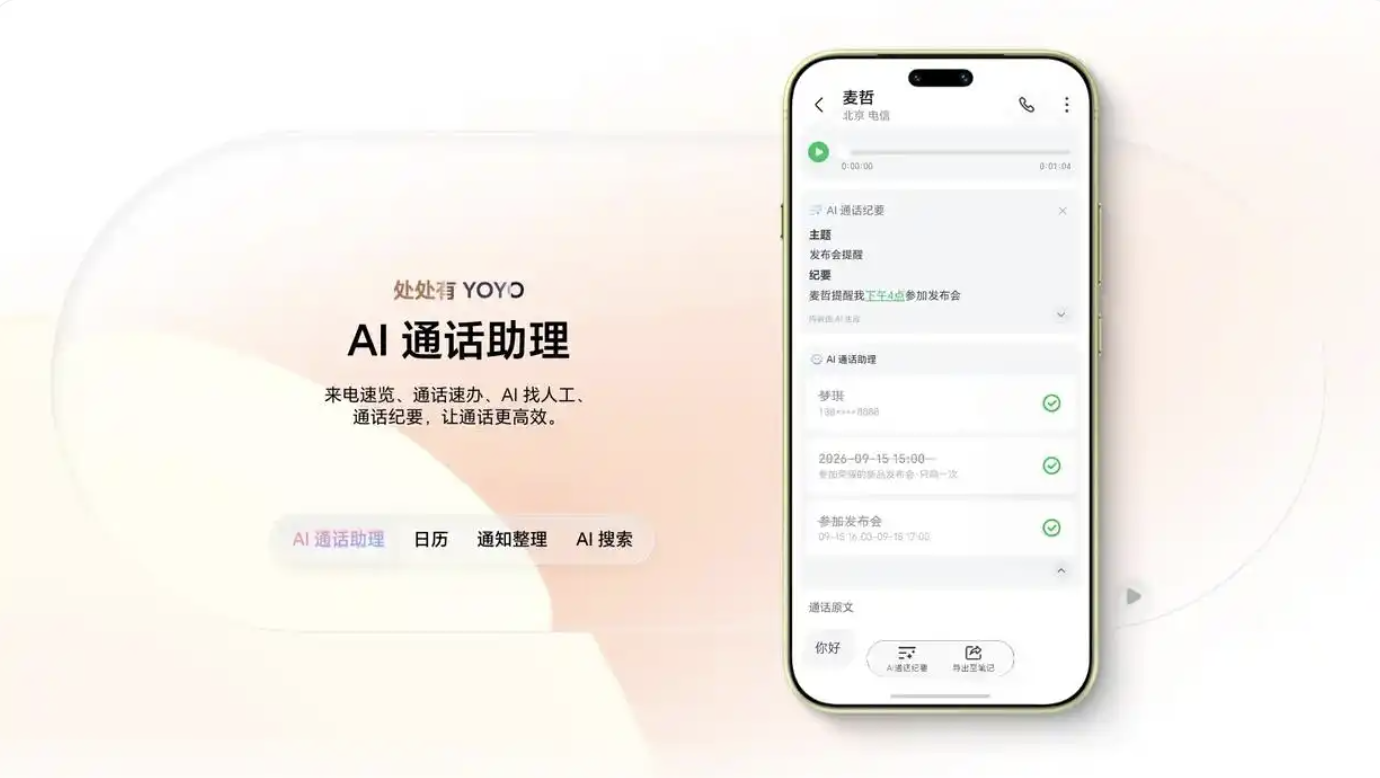
On September 15, Honor launched MagicOS 11. The biggest upgrade is that the phone can automatically carry out more complex and longer tasks. According to Honor, the new-generation assistant YOYO has upgraded its system-level agent execution framework, YOYO Harness, and can now complete complex tasks with more than 100 consecutive steps, which the company says is the highest level in the industry today.
For example, after a user gives a voice command like “I want to see the XXX concert,” YOYO can check the show time, set a ticket-grab reminder, and add the artist’s hit songs to a playlist so the user can practice anytime. It can also show the pickup code when the user gets near a parcel station and flag fresh food or bulky items that need to be handled first. And when the user calls customer service, YOYO can wait on hold and then bring in a human agent.
MagicOS 11 also adds a YOYO Tasks feature, aimed at turning time-consuming and repetitive phone operations into automated workflows. In an on-site demo, it could check the weather every morning and, once the temperature hits a set level, turn on the car’s air conditioning ahead of time. When the user leaves home, the system can also automatically turn off home devices.

As the computing device users spend the most time with, the phone holds a huge amount of personal information and connects to the richest set of services on the mobile internet. That makes it a key entry point where model companies and hardware makers fight over the right to distribute services.
Zhang Chong, general manager of Honor’s MagicOS AI Product Department, observes that last year the industry’s understanding of phone agents was still just about tuning models and some prompts, while this year’s keywords have become better models and a better Harness. Harness is a hot concept in the large-model world right now, and it can turn a model’s probabilistic output into reliable, controllable task execution.
There is no standard answer for the technical path of phone agents. Right now, major players are mainly trying three approaches:
GUI directly recognizes apps and then simulates user taps and input. It does not require apps to open APIs or agent interfaces in advance, and this is the route used by the first-generation Doubao phone, Nubia M153. It can cover more apps, but it is easily disrupted by page changes and pop-ups, and automatic “screen reading” raises the risk of exposing sensitive information;
MCP and Skills let apps package their services as standardized tools that AI can call directly. This kind of interface is more stable, but apps need to opt in, which means striking deals with app makers one by one;
A2A handles communication between agents. A system lead at a top phone maker once told NUPIAO that getting every internet platform to open deep APIs does not make business sense, while A2A lets each side keep its own agents and service boundaries, making standardized cooperation easier to build. That said, this model is still limited at this stage by how widely app agents are adopted.
In an interview with NUPIAO, Zhang Chong said, “Looking at this point in time, the route itself is not that important. The most important thing is to actually get the task the user gave you done.” He believes this is the top priority for AI phones today, with interaction and everything else coming second.
Honor welcomes every route. Zhang Chong explained that YOYO will prioritize standard interfaces such as MCP and Skills, and for apps that have not yet opened interfaces, it will fall back to GUI to complete operations. “Doubao is very strong in GUI capability, but this year we have caught up with Doubao in automatic execution.”
Sun Jianfa, president of Honor MagicOS, revealed that Honor’s automatic execution capability is now going through regulatory certification. The related development and verification work has been completed, and “the certification work is also progressing smoothly.”
Zhang Chong explained: “Right now, MCP and Skills are more like highways between users and services. If the highways are built fast enough, we definitely want to take them. But if there is no highway, our current strategy is to drive wherever there is a road.”
More and more players are joining the AI phone battlefield. Beyond the top phone makers, model companies such as OpenAI, ByteDance and StepFun have also jumped in. Yin Qi, chairman of StepFun, said in an earlier interview that the business model for future AI terminals will be different from existing terminal systems. “It will definitely not be about making money simply by selling hardware, and it will definitely not be about generating profit from preinstalled ads in long-tail apps.”
When it comes to competition with Doubao and other phones, Zhang Chong believes phone makers’ trump card is the depth of integration between the native system and hardware, which shows up in three areas:
First, sensing capability: phone makers have long built up hardware sensing, contextual fences and awareness of third-party app service states. This information is the foundation for good proactive services and memory.
Second, service capability and skill compatibility in an open ecosystem: phone makers have system-level permissions and can rebuild underlying functions with AI. For example, when carrying out complex logic such as “automatically adjusting alarm times based on workdays and weather,” third-party assistants struggle because they lack the ability to take over underlying system services. Take Honor as an example: MagicOS 11 supports 700 tools and 500 open Skills, and YOYO Harness combines and calls these capabilities based on task needs.
Third, proactive service scenarios and accumulated experience: phone makers’ proactive services already cover many real-world scenarios, creating a data loop that is a prerequisite for making models stronger. Zhang Chong believes these accumulated advantages will be hard to catch up with in the short term.
Technology has already brought AI into phone systems. What needs to be rebuilt next is a new set of traffic distribution rules, and that will decide the competitive landscape in the next stage.