NUPIAO Reporter |
NUPIAO Editor | NUPIAO Editorial Team
At the 48th WorldSkills Competition, robot-related events are focusing on how robots can enter real-world settings and complete specific tasks. At the same time, many competition tasks increasingly stress collaboration across mechanical, electrical, programming, and control skills.
Robot system integration and autonomous mobile robots both use robots directly as the subject of competition. The former asks contestants to think about how robots fit into production workflows, while the latter involves the mechanical design, assembly, programming, and testing of mobile robots.
That also mirrors what is happening in the robotics industry.
Data from the International Federation of Robotics shows that China installed 295,000 new industrial robots in 2024, up 7% year on year and accounting for 54% of global new installations. By the end of that year, the number of industrial robots operating in Chinese factories had reached 2.027 million. Chinese robotics companies have also begun pushing products into food processing, textiles, wood manufacturing, and other industries where robots had previously seen relatively little use.
Yao Maoqing, partner and senior vice president of Zhiyuan, president of its embodied business unit, and chairman and CEO of Mifeng Technology, also said in an earlier interview with NUPIAO that a year ago the industry was still cautious about robots truly entering factories. This year, however, robots can be seen being continuously deployed in multiple real-world scenarios, rather than just being withdrawn after a demonstration.
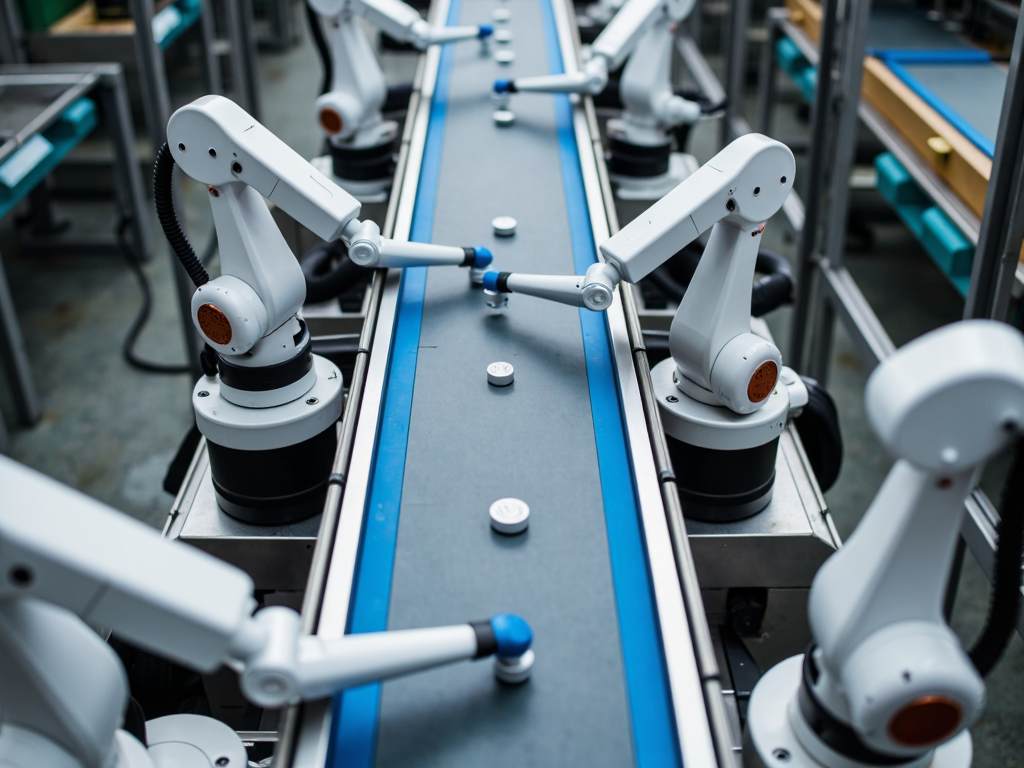
The broader robot applications become, the more complex the production environments they face. How to get a robot into production and keep it running steadily has become a new problem.
From Knowing Only Basic Tasks to Understanding Multi-Device Integration
“In the past, employees only needed to know simple teaching. Now we need more versatile engineers who understand multi-device integration,” Dobot told NUPIAO.
“Teaching” is a fairly basic task in industrial robot applications: setting the robot’s positions and motion paths through a teach pendant or similar device. But once a robot actually enters a production line, what needs to be handled goes far beyond the robot itself.
Dai Jingqin, an expert with the Macao, China delegation for autonomous mobile robots, told NUPIAO that their mobile robot event also requires contestants to understand mechanical design, programming, and other areas, which reflects the industry’s demand for versatile talent. “If you can only design the machine but cannot program it, the robot will not move. The abilities this event tests actually match what the industry needs now—you need to know a little about everything and be able to support each role,” Dai said.
Dobot told NUPIAO that the roles it currently feels are relatively scarce include field technical support engineers and robot integration engineers.
Recruitment platform data shows a similar shift. NUPIAO checked recruitment platforms and found that some robot system integration engineer positions offer monthly salaries mostly between 12,000 and 25,000 yuan. Pay rises further for roles that demand more experience and broader capabilities. On BOSS Zhipin, a JD Logistics robot system integration engineer position requires five to ten years of experience and offers a monthly salary of 30,000 to 40,000 yuan.
Public hiring requirements also show what skills companies want. NUPIAO checked companies’ recruitment websites and found that Dajie Robotics, which is hiring electrical engineers this year, requires three to five years of non-standard automation experience and proficiency in PLC, robot programming, and hardware integration.
Dobot told NUPIAO that an engineer who can independently complete robot system integration and on-site commissioning needs to master robot programming and debugging, be able to read electrical drawings and complete basic wiring, understand production line processes, adapt solutions to actual needs, and have on-site troubleshooting and equipment safety capabilities.
These are exactly the skills highlighted by many manufacturing events at this WorldSkills Competition.
The competition descriptions show that robot system integration requires technicians to bring robots into production workflows; mechatronics involves mechanical, pneumatic, electrical control systems, programming, and robots; and industrial control requires handling the installation, programming, and faults of automated and electrical production systems.
As automation increases, some work that used to be divided among multiple roles is now overlapping in robot application scenarios.
Real talent demand has already appeared in lists of shortage occupations published by some local governments. In March this year, the Hangzhou Human Resources and Social Security Bureau released the Hangzhou Skilled Occupation (Job) Shortage List (2026 Edition), with industrial robot system operators, industrial robot system maintenance workers, and industrial vision system maintenance workers in the top three. Occupations related to robot applications, such as mechanical equipment installers, electrical equipment installers, intelligent hardware adjusters, and IoT installation and commissioning workers, also made the list.
Talent Needs Hands-On Experience Solving Non-Standard Problems
In terms of academic programs, training for robot application talent is not a blank slate. The Ministry of Education’s 2025 higher vocational education teaching standard for the Industrial Robot Technology major already lists industrial robot application system integration, operation and maintenance, automation control system installation and commissioning, and technical support as key positions or technical areas. Its talent training goals also explicitly include programming and operation, installation and commissioning, and operation and maintenance of industrial robots and application systems.
But in real projects, Dobot has felt that there is still a gap between school teaching and real corporate projects. As its business expanded from education and research to industrial, retail, medical, and other scenarios, the company found during a large number of project implementations that the industry needs more talent with practical engineering capabilities.
The hardest thing to gain in a classroom is experience handling non-standard problems.
Dobot said that on-site troubleshooting, multi-device joint debugging, and adjusting solutions based on customers’ site conditions are all relatively difficult to learn through standardized classroom teaching. “Textbooks talk about standard processes, but every site’s working conditions are different.” The ability to handle complex, non-standard problems needs to be built up with real equipment and real projects.
This WorldSkills Competition also reflects the need to test “uncertainty” in real scenarios. Dai Jingqin introduced that this year’s autonomous mobile robot event includes a navigation task: the robot must rely on sensors and algorithms to navigate in an unknown environment, and obstacles may appear unexpectedly during the process. “It’s just like our real scenarios,” and real environments do not always operate under pre-set conditions.
That also explains why training skilled talent matters so much today.
Unlike software development, where knowledge is relatively standardized, industrial robots ultimately face highly specific production scenarios. The same robotic arm entering an auto plant and a food plant needs to complete different processes; even when performing similar tasks, different factories may have completely different conveyor lines, fixtures, sensors, and control systems.
At the same time, AI is reshaping the skills a robot application engineer needs to master.
Dobot believes that some repetitive basic teaching, simple parameter fine-tuning, and fixed-process debugging will gradually be handled by AI and intelligent technologies, and the share of repetitive human work will decline. In the future, engineers will focus more on implementing intelligent scenarios and will need to handle the deployment and adaptation of multimodal perception systems involving vision, force, touch, and other sensing capabilities. As embodied intelligence technology enters application, they will also need to understand the linkage between AI models and robots and verify the stability and safety of intelligent solutions in industrial and commercial sites.