NUPIAO
On October 9, IDC dropped its latest preliminary numbers, and they weren’t pretty: global traditional PC shipments came in at just 62.7 million units in Q3 2026, down a sharp 20.1% year over year and 9.1% lower than Q2. The third quarter usually gets a lift from back-to-school buying and ranks as one of the year’s peak sales seasons. This year, though, demand kept fading—breaking a seasonal pattern the industry has relied on for years.
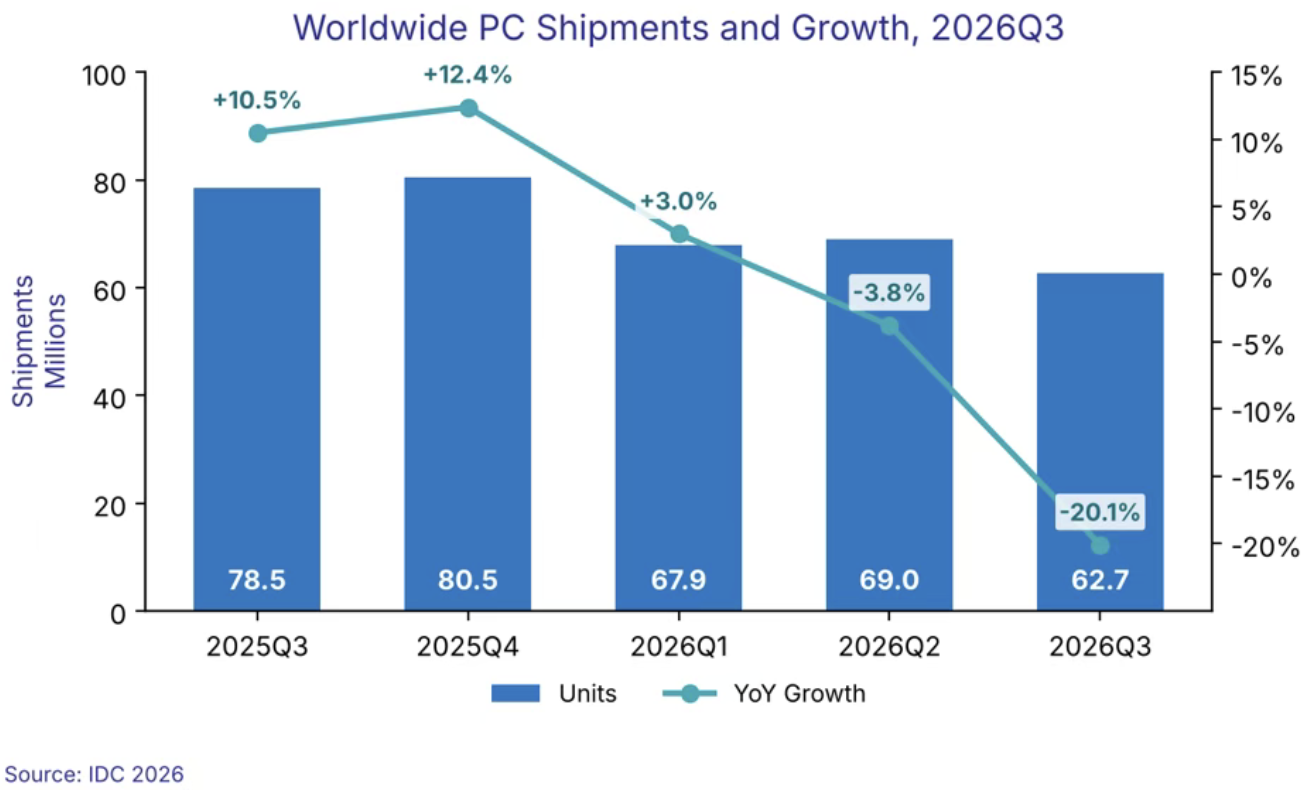
That makes it the second quarterly decline in a row, and the fall is far steeper than Q2’s 3.8% drop. As for why, IDC says channel partners spent the quarter mostly clearing out inventory they had loaded up on earlier. Because of that, Q3 shipments never got the usual seasonal rebound.
Jitesh Ubrani, IDC’s research director for consumer devices, said this is the result of concentrated early stocking in the first half. Vendors and channel partners bought heavily at the start of the year to get ahead of price hikes—and that ended up disrupting the usual pattern of Q3 coming in above Q2.
In Ubrani’s view, channel partners are now worried about two things: higher prices are already squeezing demand, and there’s still plenty of inventory sitting around. There may be a round of promotions that gives consumers some short-term relief, but prices probably won’t return to where they were a year ago and will stay elevated overall. What’s worse, the macro environment is still getting weaker, and conditions could deteriorate further in the coming quarters before there’s any chance of a rebound.
Still, IDC noted that vendors were not hit evenly. Lenovo, HP and Dell all declined more than the overall market and together gave up 4.2 percentage points of share—likely because they are still feeling the impact of earlier pull-forward stocking this year.

IDC’s shipment data puts the top five vendors in Q3 as Lenovo, HP, Dell, Apple and Asus. Lenovo stayed No.1 with 14.9 million units and 23.8% share, down from 19.3 million units and 24.6% a year earlier—a 22.6% year-over-year drop.
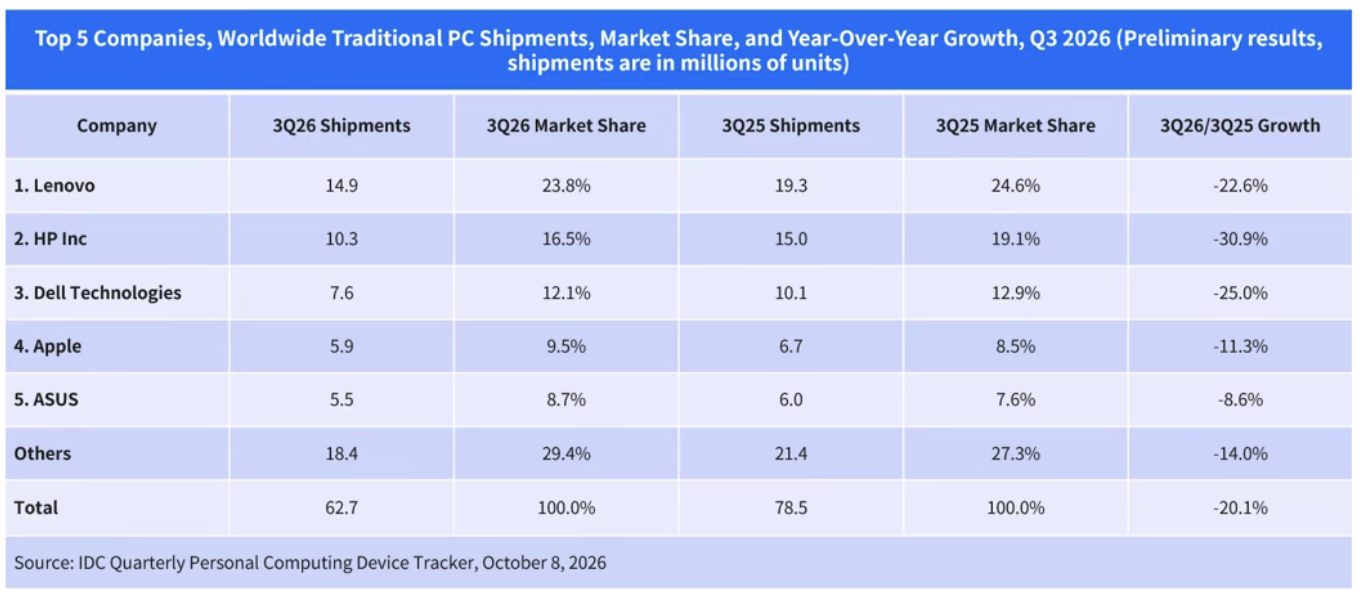
HP came in second with 10.3 million units and 16.5% share, down from 15.0 million units and 19.1% a year earlier. That’s a 30.9% plunge—the biggest drop among the top vendors.
Dell ranked third with 7.6 million units and 12.1% share, versus 10.1 million units and 12.9% a year earlier, down 25.0% year over year.
Apple was fourth with 5.9 million units and 9.5% share, down from 6.7 million units and 8.5% a year earlier. Its 11.3% decline was the smallest among the top five, and its share actually rose against the tide. Asus took fifth with 5.5 million units and 8.7% share, also gaining share.
Compare IDC’s two quarterly data sets and the market’s cooling speed is obvious. In Q2 2026, global PC shipments were 68.2 million units, down 4.9% year over year—the first negative growth after nine straight quarters of gains. Just one quarter later, the year-over-year decline widened from under 5% to 20%, a sharp downward acceleration.
Go back a year and Q3 2025 global PC shipments were 78.5 million units, when the market was still running relatively steady. In just one year, the industry’s mood has flipped dramatically. Omdia’s observations for the same period largely line up with IDC’s view. Omdia said in an earlier report that memory shortages are pushing up costs and weighing on global PC end demand, with inventory pressure gradually showing up across the channel.
The top-five lineup in Q2 was also quite different from Q3. In Q2, Lenovo shipped 16.6 million units for 24.4% share, down just 2.1% year over year—a solid lead. HP shipped 13.0 million units, down 9%; Dell shipped 9.3 million units, down 5%. Apple was the only top-five vendor to grow in Q2, with 6.7 million units, up 10.1% year over year.
In just one quarter, Apple and Asus went from slight growth to modest declines, while Lenovo, HP and Dell saw their declines multiply. That shows Q3’s demand contraction hit traditional PC giants much harder.
Sure, AI PC upgrades and new product launches are still happening, but most new models are product refreshes—not the kind of thing that sparks a massive replacement wave. Regular consumers still swap out computers every few years, and commercial customers are watching procurement budgets more closely. The underlying memory chip shortage also shows no sign of a quick fix. Analysts generally expect memory supply to stay tight at least until the end of 2027. High chip costs will keep pushing up system prices, which in turn weighs on end-user willingness to buy.
IDC forecasts that global PC shipments will fall 11.3% year over year for the full year 2026, with Q4 still under pressure and the year-over-year decline expected to stay around 20%.
This market correction is really the result of the earlier inventory cycle, the chip supply cycle and the macro cycle all converging. Once the benefits of pull-forward stocking are fully used up, the PC industry will need fresh real demand to get growth back on its feet.