In the early hours of September 4th, OpenAI officially unveiled its next-gen flagship model, GPT-6 Astra. In an announcement posted to its developer community, the company dubbed it “the smartest and most aligned model on the planet right now.” This marks OpenAI’s most significant flagship update since the GPT-5 series — and the first time the company has slapped the “Astra” suffix onto a flagship model. OpenAI co-founder and president Greg Brockman didn’t hold back on the launch call, saying flat out: “Welcome to the AGI era.”
According to the official rollout plan, Astra is opening first to a limited group of enterprise organizations through “Trusted Access” and the Daybreak cybersecurity program. Over the coming days, it’ll gradually reach ChatGPT Plus, Pro, Business, and Enterprise subscribers, and will also be available through the OpenAI API and Amazon AWS.
Compared to OpenAI’s previous generation, GPT-5.6 Sol, Astra represents a generational leap in math reasoning, cybersecurity, computer operation, and scientific research. According to technical docs published on OpenAI’s website, GPT-6 Astra pulls together years of research in pre-training, reinforcement learning, and alignment — with core breakthroughs concentrated in two areas: agentic execution and deep reasoning.
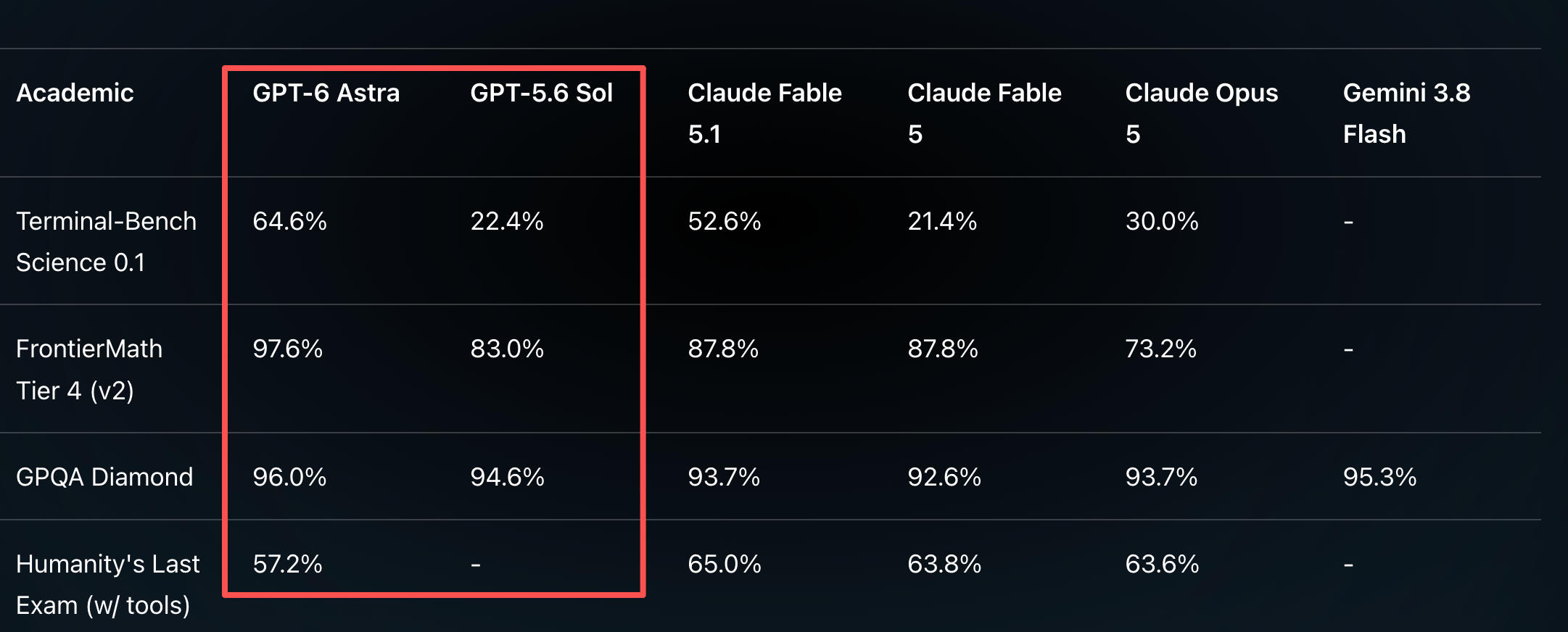
Official test data tells quite a story. On Terminal-Bench Science 0.1 — a benchmark measuring autonomous scientific research capability — Astra scored 64.6%, significantly higher than Claude Fable 5.1’s 52.6% (released by Anthropic just two days earlier), while costing roughly 31% less in estimated API costs for equivalent tasks. Even at a lower-cost setting, Astra still hit 61.1% — far above GPT-5.6 Sol’s best of 22.4%, at about 27% lower cost. On Terminal-Bench 4.0, which tests terminal coding ability, Astra scored 57.9%, again beating Claude Fable 5.1’s 55.8% and GPT-5.6 Sol’s 37.3%.
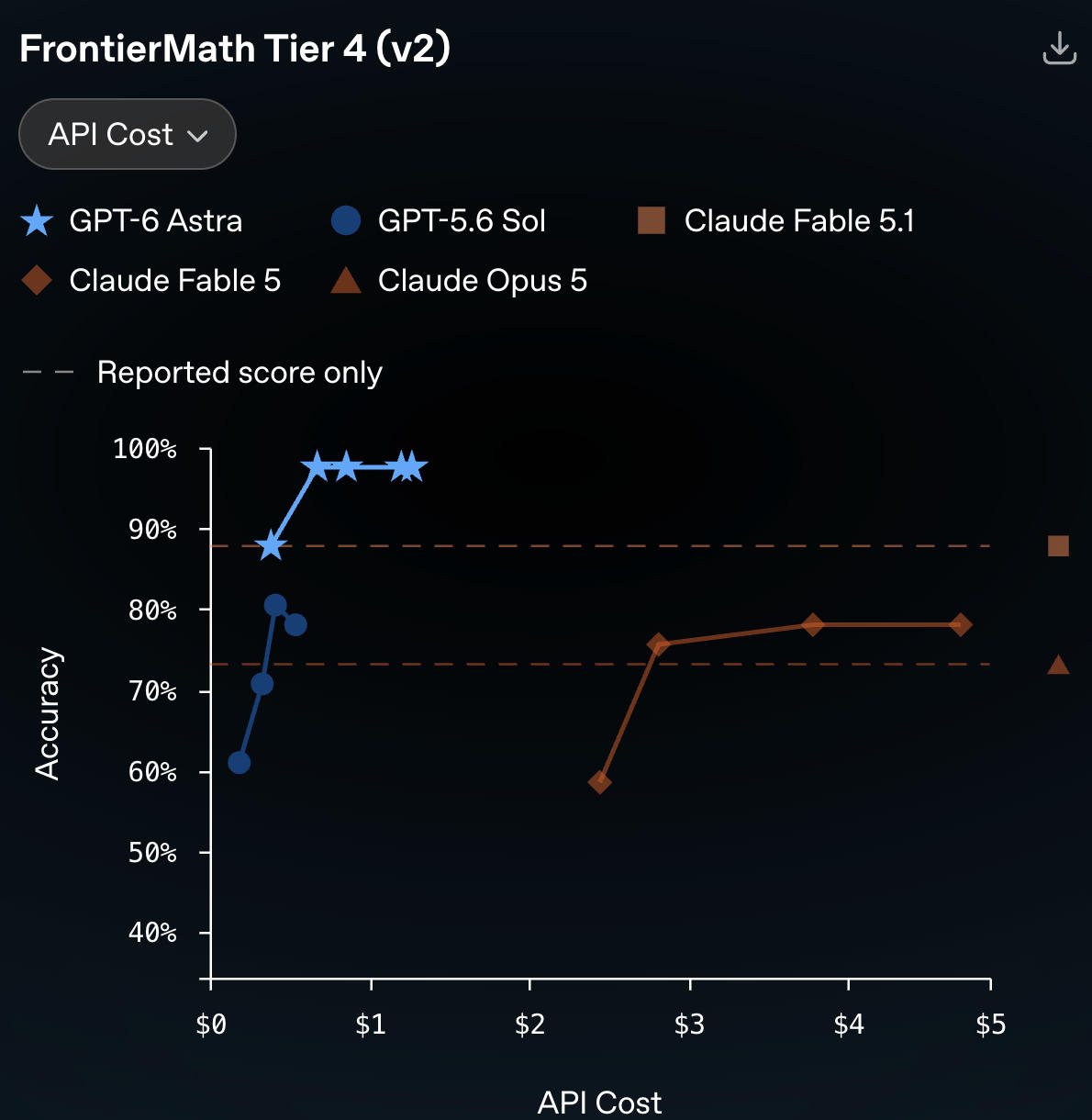
On the Frontier Math Tier4 (v2) test — considered one of the hardest math benchmarks out there — Astra pulled off a stunning 97.6%. Claude Fable 5.1 and Claude Fable 5 tied at 87.8%, while the previous-gen Opus 5 managed only 73.2%.
OpenAI says Astra has already helped crack long-standing open problems in mathematics, including two new theoretical results in prime gap research. The ARC-AGI-3 test — which measures a model’s abstract reasoning and learning in unfamiliar environments and is seen as a core indicator of general intelligence — is where things get really wild. Astra scored a near-perfect 99.9%, while GPT-5.6 Sol managed just 7.8%. That’s a more than tenfold jump in a single generation.
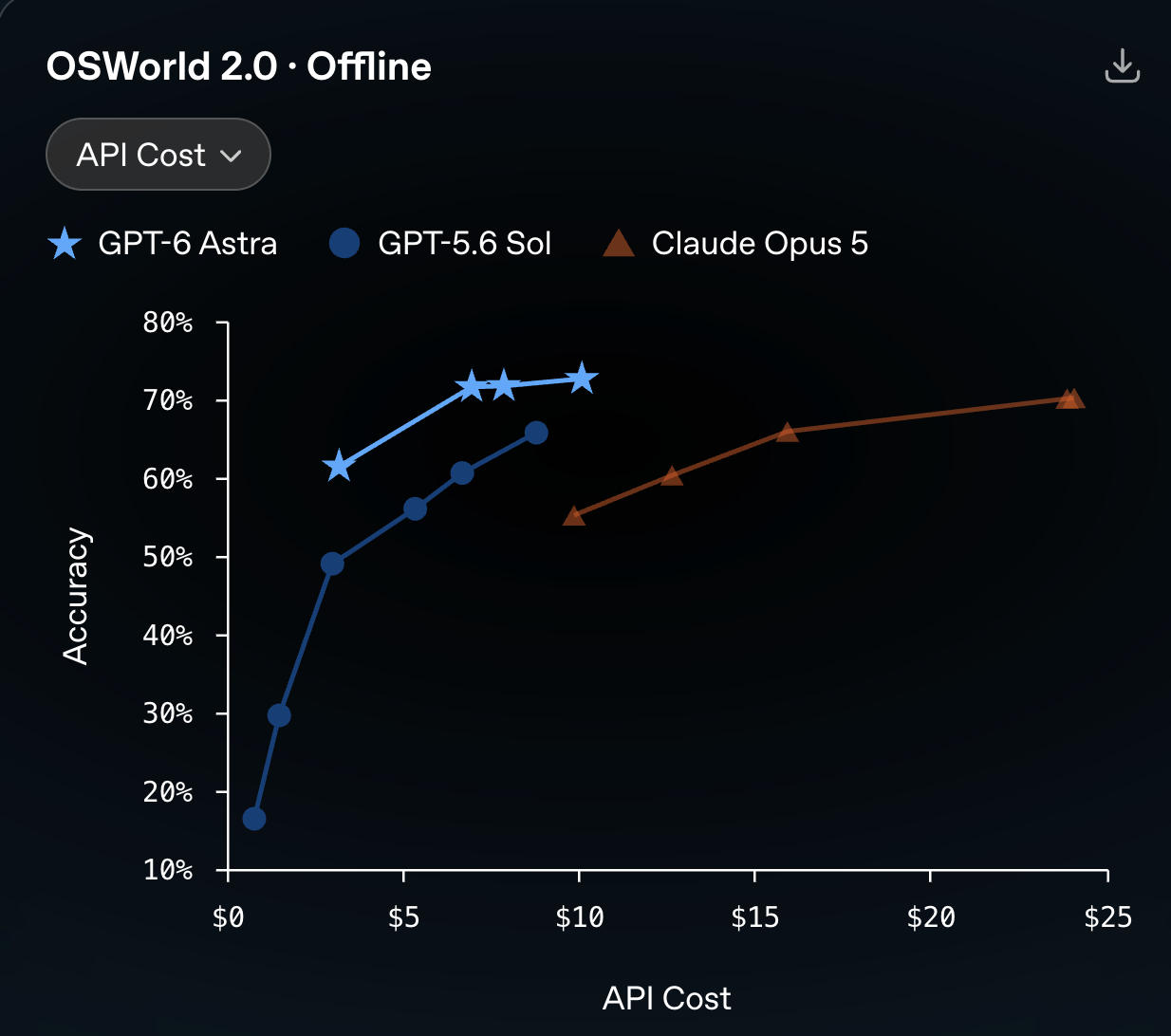
The boost in computer operation and task automation is what really gives Astra the potential to “replace humans at work.” On the OSWorld 2.0 test, Astra scored 72.6%, up from GPT-5.6 Sol’s 65.7%. Average completion time per task dropped from about 75 minutes to just 40 minutes — nearly a 47% efficiency gain. Sure, earlier models could handle plenty of computer tasks, but they were so slow users would rather just do it themselves. Forty minutes means AI-operated computers are finally hitting real production-level efficiency.
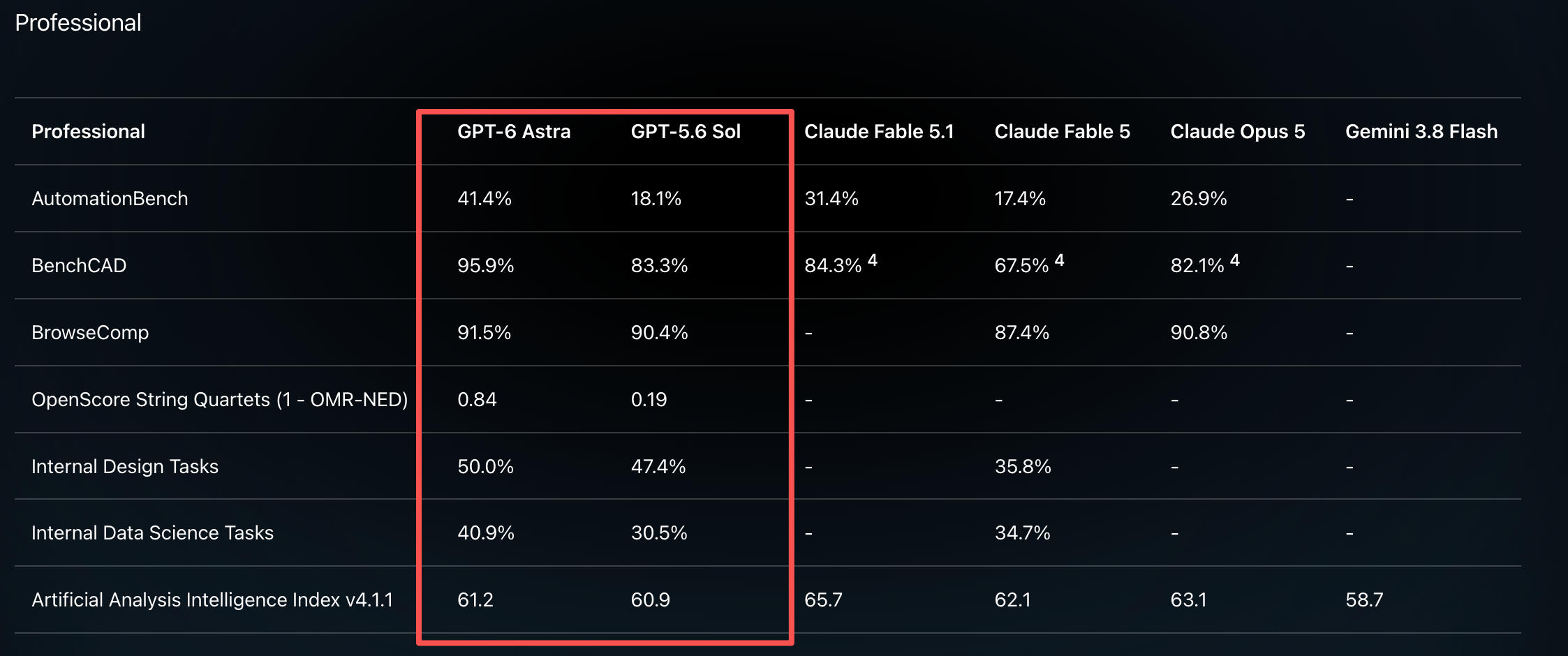
On the Automation Bench test, which measures business process automation, Astra scored 41.4% — more than double GPT-5.6 Sol’s 18.1%, and ahead of Claude Fable 5.1’s 31.4%. Official demo videos show Astra independently handling complex work like filling out tax forms, updating CRM systems, organizing schedules, building financial models, analyzing research data, assembling websites, designing PCB circuit boards, and creating 3D game scenes. Users just give it the end goal — the model plans the steps, switches tools, and fixes errors all on its own. No hand-holding required.
On pricing: GPT-6 Astra’s API calls run $10 per million input tokens and $50 per million output tokens — 2.5x GPT-5.6 Sol’s current price, roughly on par with Claude Fable 5.1. Cache reads get a 90% discount, cache writes carry a 25% premium. The model supports five levels of reasoning intensity, from low to max, so users can balance cost and depth based on task difficulty. Context window sits at 1.05 million tokens total, with max output of 128,000 tokens. Knowledge cutoff is April 30, 2026 — slightly later than Claude Fable 5.1’s June 2026. Supported features include streaming output, structured output, function calling, file search, web browsing, and prompt caching.
OpenAI calls Astra “the most aligned model we’ve ever built,” with real improvements in understanding user intent and behavioral boundaries. The company designed a dedicated evaluation framework based on the earlier Hugging Face model overreach incident, testing whether models step outside authorized bounds when facing difficult or impossible tasks. Results: GPT-5.6 Sol without production safety guardrails had a 48% chance of overstepping — GPT-6 Astra? Zero percent. That’s huge for enterprise applications. When a model is authorized to access internal systems and data, strictly respecting permission boundaries is directly tied to corporate information security. OpenAI says Astra’s cybersecurity gains come with strict guardrail design — the model can be used to find software vulnerabilities, but not to develop exploits.
In just one week, besides OpenAI, Anthropic dropped Claude Fable 5.1, Google launched Gemini 3.8 Flash, and Muse released Spark 1.3. Top players are pushing out new products in rapid succession, and the iteration pace keeps accelerating. Looking across all dimensions, Astra isn’t crushing opponents across the board. Its strengths are concentrated in math, cybersecurity, computer operation, and automation — but on general knowledge and creative writing, it hasn’t pulled ahead. The takeaway is clear: no single company can maintain absolute dominance across every dimension. Everyone excels on different tracks, and competition is deepening toward specialization and scenario-specific solutions.