Since the start of 2026, the memory-chip price wave sparked by AI computing demand has kept heating up. As RAM and SSD prices climb, pressure is moving down the supply chain—monitor prices are also showing signs of rising.
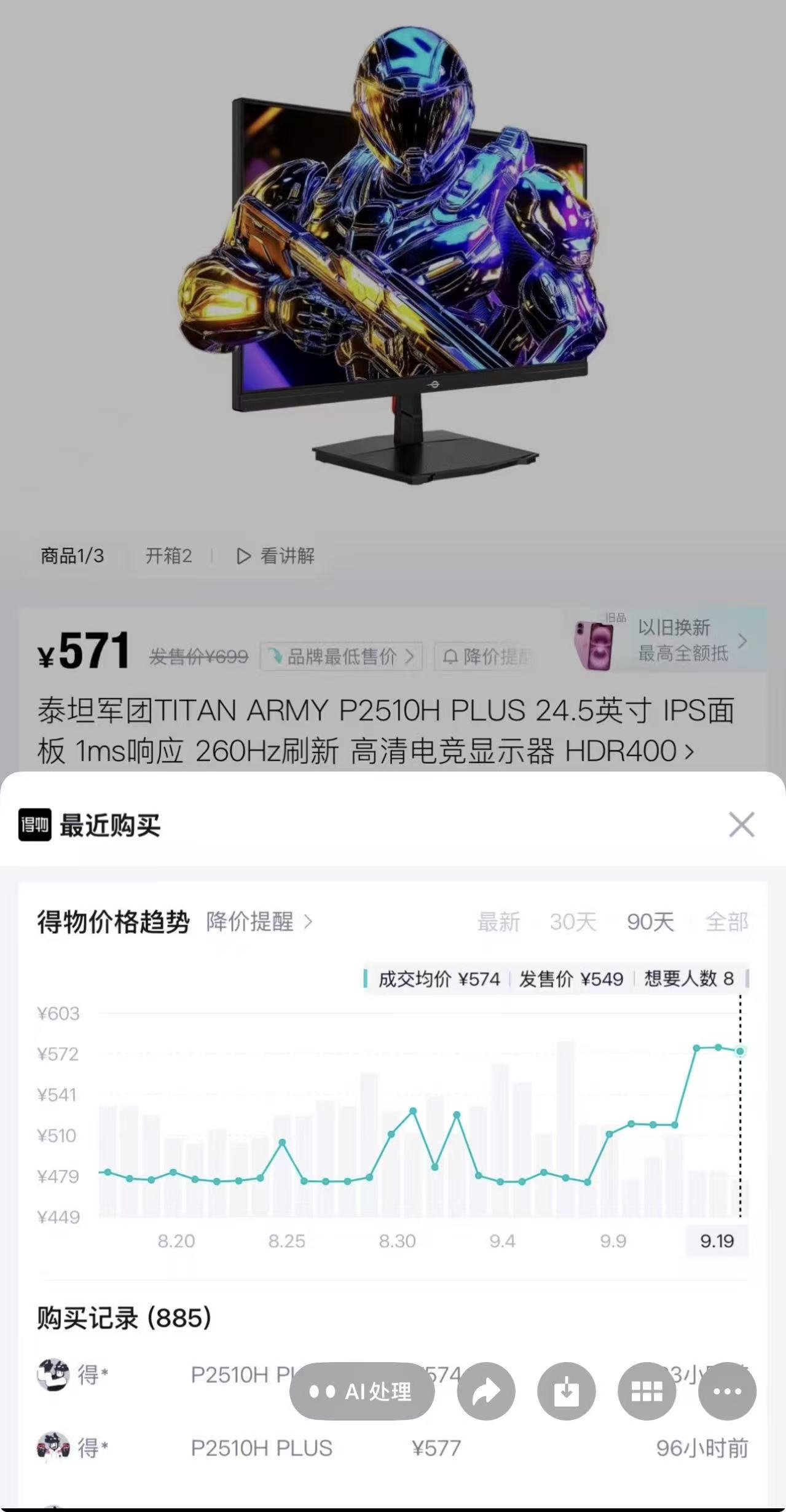
On September 20, NUPIAO checked a Titan Army monitor on Dewu APP. Data for the past 90 days showed that its price rose from 482 yuan to 547 yuan, an increase of 65 yuan, or about 13.49%.
In addition, NUPIAO checked a KTC display on JD.com. Data from the Manmanbuy app showed that the product had fallen to a 60-day low of 1,064.34 yuan on August 20, then began rising after September 10, with the latest price at 1,199.7 yuan.
KTC’s JD.com flagship store customer service told NUPIAO: “Prices sometimes change with promotion intensity or market fluctuations, so some products may go up or down in price.”
According to the latest report from RUNTO, the average online market price of gaming monitors in August was 1,168 yuan, up about 7.0% year on year.
The report noted that the root of this round of monitor price hikes lies in the continued accumulation, transmission, and release of cost pressure across the entire supply chain, including core components such as driver chips, motherboards, power components, and backlight modules.
On August 14,professional display brandKTC’s team released a “Statement and Commitment on Product Price Adjustments,” saying its monitor product line may raise prices later.
The team said continuous price increases for core components have sharply pushed up monitor production costs, making it hard for KTC to absorb the extra cost pressure alone. KTC said “the current pricing window still offers good value” and advised users with clear near-term buying needs to plan their purchase timing wisely.
Previously, RAM and hard drive prices had already risen.According to earlier reports fromDaily Economic News, reporters visited the Hangzhou Buynow Computer City and learned that ordinary consumers are facing steep increases in RAM and storage drive prices. One dealer said RAM and SSDs have risen so sharply that they feel nervous now and won’t stock too much. According to the report, some SSDs and RAM modules have doubled in price: a 1TB SSD rose from 500 yuan to around 1,000 yuan, while an 8TB SSD made for PS5 costs nearly 20,000 yuan—enough to buy three PS5 Pro consoles.
NUPIAO learned that behind the rising prices of displays, RAM, and hard drives is the ongoing memory-chip price wave driven by AI computing demand.
Monitors themselves are not memory-chip-intensive products, but the control boards, interface chips, and supporting electronic materials the industry needs are also in an overall tight semiconductor capacity environment. Procurement costs have risen in tandem, further amplifying cost pressure on complete monitors.
In September 2025, SanDisk was the first to announce a price increase of more than 10% on flash products for all channels and consumer customers, kicking off a new round of industry-wide price hikes.
Soon after, U.S. memory-chip giant Micron Technology notified channel partners that it was suspending quotes for all DDR4, DDR5, LPDDR4, LPDDR5, and other memory products, and canceling all agreed customer prices.
The global memory-chip market is currently in a structural supply-demand imbalance. The latest memory industry report from TrendForce notes that in the first half of 2026, contract prices for NOR Flash and SLC NAND niche flash memory rose cumulatively by 100%-120% and 130%-150%, respectively. The supply-demand gap is still unresolved in the second half, and both product types are expected to rise another 60%-75%; general-purpose TLC NAND contract prices rose 70%-75% quarter on quarter in Q2, while DRAM contract prices rose 58%-63% quarter on quarter, the highest single-quarter increase in nearly 15 years.
The core contradiction behind this situation is that the four major memory makers—Samsung, SK Hynix, Micron, and Kioxia—have proactively adjusted capacity allocation, shifting mature wafer processes on a large scale to HBM high-bandwidth memory and high-layer enterprise 3D NAND, which are essential for AI servers. This has squeezed the capacity available for consumer SSDs and portable storage.
Meanwhile, cloud providers such as OpenAI, Amazon, and Google keep locking in long-term orders to build large models. Storage configuration per AI server has expanded from a few TB to hundreds of TB, and massive enterprise procurement continues to drain spot inventory, forcing consumer electronics to bear the premium cost of limited remaining capacity.
In a major research report titled “Chipflation–Navigating A Memory Crisis” published in June 2026, Morgan Stanley proposed the concept of “Chipflation” and clearly stated that “this memory upcycle is not an ordinary cyclical recovery, but an AI-driven structural reset of the industry.” The bank believes AI has repriced memory resources such as DRAM, HBM, NAND, and enterprise SSDs, turning memory from an ordinary component into a “scarce strategic resource for computing power,” and the price upcycle could last through 2027.
In a memory-industry report released earlier this year, Goldman Sachs noted that the global memory market’s supply-demand imbalance has reached its highest level in nearly 15 years. It expects the global DRAM supply gap to reach 4.9% in 2026 and the NAND gap to reach 4.2%, a classic case of demand exceeding supply.