Reported by NUPIAO
On July 9th, MiniMax (00100.HK) faced its first massive post-IPO lock-up expiry. A staggering 153 million shares—accounting for 48.9% of the total equity—hit the market. With this flood of tradable shares suddenly available, the stock went on a wild ride. It opened low, spiked briefly, and then got slammed by relentless selling pressure, ultimately closing at 297.4 HKD—a brutal single-day drop of 17.98%.
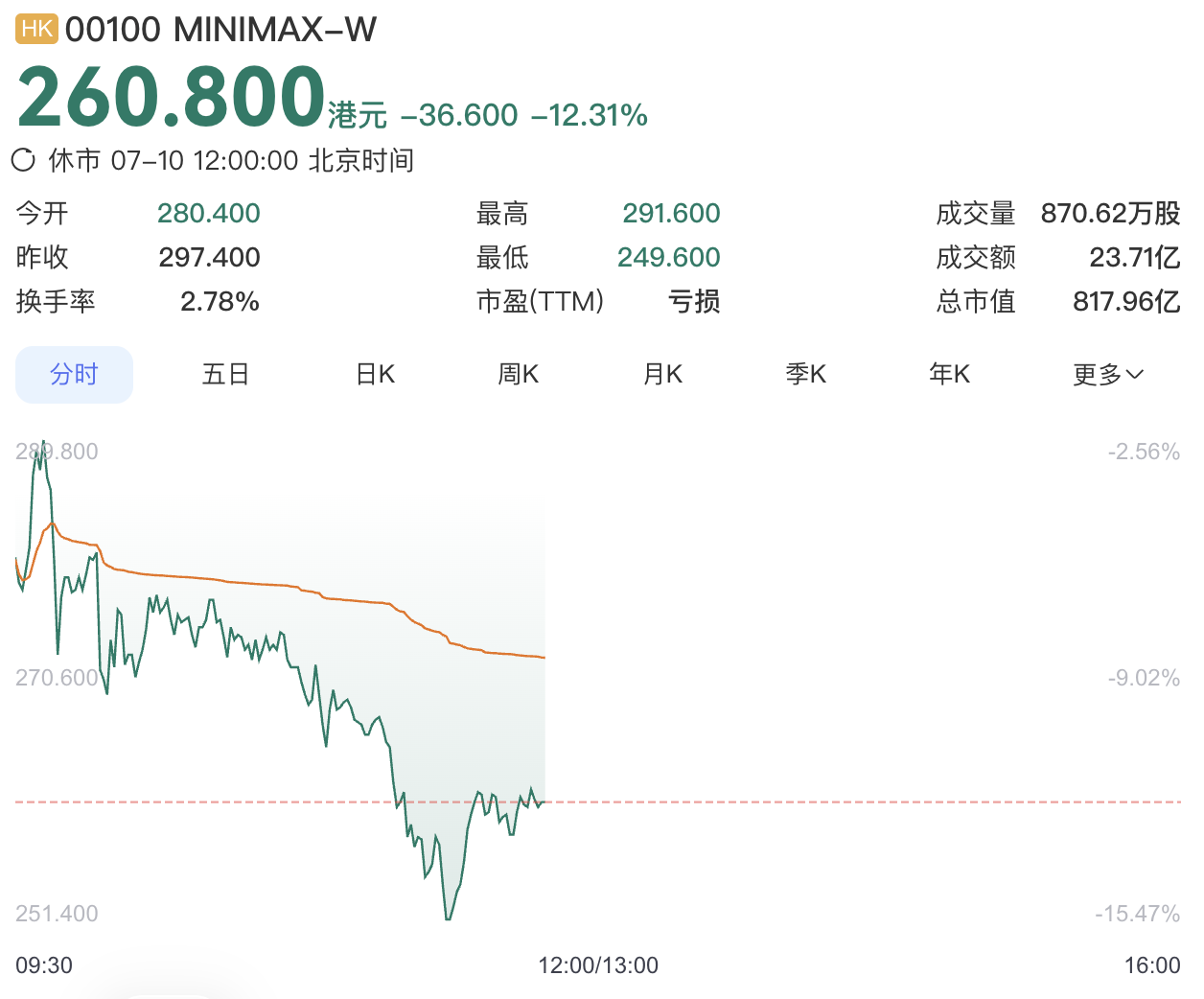
The bleeding didn’t stop on day two. On July 10th, MiniMax kept sliding, and as of this NUPIAO report, it was sitting at 260.800 HKD—down another 12.31%, leaving the market cap at 81.796 billion HKD. Let’s put that in perspective: back in March, the stock peaked at 1330 HKD, pushing the valuation past 410 billion HKD. Compared to that all-time high, MiniMax has now shed a whopping 80% of its value. All those investor fears about lock-up sell-offs and the slow pace of AI commercialization are clearly playing out right on the trading screen.
But here’s the standout move: today, MiniMax’s founder and CEO, Yan Junjie, fired off an all-staff letter to tackle the market chaos head-on, making it crystal clear that the company’s long-term game plan hasn’t changed.
He dropped a massive bombshell in that letter—effective immediately, he’s taking zero salary from the company until the day they actually achieve AGI (Artificial General Intelligence). And he’s not just stopping at words. Over the next four years, he’s carving out 4% of his personal shares (based on total company equity) to reward the team members who stick around and build real value together. Plus, he’s dedicating another 1% to set up a dedicated fund to keep backing open-source communities.
Yan also made a passionate point: the folks on the front lines know the real speed of tech evolution better than anyone else, and they understand the long-term value the company is stacking up right now. He’s throwing 100% of his time, energy, and resources into this mission, calling it a “long-term commitment as a founder.” He closed the letter with a powerful sign-off: “We will keep going until we get there. Intelligence with Everyone.”
And guess what else happened on July 10th? MiniMax locked in a fresh 16 billion HKD funding round. This deal pulled in a who’s who of top-tier global sovereign funds, long-term investors, elite Chinese institutions, and top multi-strategy funds spanning Asia-Pacific, Europe, and the US. We’re talking over 20 long-term and sovereign funds, with a bunch of pre-IPO and cornerstone investors actually upping their stakes in this round. Word is, over 100 institutions jumped in, oversubscribing the deal by 7x. The initial offering was around 1.8 billion USD, but thanks to crazy institutional demand, it ballooned past 2 billion USD.
With MiniMax’s cornerstone investor lock-up window looming, over 80% of the pre-IPO and cornerstone shareholders have flat-out stated they’re bullish long-term and holding onto their shares. The crowd making this pledge includes big names like Aspex, Boyu, IDG, Janchor, and Martis Fund, alongside state-backed players like China Life Investment and Xuhui Capital, and early backers like Alibaba, miHoYo, Cloudo Ventures, and Mingshi.
On top of that, MiniMax’s founding team voluntarily locked themselves up for 12 months—doubling the standard 6-month industry norm. So, this first wave of unlocked shares didn’t even touch the founders or employee stock pools.
Meanwhile, earlier in July, three global financial heavyweights—Goldman Sachs, Bank of America, and Citi—all slapped a “Buy” rating on MiniMax.
Goldman Sachs pointed out in its report that MiniMax’s M3 model hybrid pricing sits at $0.22 per million tokens. Thanks to a higher ratio of self-built, optimized computing power and an efficient architecture with smaller activated parameters, their gross margins are noticeably beating the competition.
Bank of America’s latest breakdown revealed a big shift in how MiniMax makes money. They noted that revenue, which used to be roughly 70% consumer products last year, is now shifting heavily toward enterprise and cloud API business, which has been bumped up to a higher strategic priority. On the profitability front, their previous M2.7 model eventually pushed inference profit margins past 40%. Even though the newer M3 has way more parameters, BofA believes that by constantly tweaking infrastructure efficiency, those long-term margins will stay rock solid.
BofA also highlighted that when it comes to grabbing compute power, MiniMax is playing it smart. By partnering with global cloud providers and new-age cloud vendors, they’re using local overseas compute to serve overseas users. They’re still securing compute reliably, and their in-house network and load optimization setups are slashing costs in a big way.
Citi is betting that MiniMax’s revenue growth will stay in the high zone. They’re also hinting that MiniMax’s upcoming next-gen video model could be the exact catalyst the market needs to flip its sentiment around.
Rumor mills in the market have been buzzing that MiniMax is cooking up a massive 2.7-trillion-parameter large language model. Internally dubbed M3 Pro, it could drop as early as Q3 this year, with plans to open-source it. This beast would dwarf their current flagship M3’s 428 billion parameters, potentially leveling up their game in complex reasoning and multi-step tasks.
Back in March, MiniMax dropped its first post-IPO earnings report. The numbers showed that for the full year of 2025, total revenue hit 79.038 million USD—a massive 158.9% year-over-year jump. Breaking it down, AI-native product revenue soared by 143.4% to 53.075 million USD, fueled by deeper user engagement, a stronger willingness to pay, and the ongoing rollout and commercialization of products like Hailuo AI. Meanwhile, open platform and other AI-based enterprise services skyrocketed by 197.8% to 25.963 million USD, mainly because the number of paying customers shot through the roof.
MiniMax’s products and services have already spread across over 200 countries and regions. In 2025, revenue from outside mainland China made up about 73.0% of their total pie.
Right now, the company is still in that grueling high-investment phase, constantly shoveling cash into compute procurement, model training, and global marketing, so they haven’t hit overall profitability yet. R&D and compute-related capital expenditures are staying sky-high, meaning they still need external funding to plug the cash flow gaps. The long-term profitability story still has to prove itself.
Zoom out to the whole domestic large-model scene, and you’ll see the competition has hit a white-hot level. Top players keep iterating their general models, vertical AI companies are constantly siphoning off client resources, and industry price wars are squeezing the profit margins out of API businesses. And overseas? It’s the same brutal story, facing off against native foreign large-model makers and other Asian AI outfits.
As some analysts see it, the market is fundamentally re-pricing AI companies. Just leaning on model parameters and flashy funding stories isn’t enough to prop up a huge valuation anymore. The real core metric that’ll dictate secondary market valuations is whether these companies can consistently deliver revenue growth and steadily narrow those losses.