Recently, Media Storm founder Tim (Pan Tianhong) mentioned while visiting a Feishu-related event that he has been trying to buy a RMB 5.1 million space ticket listed on Ctrip. Earlier, in an interview on Luo Yonghao’s podcast, he said his ultimate life goal is to go to Mars — and that he would even be fine “dying on Mars.”
According to product details from Honghu Yiyou, Ctrip’s high-end luxury travel brand, the ticket starts at RMB 5.1 million per person and connects to Virgin Galactic’s commercial suborbital flight program. It is currently the most expensive space tourism product publicly sold through domestic channels in China.
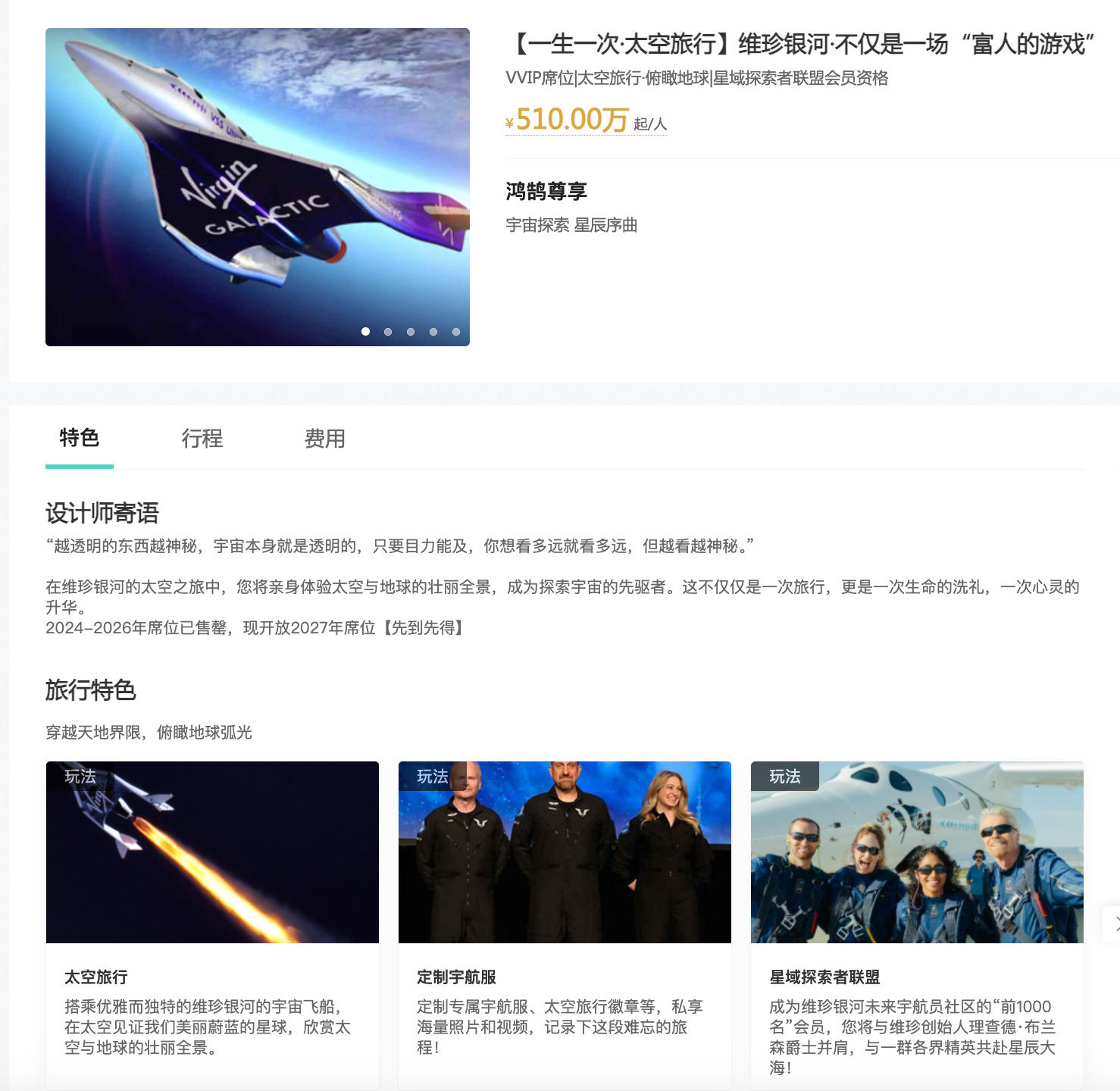
The platform says users who sign up now are expected to take the trip by late 2027. The whole journey lasts six days. For the first four days, travelers will undergo systematic training at Virgin Galactic’s astronaut base in Las Cruces, New Mexico — including putting on a custom spacesuit, simulated cabin training, getting familiar with the full flight process, and completing a comprehensive rehearsal before launch. Day five is the real flight day: travelers will board an air-launched spaceship for a roughly 90-minute suborbital flight, experience a few minutes of weightlessness at the edge of space about 80 kilometers above Earth, and look down at the curvature of the planet through the window. Day six is the return trip.
The fee covers accommodation, meals and airport transfers during the four training days, plus a custom spacesuit, an astronaut badge, a Space Explorer Association pin, and flight videos and photos. International flights, visas and insurance are not included. Participants must first pay a deposit of USD 100,000 to USD 150,000 to lock in a seat; the deposit is non-refundable if they cancel.
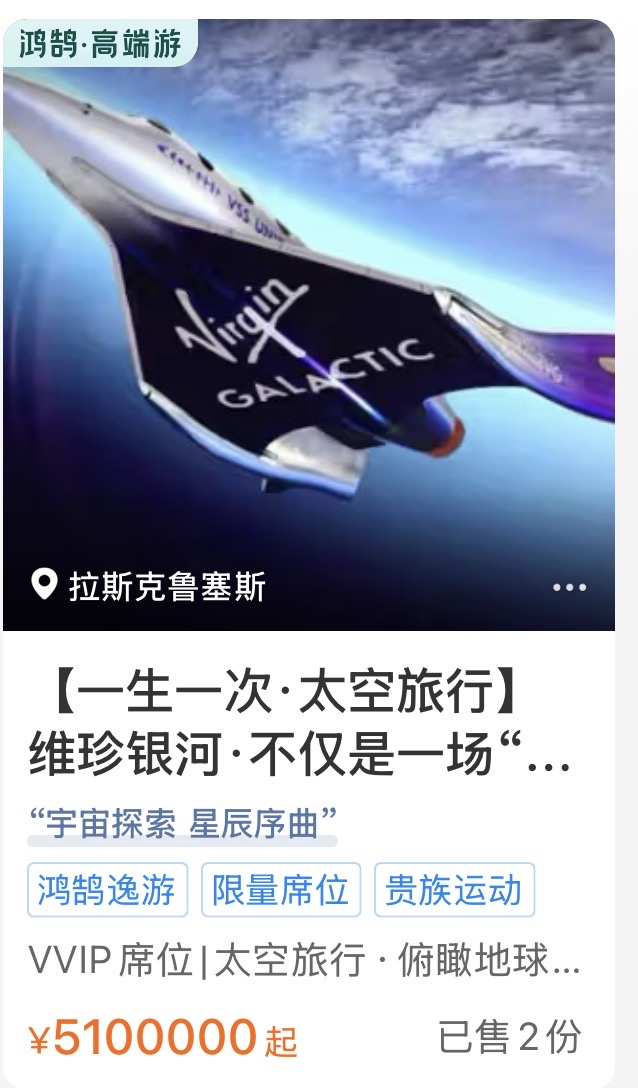
NUPIAO checked the Ctrip app and saw that the product has already sold two spots. However, according to earlier reports from Sichuan Observation and other media, about 700 reservations have been made worldwide. Seats are queued in reservation order and scheduled by Virgin Galactic.
Public information shows that Virgin Galactic was founded in 2004 by British billionaire Richard Branson and is headquartered at Spaceport America in New Mexico. It is one of the world’s earliest companies to make commercial suborbital space travel its core business. Unlike Blue Origin’s vertical-launch rocket recovery route and SpaceX’s focus on orbital crewed spaceflight, Virgin Galactic has chosen a more distinctive air-launched technical path.

Virgin Galactic uses a twin-fuselage jet carrier called WhiteKnightTwo to carry the spaceship to about 15,000 meters, then releases it. The spaceship immediately ignites its rocket engine, climbs to suborbital space at about three times the speed of sound, and shuts down its engine after reaching an altitude of about 80 to 100 kilometers. Passengers can look down at the curvature of the Earth through the windows while weightless, and the ship then glides back to the runway for landing. The advantage of this approach is that passengers do not have to endure the high g-forces of a vertical rocket launch, so the experience is relatively gentler.
In 2019, Virgin Galactic listed on the New York Stock Exchange through a SPAC, under the ticker SPCE, becoming the world’s first publicly listed commercial space travel company. At its peak, its market value came close to USD 10 billion. In June 2023, the company carried out its first fully commercial spaceflight mission, Galactic01, and has since completed several paid-passenger flights.
Still, this RMB 5.1 million ticket is more like a “futures ticket.” The main reason is that Virgin Galactic’s next-generation Delta-class spaceships have been repeatedly delayed. After VSS Unity completed its final flight and retired in 2024, all of the company’s commercial flight missions have effectively depended on the Delta-class ships being delivered on schedule.
According to Virgin Galactic’s second-quarter 2026 financial report, the company posted a net loss of USD 55.89 million for the period. That was narrower than the USD 67.28 million loss in the same period a year earlier, but revenue was only USD 134,000, leaving commercial income almost negligible. On its Q2 2026 earnings call, the company announced that the first commercial flight of the Delta-class spaceship would be pushed from fall 2026 to February 2027 because installation work was taking longer than expected.
In fact, before saying he wanted to buy a space ticket, the Media Storm team had already produced several space-exploration videos. In 2020, the team tied a 3-kilogram panoramic camera to a high-altitude helium balloon and sent it up to 30,000 meters to film the curvature of the Earth. The balloon also carried the dreams written down by 10,000 fans. In the video, Tim told the camera, “Let’s go be the people who chase the stars.” That video became one of the team’s early signature works.
In 2023, after two and a half years and more than RMB 3 million, the Media Storm team co-funded a custom satellite with Insta360; it was developed and built by the Changsha Tianyi Research Institute. On January 15, 2023, the satellite rode as a small payload on a larger BUPT satellite and was successfully launched into orbit by a Long March 2D Y71 carrier rocket from the Taiyuan Satellite Launch Center in a “one rocket, 14 satellites” launch.
In the video, the team put the dreams of more than 5,000 fans on a screen in rotation, completing a creative project that “took fans’ wishes to space.” The video has received more than 14 million views on Bilibili, and Tim himself called it the best video the company has ever made.