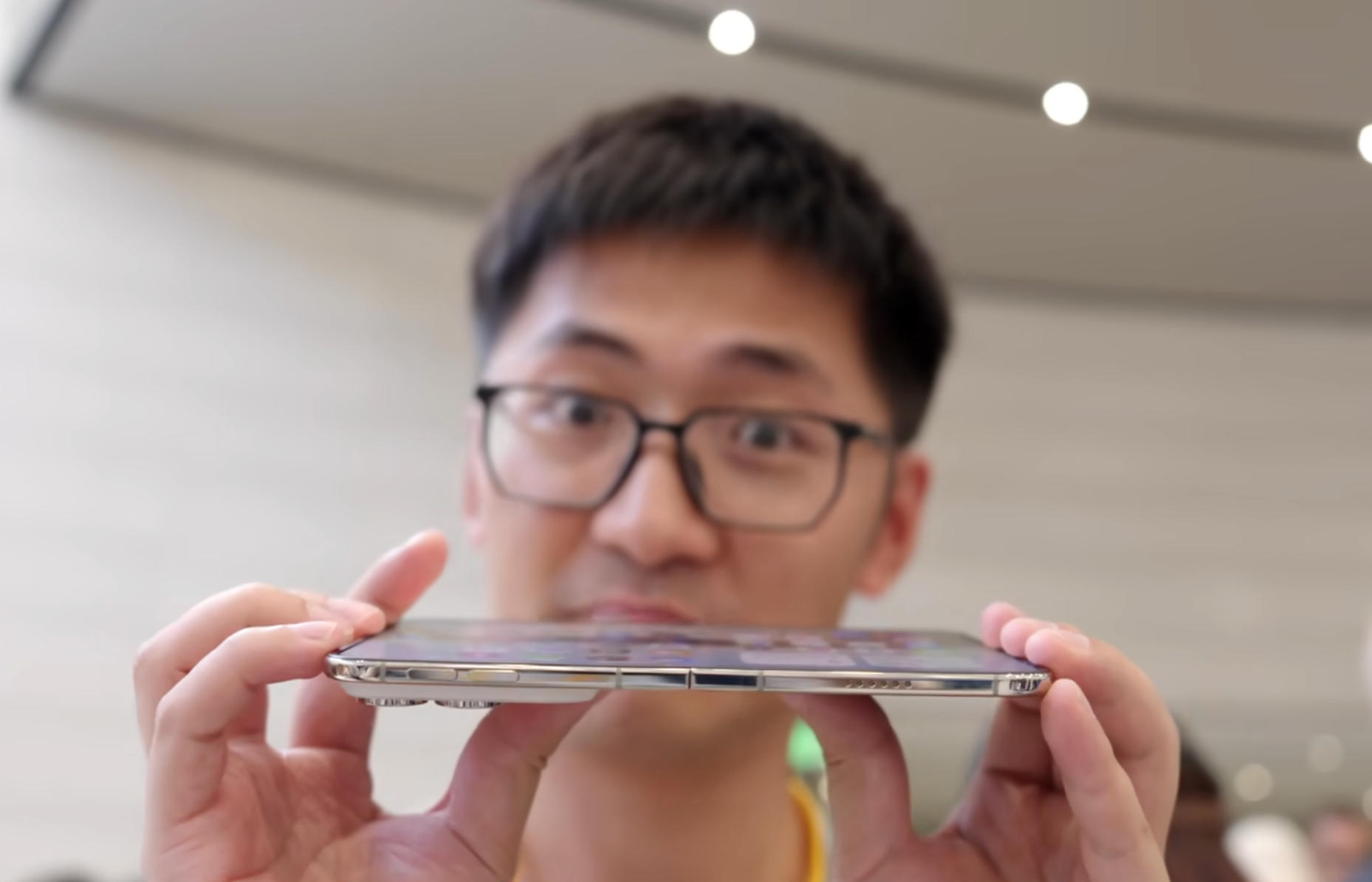
On September 17, the embargo lifted on hands-on experiences with Apple’s first foldable phone, the iPhone Duo. In his review video, Tim (Pan Tianhong), founder of leading tech video team Media Storm, revealed that on launch day he did a “reverse bend” test on the iPhone Duo in Apple’s demo area—and when he reviewed the footage, he noticed the outer screen had already started flickering.
He later said in the video that he “absolutely did not bend it hard,” and argued this shows foldables are fundamentally different from traditional slab phones when it comes to reliability.
Tim also called out a few iPhone Duo downsides in his review. For example: it gets seriously hot near the camera when recording video or running high-load tasks; the inner screen scratches easily from small debris like little stones; the under-display camera image quality is weak; side-mounted fingerprint, dropping the physical mute switch, and eSIM-only support all cause inconvenience; and on the software side, you can’t log into tablet WeChat, there’s no dual WeChat, and the split-screen ratio is fixed.
Angry Miao founder Li Nan quickly posted a rebuttal. Li Nan was previously a lead writer at ifanr, joined Meizu in 2012, and served as CMO and senior vice president, president of the Meizu Blue business unit. He led Meizu’s brand rebuild and helped secure $59 million in funding from Alibaba. After leaving Meizu in 2019, he founded Angry Miao, which mainly makes high-end mechanical keyboards, mousepads, and other digital accessories.
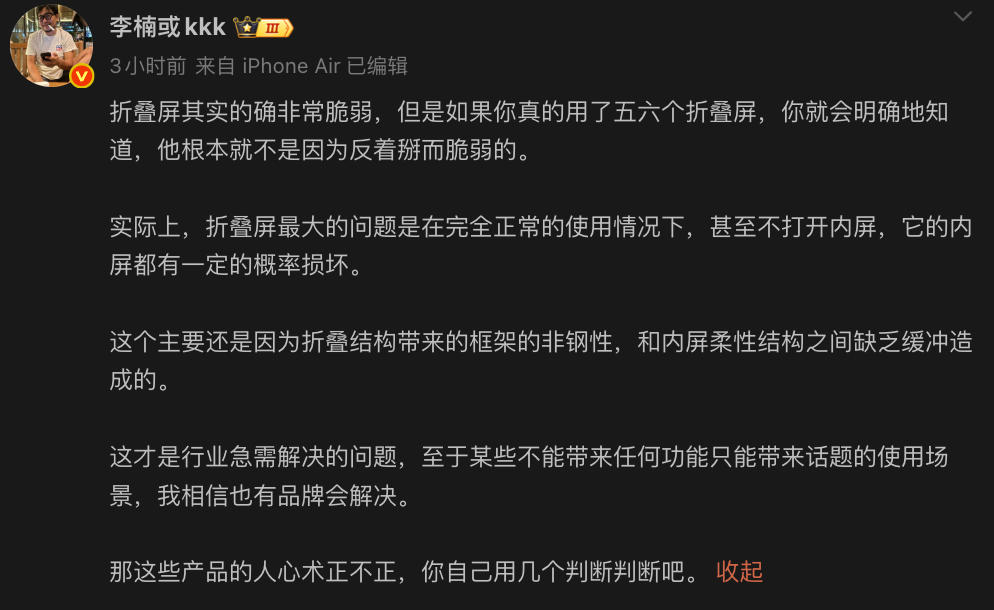
He believes industrial design, reliability testing, and quality standards should all be validated against normal user scenarios. The hinge already passes opening and closing to 180 degrees—”what product function is reverse bending supposed to serve? The traffic and topic function?” In his view, foldables are indeed very fragile, but not because of reverse bending. In fact, under completely normal use, even without opening the inner screen, the inner screen has some chance of getting damaged. This is mainly because the folding structure makes the frame non-rigid, and there’s a lack of buffering between that and the flexible inner screen structure. That’s the problem the industry urgently needs to solve.
That said, some netizens argue that “reverse bending” isn’t completely divorced from real life. For example, putting the phone screen-down on a sofa and sitting on it, side compression in a pocket, or twisting inside a backpack can all create reverse torque on the hinge. These aren’t intended use cases, but they’re foreseeable, high-frequency misuse scenarios.
Worth noting: right now, the foldable industry lacks a unified reliability evaluation standard. Major manufacturers usually publish hinge cycle counts (such as 200,000+ certification), dust and water resistance ratings, UTG glass material, and other info, but details of their test methods are generally not made public. And almost all of them are based on the single action of normal opening and closing; side pressure, torsion, particle ingress, temperature swings, and other non-axial load scenarios are rarely disclosed.
As Apple’s first foldable phone, the iPhone Duo carries high expectations, and the attention is obvious. It uses a horizontal book-style inward fold design. At the launch event, Apple repeatedly stressed its “full reliability,” claiming the custom variable-torque design consists of more than 100 precision components and uses a nano-textured surface layer to reduce the crease. It also boosts overall rigidity through multi-layer lamination, support ribs, a titanium alloy frame, and other structures, with overall screen rigidity 40% higher than other displays in the industry.
Apple China’s official website shows the iPhone Duo comes in four storage versions: 256GB at 15,999 yuan, 512GB at 17,999 yuan, 1TB at 21,499 yuan, and 2TB at 26,499 yuan. Global versions support eSIM only, and the China model also mainly relies on eSIM; this is Apple’s highest-priced iPhone to date. The iPhone Duo will open preorders at 8 p.m. on October 16 and go on sale October 23, when more real-user impressions and after-sales cases will emerge.