NUPIAO Reporter |
NUPIAO Editor | Wen Shuqi
“Most of last year’s calls were right, but a little too conservative.” Lin Fan recently sat down with NUPIAO for an exclusive interview and once again shared his read onAItalent. He said competition for foundation-model talent among big tech companies and top startups has only gotten fiercer this year. For AI talent in areas like pre-training, post-training, and inference optimization, some fresh graduates are already pulling in salaries in the millions — even tens of millions of yuan a year.
Back in August last year, Lin Fan told NUPIAO that “big companies’ high-pay poaching ofAItalent could last another six months.” In his view, this year’s change is coming from the application layer. As foundation-model capabilities improved across the board,Agentsuddenly took off, and the overall talent expansion trend is still going.
Recruiting data tells the story even more directly. According to Lin Fan, AI talent hiring on the Maimai platform grew another7.9times this year. Right now, 30% to 40% of open roles on the platform are alreadyAIrelated.
Among them,FDE(forward-deployed engineer) postings jumped1523%year over year, while world models andAgentdevelopment rose645%and436%respectively. Roles in compute scheduling and embodied intelligence are also expanding fast.
Since the fourth quarter of last year, becauseCoding Agenthas evolved so fast, not only are traditional operations, marketing, and design roles shrinking noticeably — traditional programmer jobs are starting to feel the pressure too. Demand for NLPalgorithm roles fell62%, speech synthesis dropped43%, backend development fell41%, and frontend development, data product managers, test development, and other roles all dropped more than20%.

In the interview, Lin Fan said the vast majority of white-collar work can be done withCoding Agent. That led him to a new call: next year, tech companies will hire onlyAItalent — no more non-AIhires.
Several signals support Lin Fan’s view. For one,AIhiring is growing by orders of magnitude every year, and in big-company campus recruiting, 80% to 90%of roles already explicitly requireAIapplication experience. On the other hand, inside organizations,AIadoption is moving very fast. For example,OpenAIneeded only9months to go from only programmers usingCodexto legal, finance, and other back-office teams using it more than4hours per person per day.
“People who useAIcan produce two or three times more than people who don’t. If a company pays the same salary — or even a30%premium — which kind of person do you want? The answer is obvious,” Lin Fan said.
Below is a transcript of the conversation between NUPIAO and Lin Fan (lightly edited):
High-pay poaching ofAItalent will continue for another year
NUPIAO: We talked a lot aboutAItalent last year, and you made quite a few predictions. Looking back at this year, what was right, and what has changed?
Lin Fan:Most of last year’s calls still hold, but some were too conservative. For example, last year I said the talent war would last at least another six months; now poaching is still going on. Last year the core battle was for foundation-model talent. Now it’s even more intense, and pay has reached eye-watering levels — fresh graduates can get annual salaries in the millions or even tens of millions of yuan.
The real new change this year is at the application layer. As foundation-model capabilities got stronger overall,Agentsuddenly took off, getting hotter and hotter starting withOpenClawearly this year. Two kinds of talent are growing fast: application development talent — people who buildAgentproducts — and application-effectiveness talent, the business-side people who actually putAIandAgentto work. So the overall expansion trend is still with us.
NUPIAO: Is the demand growth mainly for technical talent or product talent?
Lin Fan:The line between technical and product roles is getting blurrier. WithCoding Agentbecoming popular, a lot of product people can do technical work, and a lot of technical people can do product work, so demand for hybrid talent keeps rising. The technical gap is bigger; product has a gap too, but not as large.
NUPIAO: Is high-pay poaching happening only among big companies, or are startups joining in too?
Lin Fan:Startups are in it too. They’re raising a lot of money now, and both sides are poaching like crazy. Compared withGPUcards, people are still cheap. Big companies are still poaching from each other, and because the flow is bigger this year, many people jump to new companies and end up building teams with former colleagues.
Our data shows thatAIjob expansion is mainly being absorbed by companies with more than 1,000 employees. This year, companies with more than 10,000 employees account for33.49%ofAIroles, while 1,000-person companies account for30.33%. Together, the two groups make up63.82%, compared with2025‘s61.61%, up2.21percentage points. Micro and small businesses are growing fastest, but they aren’t the biggest contributors. Companies with fewer than 100 employees sawAIjob demand grow1040.57%year over year — the highest growth rate among all company sizes.
NUPIAO: How long will high-pay poaching last?
Lin Fan:Conservatively,the trend will continue for at least another year, and the scale is still expanding. Overall,AIis spreading extremelyfast, and demand for talent will keep growing. Last year,AItalent hiring grew10times over the year before, and this year it grew7.9times over last year — demand is expanding by orders of magnitude, but theAItalent supply across society is not expanding by orders of magnitude.
NUPIAO: But from our conversations with some tech talent, many people think this round of high pay won’t last very long.
Lin Fan:We always look one year out. The biggest variable is how strongAGIactually gets. If it becomes extremely capable, many jobs won’t need people, and naturally there will be no need to poach or spend big. If it still needs people to do the work, there’s still room for poaching.
NUPIAO: Robotics fundraising has also been very active this year. Has hiring demand clearly increased?
Lin Fan:Hiring in embodied intelligence is growing very visibly too — roughly10times.That said, embodied intelligence still can’t outbid foundation-model companies for talent today, and there’s a clear trend of people from autonomous driving, large models, and the auto industry moving into embodied AI. This isn’t just happening in China — the US is also moving quickly into embodied intelligence.
Next year, tech companies will hire only AI talent
NUPIAO: How does Maimai defineAItalent?
Lin Fan:The first group is foundation-model talent — people doing pre-training, post-training, and modelInfrawork. The second is application development talent — people buildingAgentproducts and using things likeRAG. The third is application-effectiveness talent: people in every role who useCoding AgentandAgenton the job—editors useAgent,HRusesAgent, operations usesAgenttoo. The third group is the largest.
NUPIAO: What factors led you to conclude that next year companies will hire onlyAItalent?
Lin Fan:First, from last year to this year,AIhiring has grown by an order of magnitude every year. Another order of magnitude, and every tech company will be hiring onlyAItalent.
Second, in big companies’ campus recruiting, 80% to 90%of roles already haveAItalent requirements. Whether it’s an application role or a product role, they want a strongAIapplication background.
Third, inside organizations,AIadoption is moving extremely fast — faster than thePCinternet and mobile internet eras.OpenAItook9months to go from only programmers usingCodexto legal, finance, and other back-office teams using it more than4hours per person per day. Inside Maimai, we were about6months behind; this year, in month4, we began upgrading the organization, and it should be done by the end of the year. For tech companies, theAgent-ification process can be done in less than a year; non-tech companies may need two or three years.
There’s another very important reason:AIis driving productivity gains that are just too big. People who useAIcan produce two or three times more than people who don’t. If a company pays the same salary — or even a30%premium — which type of person do you want? The answer is obvious. So next year, basically everyone will hire onlyAItalent.
NUPIAO:AIera — has the way talent is evaluated changed?
Lin Fan:In resume screening, the basics haven’t changed much. If they look atC9, they still look atC9; if they look at985or first-tier universities, they still do. But people withAIskills will stand out more. The subtle change is in interviews: most interviews used to focus on whether you had done this kind of work before. In theAIera, experience matters less and less in interviews, while intelligence and the ability to work withAImatter more and more.
BecauseAIalready has most of the experience. In the past, an apprentice needed a year or two to get up to speed; now a smart person who knows how to useAIcan produce good results in maybe one or two months. New hires ramp up faster, cost less, and have more drive — so the company’s choice is pretty clear.
NUPIAO: How do you interview for something like “smart”? Will talent screening become fuzzier?
Lin Fan:It really does get fuzzier. I often talk withHR,HRsays the boss wants smart people, but how do you interview for “smart”? One of the most effective ways is to put someone in front of a real problem and have them solve it withAIon the spot.AIis fast — maybe20minutes, and the result is right there.
Another lazy but effective method is to look at the school. The gaokao itself is a huge screening mechanism in China, so talent from Tsinghua and Peking University is increasingly valuable — when you can’t tell people apart, hiring from Tsinghua or Peking University is always a safe bet.
NUPIAO: What changes do these shifts bring to recruiting?
Lin Fan:The whole recruiting approach will change. First,HRused to have solid experience in who to hire and how to hire them; now many companies don’t even know who they should hire in theAIera. Second,AItalent doesn’t apply with a resume — you have to go hunt them down. TheAIcircle has a strong culture, and the people you want to poach all know each other, so getting into that circle matters. Third, retention has become a big problem.AItalent can join, decide in two or three days that the company isn’t good enough, and leave immediately.
Maimai is focused on three things. First, tagging the three types ofAItalent on the platform so companyHRcan see and find them clearly. Second, launching a recruitingAgentthat letsHRget candidates directly through conversation. A quick tip forHR: if you reach out to candidates, chances are they’ll ignore you — but if aCTOor evenCEOcomes to poach them, talent is still willing to talk. Third, Maimai’s employer-brand product helps companies attract people externally and retain them internally. Of these3features,AItalent tags and employer branding are already live, and theAgentrecruiter is about to launch.
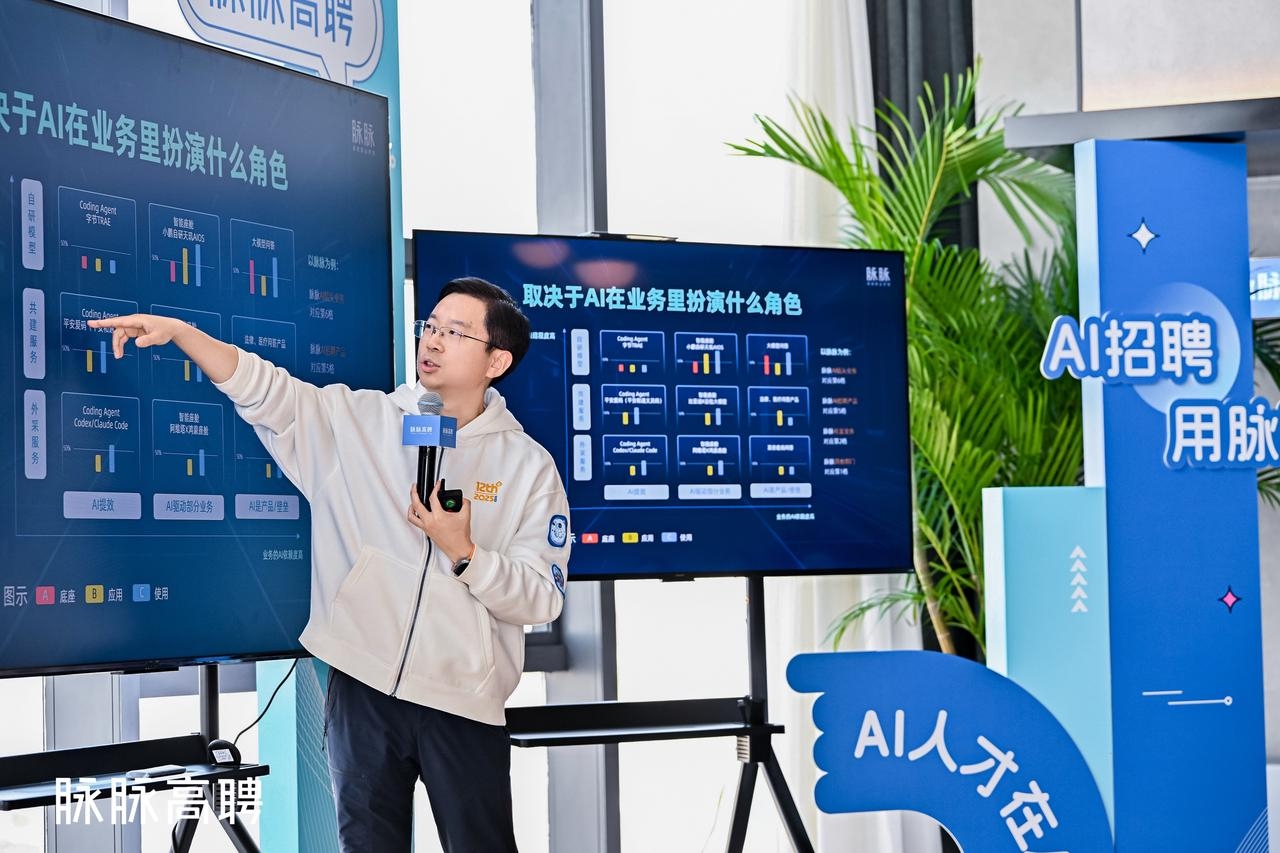
AIcan not only replace multiple job types — it can actively grab work
NUPIAO: You went to the US last month. What new changes did you see?
Lin Fan:First, foundation-model intelligence is still developing at high speed, and it’s likely even faster than in the past year. The technique ofAIimproving itself(RSI)is being used more and more at major foundation-model companies.
Second, startups are shifting more toward “job replacement.” AfterCoding Agentproved it can replace programmer efficiency, people realized that the vast majority of white-collar work can be done withCoding Agent, and each job-type replacement is a tens-of-trillions-dollar business. In the past, the US mainly targeted high-income groups like lawyers and doctors — for example,Harveybuilt legal tools. But nowLinkedInis going afterHRjob replacement, and all kinds of startups are building replacements for different job types. Model intelligence is good enough, and prices are cheap enough, so solutions for replacing non-high-income jobs are starting to appear too.
NUPIAO: Was there anything that surprised you?
Lin Fan:In the past, employees assigned work toAgent, but nowAgenthas evolved to actively grab work. For example, after some products connect toSlackcompany group chats,Agentsees a topic and proactively says, “I can help you with this — do you want me to do it? Just confirm.” When it hits an incident-level issue, it will even say directly, “Here’s what went wrong online today, I found the fault, and it’s already fixed.”Agenthas gone from passively taking work to actively grabbing it.
NUPIAO: China doesn’t seem to be seeing this trend yet?
Lin Fan:Our models are about3to6months behind overseas, and the application layer may be another1to1and a half years behind. Labor is expensive overseas, so there’s a stronger incentive to replace it; in China, labor isn’t that expensive yet, so the need isn’t as urgent. But once the trend takes shape, China will catch up fast.
NUPIAO: But in China, the trend ofAIreplacing programmers has started to appear.
Lin Fan:That trend is fairly visible, but I wouldn’t call it complete replacement. We have a big-picture call: programmers won’t lose their jobs. Because once programmers addCoding Agent, they’ll move into industries that previously couldn’t afford programmers.
I often joke that the internet industry spent20years splitting the programmer role into many roles—frontend, backend, testing, data analysis, and so on. WithCoding Agent, the whole industry may spend the next two to three years merging those roles back into one person. A big company that used to need10,000 programmers. In the future,5000or even3000would be enough. The programmers who are freed up will go to small and mid-sized companies, and then further down into agriculture, logistics, retail, and other traditional industries that previously couldn’t afford programmers.
NUPIAO: From our visits, many Chinese companies are still at a fairly early stage inAIadoption. Is it a bit hard to talk to them aboutAIreplacement at this point?
Lin Fan:It’s normal that usage is still basic — the tools aren’t good enough yet. But the bottleneck isn’t the model—the model itself is already strong enough. The bottleneck is at theHarnesslayer: for each job type, you need its context and best practices to serve that job well. We ran an experiment: asking a large model directly to write a strategic analysis report got a model score of about75; adding a distilledSkillto guide the model pushed it to90. Today, every industry and every job type lacks this kind ofHarness. UsingOpen AIas a reference, once the tools mature,Agentadoption at companies will likely take6to9months to go from “some people find it useful” to “everyone uses it every day.”