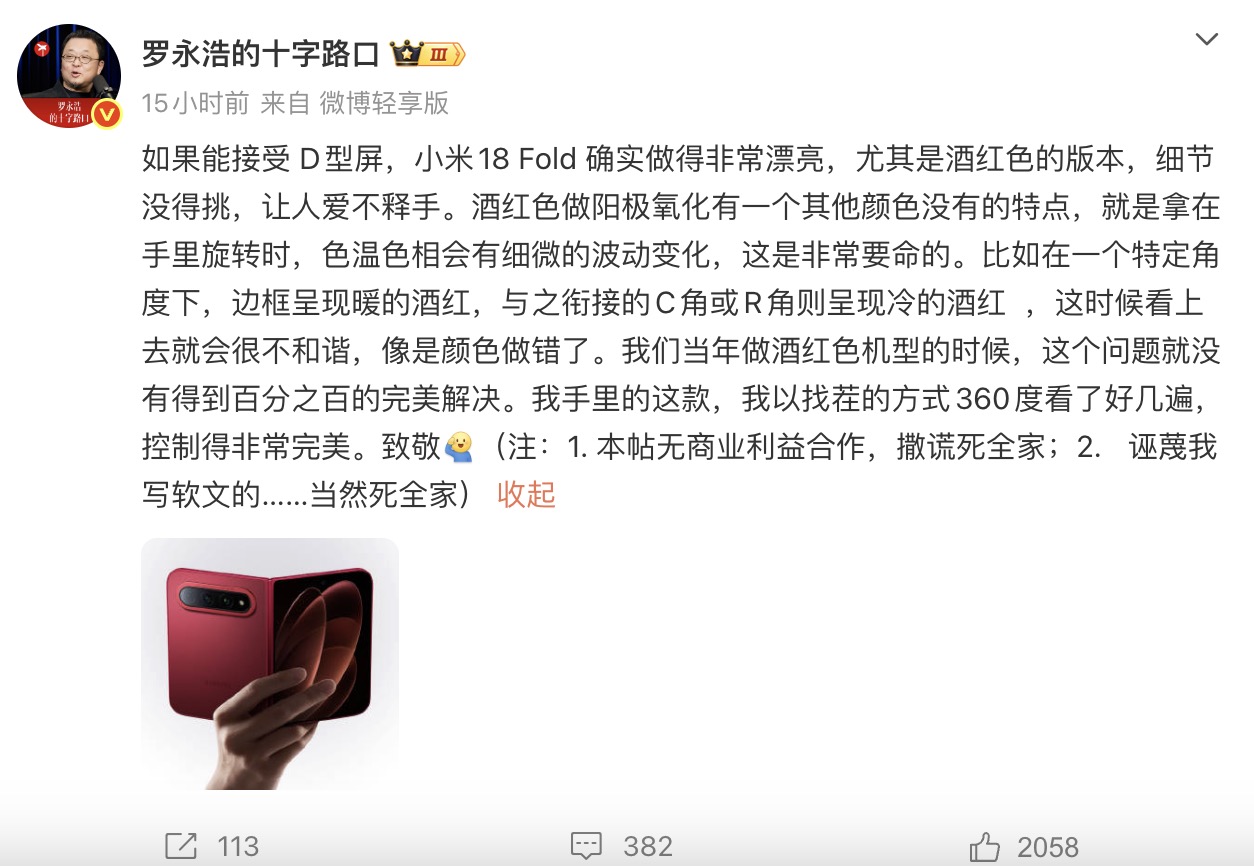
On the evening of September 23, Luo Yonghao posted on his social media account, giving his take on Xiaomi’s newly launched mid-fold device, the Xiaomi 18 Fold. He praised the craftsmanship details of the phone and made it clear in the post that there was no commercial partnership involved.
In the post, Luo said that if you can get past the D-shaped screen, the Xiaomi 18 Fold is genuinely beautifully made—especially the burgundy version. The details are flawless, and you just can’t put it down.
The D-shaped screenrefers to the special display on the Xiaomi 18 Fold’s outer screen—straight on one side and curved on the other, forming a “D” shape. It’s designed for a slim body and wide field of view, though it does come with the trade-off of visual asymmetry.
As a former smartphone entrepreneur, Luo also noted that the Xiaomi18 Fold‘s anodized burgundy finish has a characteristic no other color has: when you rotate it in your hand, the color temperature and hue shift ever so slightly. Back when he was making burgundy phones himself, he never managed to solve that issue perfectly. He also stressed, “This post is not a sponsored piece, and there’s no commercial partnership.”
The post drew a flood of comments. One user wrote that as a former phone industry insider, Luo’s assessment carries real weight.
The Xiaomi 18 Fold officially launched on September 7 and went on sale September 10, starting at 10,999 yuan. It’s Xiaomi’s first mid-fold phone, featuring a 5.38-inch outer screen paired with a 7.58-inch inner display, with a focus on a slim, lightweight folding experience. According to third-party industry monitoring data, the device racked up nearly 80,000 activations in its first seven days on sale—though Xiaomi has not confirmed this. As of now, Xiaomi has not responded to Luo’s public comments.
Luo Yonghao founded Smartisan in 2012 and entered the smartphone industry. In the early days, he attracted a lot of attention with his highly personal product philosophy and launch events. But the company later struggled with production capacity, funding, and supply chain pressures, and its phone business kept losing money. In 2019, Smartisan fell into a debt crisis, and Luo left the phone business to start paying off debts. Since then, while he no longer develops phones himself, he still frequently shares product-level reviews of new phones from major brands on social media as a former hardware industry insider.
Since the Smartisan days, Luo has commented on phones from Xiaomi, Apple, Samsung, vivo, and others at launch events and on social media—sometimes praising them, sometimes criticizing.
Luo’s proactive emphasis that there’s no commercial deal with Xiaomi this time is tied to the ongoing public opinion storms he’s been facing lately.
Just half a month ago, Luo was questioned by many netizens for “taking money to do a job” after he publicly mentioned that he “missed Chicecream.” People thought his comments were paid hype ahead of the brand’s relaunch.
On September 12, Luo posted about his personal tasting experience, saying that after trying “Mr. Yeti” ice cream at the airport, he felt the product was “just so-so,” and considering the price, “you could even call it bad”—”way worse than Chicecream, I miss Chicecream.” At the time, he also noted in the post that this was just a normal consumer review and question, and asked people not to accuse him of sabotage or anything like that. He also mentioned thatChicecream had gone bankrupt.
Later, according to the National Enterprise Bankruptcy Reorganization Case Information Network, on September 14, the administrator of Chicecream Food (Shanghai) Co., Ltd. issued an announcement stating that the company’s intangible assets had been fully carved out. The announcement showed that on May 7, 2026, 508 intangible assets under Chicecream’s name—including 492 registered trademarks, 8 licensed patents, and 8 copyrights—were bundled and auctioned off on JD.com’s judicial auction platform.
On September 15, media reported that Chicecream had changed hands and would appear at the Tianjin Ice Expo on September 16.That night, Luo posted again, saying that Chicecream’s two biggest PR disasters were actually both unfair: the “ice cream that won’t melt under a lighter” was a pseudoscience frenzy; and “it’s just this expensive, buy it or don’t” wasmaliciously edited—the original context was aimed at raw material suppliers, not ordinary consumers.
According to NUPIAO, at a media briefing on September 16, Chicecream’s new brand owner, Zhongxuegao Brand Management (Shanghai) Co., Ltd., responded: “We believe that whether something tastes good or not is a normal subjective evaluation by consumers—a thousand people, a thousand tastes. Chicecream hopes to gain recognition in the future, but we won’t shy away from criticism. We welcome all consumers, including Mr. Luo Yonghao, to review and critique our products when they relaunch.”
At the same time, the Chicecream brand firmly stated its opposition to all forms of unfair competition. Chen Dacheng, CEO of Zhongxuegao Brand Management (Shanghai) Co., Ltd., also said he’s a customer of Mr. Yeti and “quite likes the rice flavor and the pistachio flavor.”
On September 16, after four days of silence following Luo Yonghao’s public criticism that it was “bad,” Mr. Yeti also broke its silence and posted on official channelssaying, “Thank you all for your long-term care and support for Mr. Yeti. We will listen carefully to the opinions and suggestions of our customers, strive to do better, and bring more delicious Eastern Gelato to consumers. Mr. Yeti also announced the upcoming launch of an ice cream harvest festival.
Also, on September 22, in response to listeners asking for updates, Luo said he would pause updates to his interview podcast “Luo Yonghao’s Crossroads” and did not give a specific return date. He replied on social media that because he’s caught up in a public opinion storm and wants to avoid dragging down the guests who appear on the show, the podcast will in principle be suspended, with several already-recorded episodes not being released for now. The podcast launched in August 2025, focusing on long-form interviews with figures in business and culture. In its first year, it racked up over 349 million plays across all platforms.