The “frog son” that once flooded WeChat Moments has finally reached its goodbye moment, more than eight years after hopping into the Chinese market.
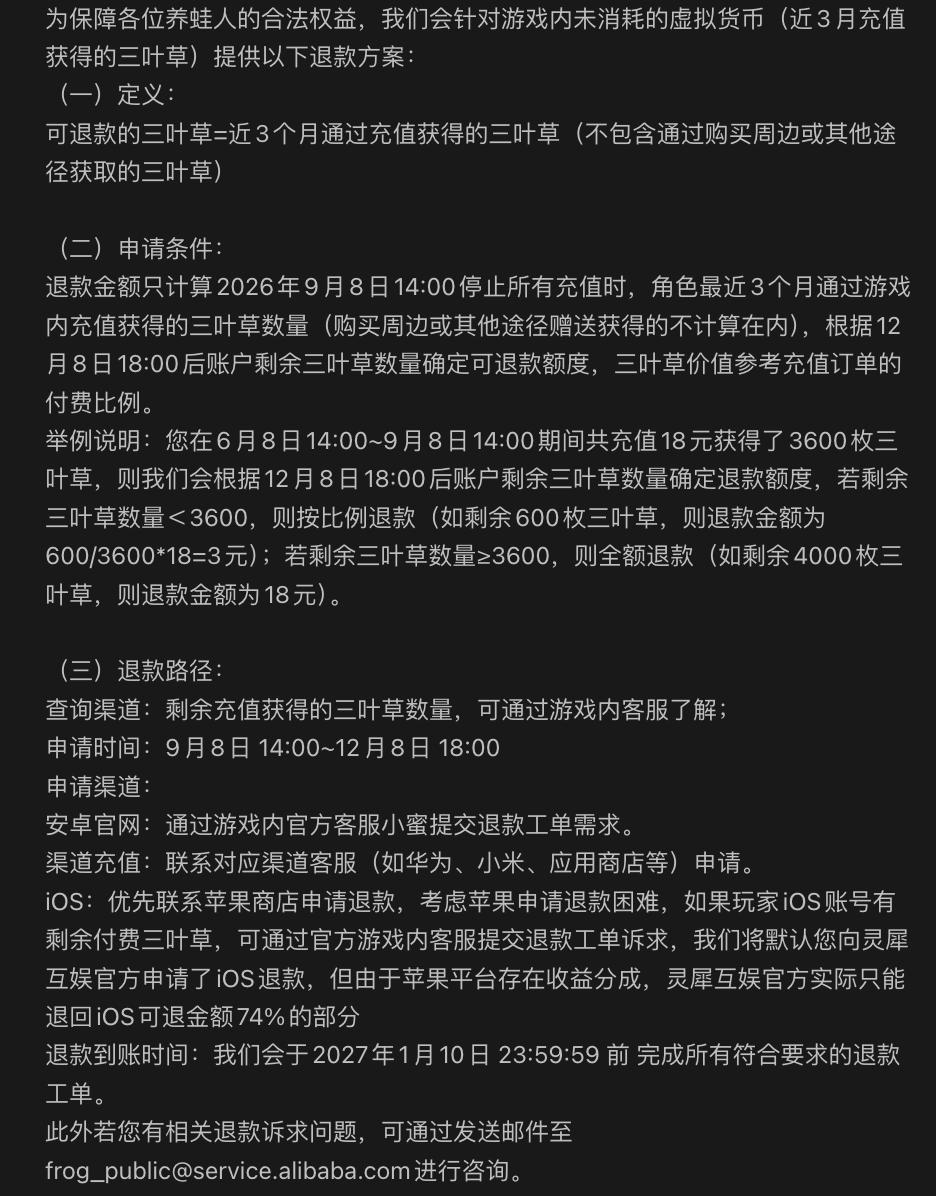
On the afternoon of September 8, the official team behind Travel Frog: China Journey issued a shutdown notice. It said that because the IP licensing cooperation has expired, the China server will officially stop operating at 18:00 on December 8, 2026. All game servers will be closed, the official website will be taken down, and all account data and character information on every server will be wiped. The refund channel for players’ remaining paid virtual currency also opened at 14:00 that same day.
This shutdown is a separate operating adjustment for the mainland China licensed version. The original Japanese game is still running normally and is not affected by the China shutdown.
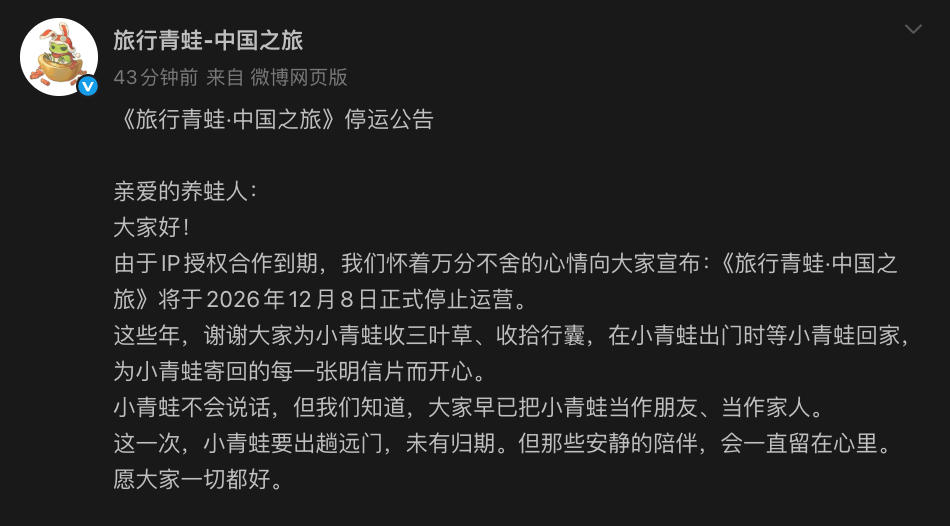
According to the announcement, starting at 14:00 on September 8, Travel Frog: China Journey will close game download access across all platforms, stop all in-game top-up channels and new-user registration. Players will no longer be able to download the game or make purchases. At 18:00 on December 8, the game will officially cease operations, servers will be shut down, the official site will be removed, and players will not be able to log in through any channel.
As for refunds, operator Lingxi Games has set specific rules for unused in-game virtual currency. Refunds will only cover unused clover obtained through top-ups between June 8 and September 8, 2026. Clover given through merchandise purchases or other events is not eligible.
The refund amount will be based on the eligible clover left in the account when the servers close on December 8, with its value converted according to the actual payment ratio of the corresponding top-up order. Applications can be submitted from 14:00 on September 8 to 18:00 on December 8.

The original Travel Frog was developed by Japanese game company Hit-Point. The Android version launched in Japan on November 24, 2017, and the iOS version arrived on December 6 that same year. The game is built around a laid-back idle style: players just prepare a bento, amulet and items for the frog, and it heads out on its own, randomly sending back postcards and local specialties. It may also eat, read or whittle wood at home. There are no complicated controls, no competition and no social pressure.
That extremely simple game suddenly exploded in China in early 2018, without any warning. Even with no official Chinese version and no marketing push, Travel Frog passed 3 million total iOS downloads in China and held the top spot on the App Store’s free games chart for days. Terms like “frog son” and “old mother” went viral, players shared the frog’s travel postcards on their own, and a unique “frog-raising” social culture took shape.
On April 2, 2018, Alibaba Group announced a strategic partnership with Hit-Point and secured exclusive publishing rights for mainland China, with Lingxi Games handling operations. In May that year, Travel Frog: China Journey began internal testing and gradually moved into open beta.
The China version kept the original core gameplay but added local touches. The frog’s destinations changed from Japanese sights to Chinese landmarks such as the Great Wall, the Forbidden City, West Lake and the Terracotta Warriors. Shop items added Chinese-style objects like baozi, jade pendants, gourds and oil-paper umbrellas. The frog’s room and garden also incorporated Chinese design elements, making the game feel more familiar to Chinese players.
Thanks to the huge popularity of the original, the China version quickly drew a massive user base and became a benchmark casual game for Alibaba’s gaming business. According to earlier Hit-Point data, China accounted for an astonishing 95% of Travel Frog’s 10 million global downloads, while Japan made up only 2%.
But the flip side of viral fame was a short life cycle. After the explosion in popularity, Travel Frog’s user activity fell quickly. Problems such as limited gameplay, slow content updates and low long-term retention gradually became obvious. For most players, once the novelty wore off, the repeated loop of collecting clover and waiting for the frog to come home lost its appeal, and users drained away.
Aurora Mobile data showed that Travel Frog’s daily active users in China peaked at 7.63 million at the end of January 2018. By the end of June 2018, that number had plunged to 126,600, down 98% from the peak.
It is worth noting that less than a month earlier, Lingxi Games, the operator of Travel Frog: China Journey, completed a major equity change. On August 17, Lingxi Games CEO Zhou Bingshu confirmed in an internal letter that Alibaba Group had formally reached a deal with CITIC Capital’s Trustar Capital. Alibaba will sell all of its shares in Lingxi Games for more than $1.5 billion (about RMB 10.1 billion), making it the largest gaming equity deal in China in 2026. That means Lingxi Games has officially left the Alibaba system and started a new chapter as an independent game company.
In recent years, Lingxi Games has gradually shifted its strategic focus toward self-developed core games and global publishing, while licensed casual games have kept slipping down the priority list. The company prefers to put resources into self-developed products it can control. For a classic title like Travel Frog, which contributes limited revenue, it is no surprise that it would not invest much in renewing the license and keeping it running.