NUPIAO Reporter | Song Jianan
On October 20, topics like “Xiaotiancai’s closed social ecosystem forces parents to buy” blew up on social media. The rule that Xiaotiancai watches’ micro-chat and friend circle features only work between same-brand devices has sparked major controversy online. Plenty of parents are venting — most kids in their child’s class use Xiaotiancai watches, and if they pick Huawei, Xiaomi, or another brand, their kid can’t do the tap-to-add-friend or online chat thing with classmates. To keep their kids from being left out, they feel forced to go with Xiaotiancai.
Li Auto’s PR social media director and Weibo blogger “Hard Bro” jumped into the discussion too, posting his take. He wrote: “Among phone brands, iMessage (Apple) and Mi Chat (Xiaomi) can’t add each other as friends either, but you still have SMS and contacts. Same logic — you could say iCloud’s closed ecosystem forces you to buy the full Apple suite, and Mijia’s closed ecosystem forces you to buy the full Xiaomi suite.”
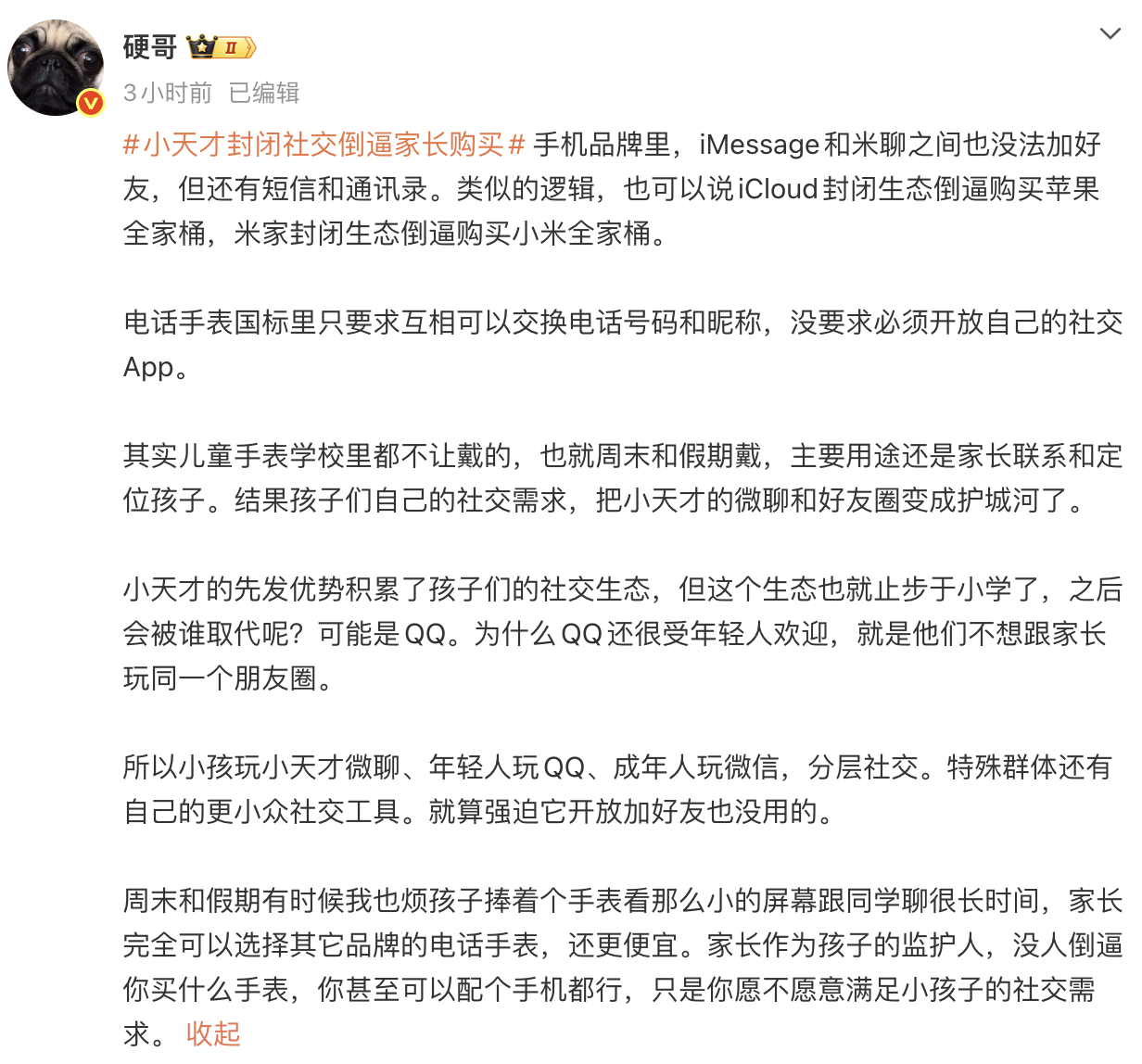
“Hard Bro” also pointed out that China’s national standard for kids’ watches only requires devices to exchange phone numbers and nicknames — it doesn’t mandate that manufacturers open up their proprietary social apps. In his view, kids mostly aren’t allowed to wear watches at school anyway, so usage is concentrated on weekends and holidays. The core function should be staying in touch and tracking your kid — social features are just a衍生 (derivative) need. It’s the social demand kids created organically that turned Xiaotiancai’s micro-chat and friend circle into a moat.
“Xiaotiancai’s first-mover advantage built up kids’ social ecosystem, but that ecosystem stops at elementary school. Who replaces it after that? Probably QQ. Why is QQ still so popular with young people? Because they don’t want to share the same friend circle as their parents.” That’s how Hard Bro broke it down.
He thinks it’s natural: kids use Xiaotiancai micro-chat, young people use QQ, adults use WeChat — social circles are naturally stratified. Even if cross-brand friending were forced open, it’d be hard to change users’ habits. He admitted that on weekends and holidays, he sometimes gets annoyed watching his kid stare at that tiny screen chatting with classmates for ages — but parents can absolutely choose another brand of phone watch, and it’s cheaper too. “As a child’s guardian, nobody’s forcing you to buy any particular watch. You could even get them a phone. It just comes down to whether you’re willing to meet your kid’s social needs.”
Facing the public backlash, NUPIAO reached out to Xiaotiancai’s official customer service. The rep said Xiaotiancai watches can add contacts from other brands for calls and texts, but currently don’t support adding Huawei, Xiaomi, or other brand watches directly to the micro-chat friend circle, nor cross-brand video calls. Per national standard requirements (GB46859-2025 “Safety Technical Requirements for Children’s Watches” takes effect January 2027), Xiaotiancai has upgraded from manually adding phone numbers to adding via Bluetooth exchange.
The Xiaotiancai rep told NUPIAO there are currently three main ways to add friends between Xiaotiancai watches: first, tap-to-add; second, adding within a group chat — both watches need to be in the same group; third, adding via Genius ID.
When asked whether cross-brand social interoperability would open up later, the rep said no product adjustment notices have been received yet, but they’ll keep collecting user feedback and pass it to the tech team for evaluation.
Actually, Xiaotiancai isn’t the only one that doesn’t support cross-brand micro-chat — Huawei and other phone watches don’t have this feature either. Huawei customer service told NUPIAO that its kids’ phone watches can currently only call other-brand watches by adding contacts, and the watch’s built-in communication features only work with friends also using Huawei watches. If kids need cross-brand chatting, they can use the WeChat feature on the watch.
Behind this controversy is Xiaotiancai’s long-standing dominant position in the kids’ watch space. A report on China’s smart kids’ watch online market published by RUNTO Technology in August showed that monthly online retail volume hit 1.121 million units, with total retail sales of 590 million yuan. Xiaotiancai held 27.8% of online sales volume and 52.6% of retail revenue — ranking first in both. However, its monthly sales volume dropped 6% year-over-year, with market share dipping slightly month-over-month.
Huawei came in second with 14.0% online sales share, up a whopping 34.7% year-over-year; Xiaomi Mitu ranked third with 8.4% share. The data shows Xiaotiancai is holding tight to the high-end market thanks to social network effects, while rivals like Huawei and Xiaomi are steadily grabbing market space through hardware and pricing advantages.
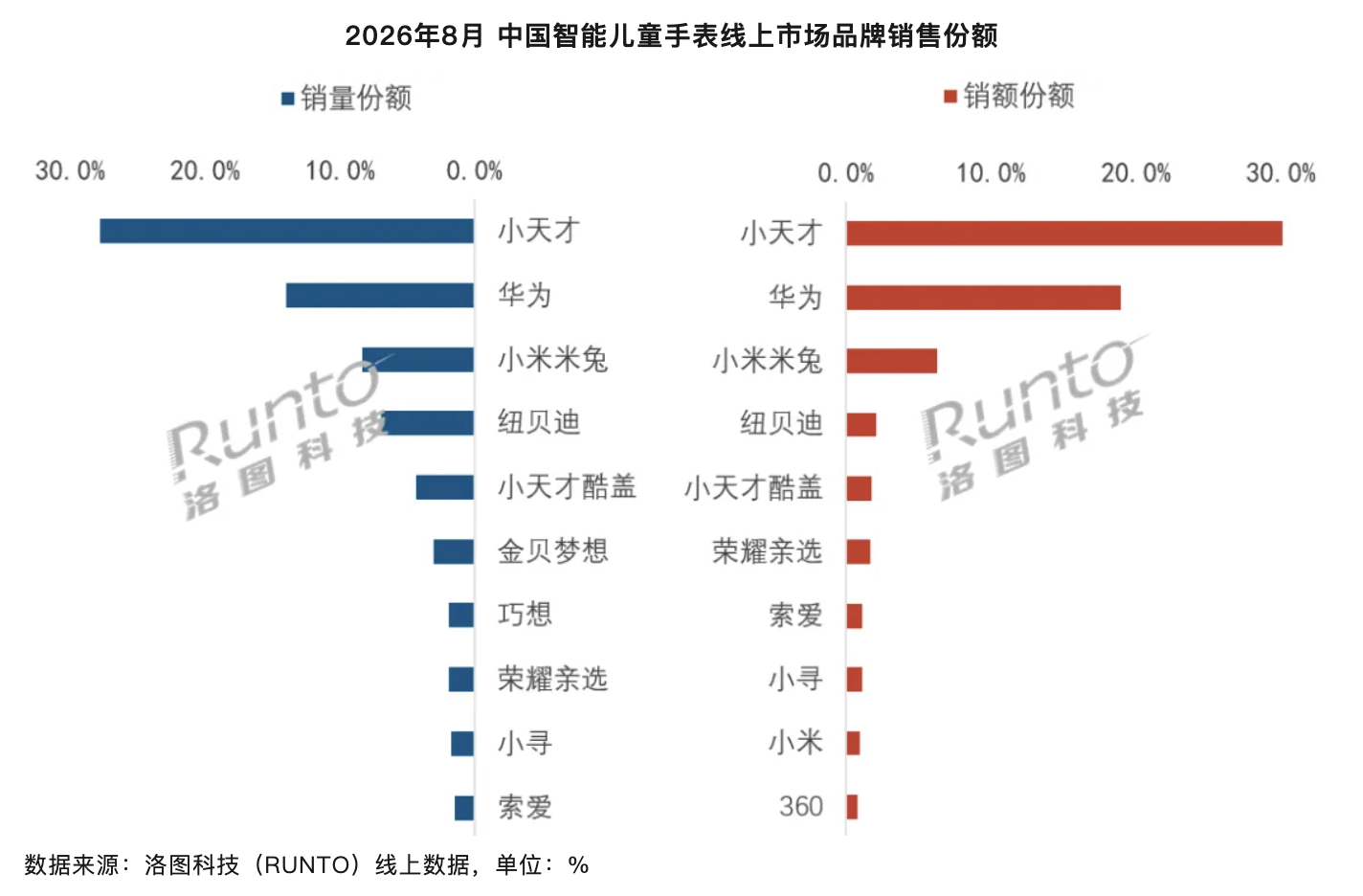
This marks the fourth consecutive month of month-over-month growth in domestic smart kids’ watch sales, hitting a new high for the year. RUNTO noted that back-to-school shopping demand drove market transactions, with revenue declines noticeably smaller than volume declines, and average prices still higher than the same period last year.
Data shows the average online retail price for kids’ watches in August was 526.9 yuan, up 11.6% year-over-year but down 6.3% month-over-month — about 116 yuan below June’s peak.
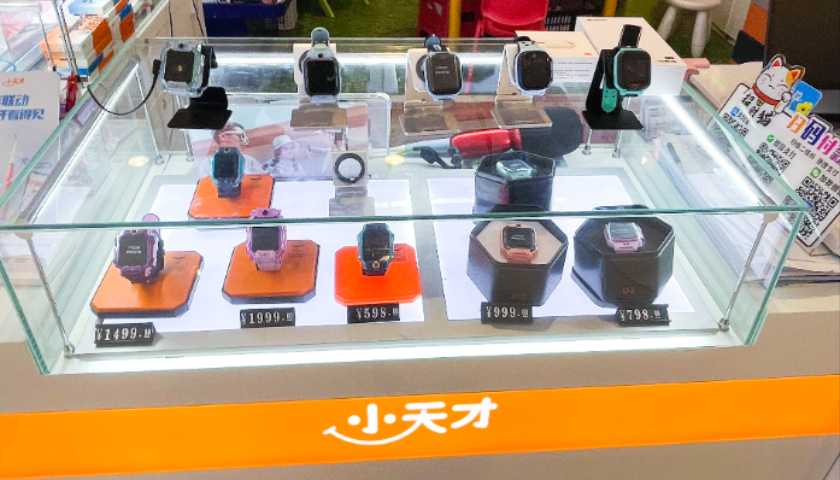
NUPIAO checked Xiaotiancai’s Tmall flagship store and found phone watches priced from 599 to 2,699 yuan. Huawei’s kids’ watch lineup is relatively limited, ranging from 658 to 2,298 yuan. Xiaomi Mitu’s range is 255 to 971 yuan — generally on the lower end.
Overall, August’s market landscape showed a stable leader and expanding mid-tier: the dual-power structure of Xiaotiancai and Huawei remains unchanged, but budget-friendly brands like Newbeidi, Xiaotiancai KuGai, and Jinbei Mengxiang gained more momentum ahead of the back-to-school season.
In the short term, as long as no mandatory interoperability rules are implemented, the kids’ social network built on first-mover advantage will remain Xiaotiancai’s most unique competitive edge. For competitors like Huawei to overtake the leader, they’ll need to find new differentiation strategies beyond hardware upgrades.