News reporter |
News editor | NUPIAO
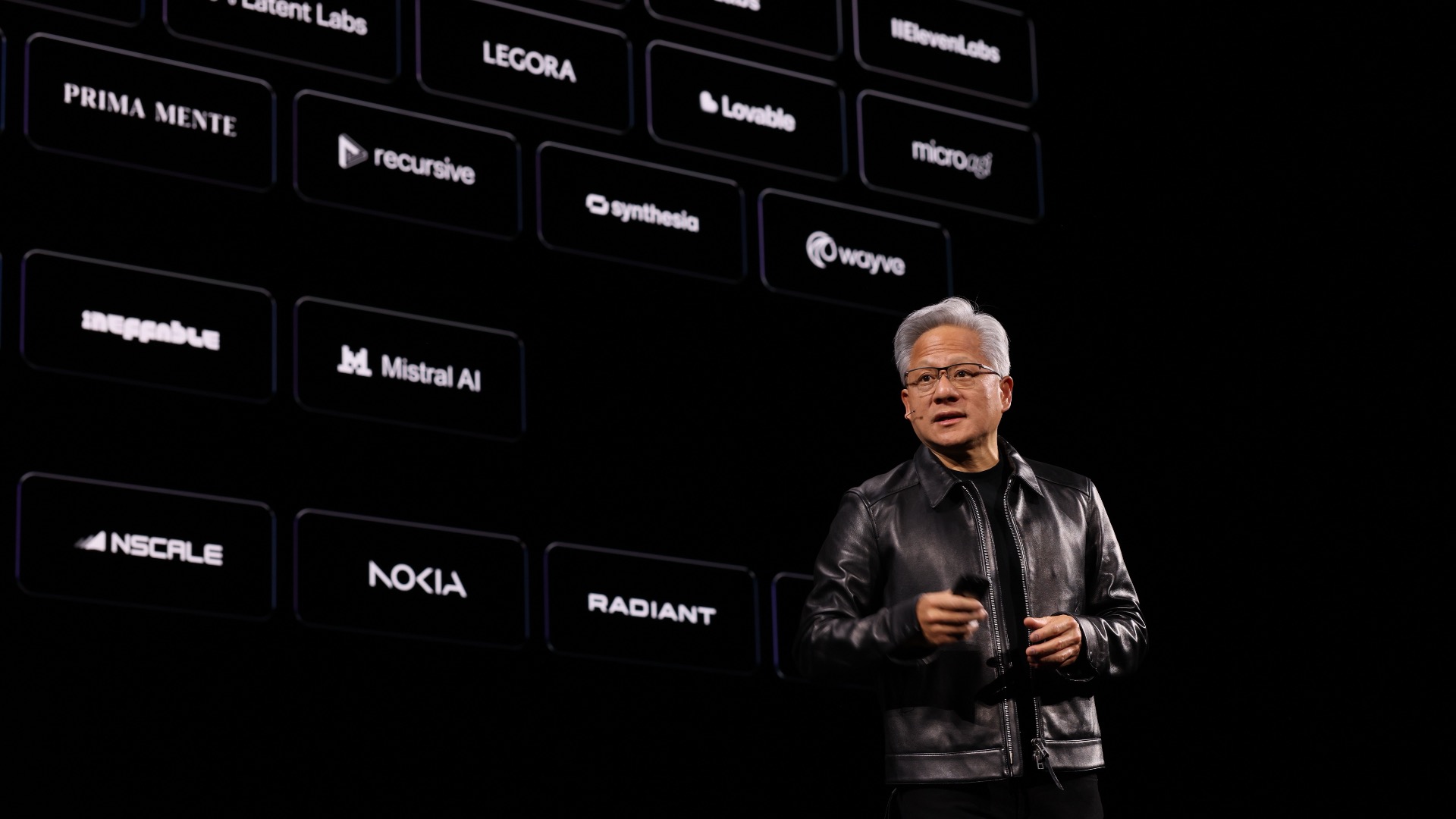
On the evening of October 21 Beijing time, NVIDIA’s GTC conference kicked off in Berlin, Germany. In his keynote, NVIDIA founder and CEO Jensen Huang showed off the next generation of AI infrastructure, enterprise agents, and robotics platforms, and he gave plenty of stage time to industrial production and Physical AI.
Huang said Vera Rubin has entered full production, and NVIDIA is expanding its computing platform from handling large language models to running full agents. In his view, models handle perception, reasoning, and planning, but for AI to actually get work done, you still need an agent framework that handles orchestration, enterprise knowledge, tools, and a secure runtime environment that limits what those agents are allowed to do.
Before the Berlin GTC, Huang had visited France, the UK, Sweden, and other places. He said NVIDIA has invested nearly $10 billion in Europe’s tech ecosystem over the past year and now works with more than 12,000 European partners.
Europe’s demand for AI compute is growing too. According to the Associated Press, Europe currently has only about 5% of global AI computing capacity, so speeding up data center construction and lowering deployment costs became one of the key themes of Huang’s keynote.
On the delivery speed of AI data centers, Huang said a 1-gigawatt AI factory can cost about $50 billion to build, covering everything from land and power to compute, networking, and cooling. For operators, how quickly equipment can go live after construction directly determines when their investment starts generating revenue.
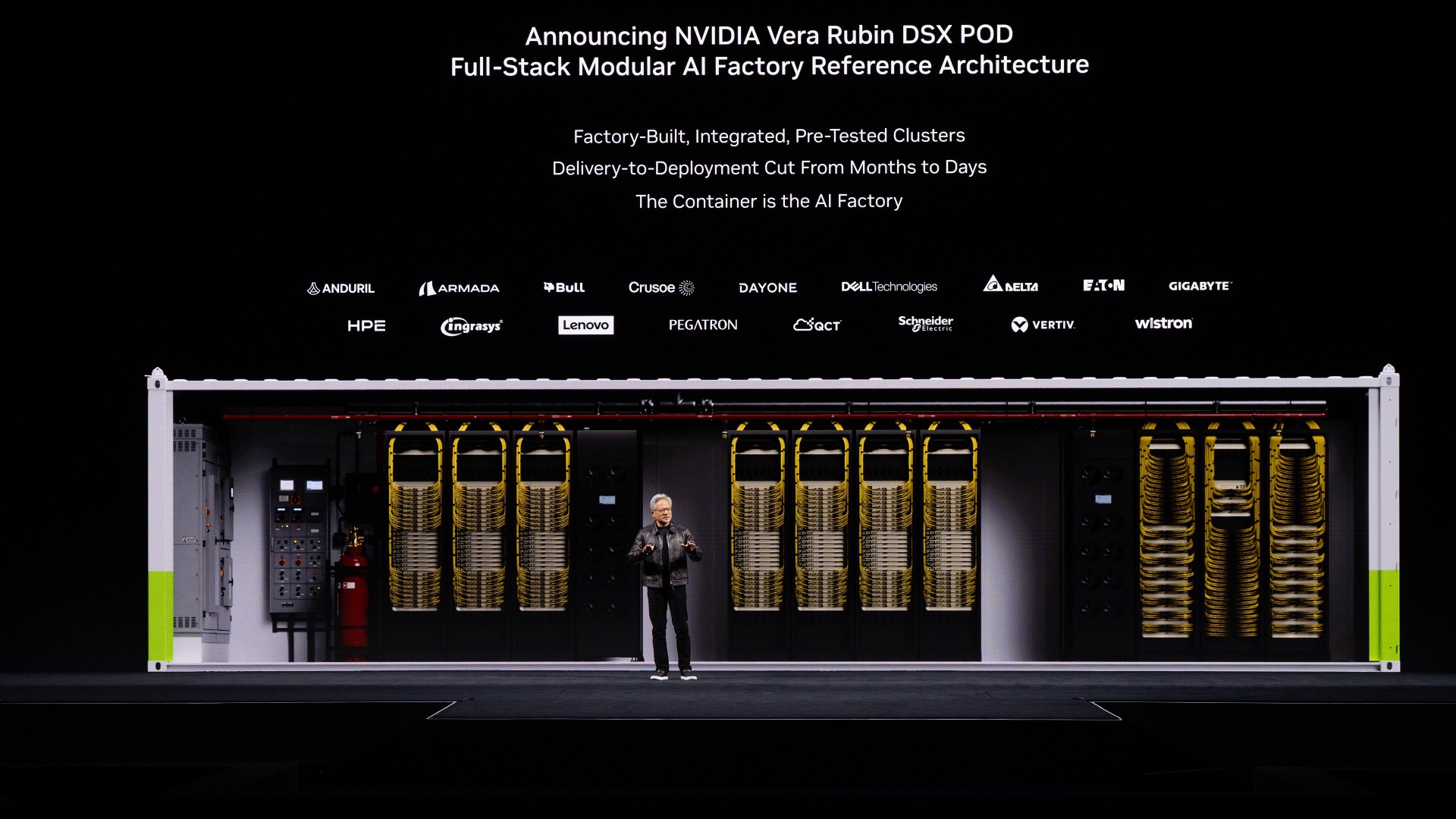
NVIDIA also unveiled its DSX POD AI factory design that day. Vera Rubin racks, network cabling, and liquid cooling systems are integrated and tested at the factory ahead of time, then delivered in container form. NVIDIA estimates that, assuming site power and other supporting infrastructure are ready, on-site deployment can shrink from about six months to as fast as 14 days. Partners including Dell, HPE, Lenovo, and Schneider Electric plan to launch related products in early 2027.
Cutting room installation time does not mean all construction headaches are solved. Power interconnection, site construction, and upstream equipment supply remain separate constraints.
At a media briefing the day before, Ian Buck, NVIDIA’s vice president of hyperscale and high-performance computing, told NUPIAO and other global media that hyperscale data centers still benefit from economies of scale. The near-term opportunity for DSX POD is mainly to help hundreds-of-megawatts projects deploy faster, not to fully replace traditional data halls.
Huang also showed how AI factories can adjust energy use. According to NVIDIA, DSX MaxLPS can dynamically allocate power based on different workloads and cut electricity use by up to about 30% while maintaining the same token output. Closed-loop liquid cooling, paired with dry cooling in suitable climates, can also reduce water consumption from evaporative cooling.
Agents were another main thread at GTC Berlin this year. Huang argued that traditional models mostly answer questions, while agents can call tools, read materials, and execute tasks repeatedly. That means enterprises care not only about model capability, but also about which files it can access, whether it can call internal systems, and whether it can be stopped immediately if something goes wrong.
To address that, NVIDIA released the OpenShell reference architecture, which puts agents into an isolated environment governed by permission policies. Software running on BlueField-4 processors independently monitors agent behavior and enforces security policies. Huang stressed that the permissions an agent needs may differ each time it starts, so security controls cannot rely only on the model itself.
That worry is not unique to NVIDIA. Gartner predicts that by 2027, 40% of enterprises may reduce autonomous agent permissions or stop using them after real operational problems caused by governance gaps.
NVIDIA went further with Agent Knowledge Foundation, designed to help agents search enterprise documents, link order and supplier data, and even predict the potential impact of supply disruptions.
The industrial robot market itself is growing. A September report from the International Federation of Robotics (IFR) showed that in 2025 global factories added more than 600,000 new industrial robots, up 11% year over year, with about 5 million in service.
But industrial robot installations do not directly reflect how fast general-purpose robots are being adopted. Huang also highlighted Physical AI applications such as autonomous driving and adaptive radiotherapy. Unlike traditional automation that follows preset programs, these systems must judge and act based on changes in the real environment, which raises the bar for reliability and safety.
Deepu Talla, NVIDIA’s vice president of robotics and edge AI, also talked about deployment boundaries at the media briefing. He said mobile navigation, inspection, and pick, place, and inspect tasks for rigid objects are starting to show clearer application opportunities, but general-purpose robots involving soft materials, dexterous hands, and complex manipulation still have a lot of work stuck in research. Model accuracy, reliability, and safety are prerequisites for scale deployment.
To bridge the gap between robot training and real-world deployment, Huang said Physical AI needs three computing systems working together: one for model training, one for physics simulation, and one for real-time operation on the robot itself. Instead of repeatedly testing in real environments, developers can first train and validate robot actions in simulation, then deploy the models to physical devices.
NVIDIA also announced updates to its Isaac open robotics development platform, adding a humanoid robot reference platform, datasets, a runtime framework, and robot learning tools, covering training-data generation, model training, simulation testing, and deployment.
NVIDIA teamed up with German robotics company Agile Robots to launch the Agile ONE SN humanoid robot reference platform, using Isaac GR00T models and the Jetson Thor computing platform. The robot is 1.4 meters tall, weighs 40 kilograms, has 31 degrees of freedom in its body, and 20 degrees of freedom in each hand. It is planned to be offered to researchers and developers in early 2027.
Huang believes a unified hardware and software reference platform can save developers the time they would otherwise spend integrating sensors, controllers, and simulation tools themselves.
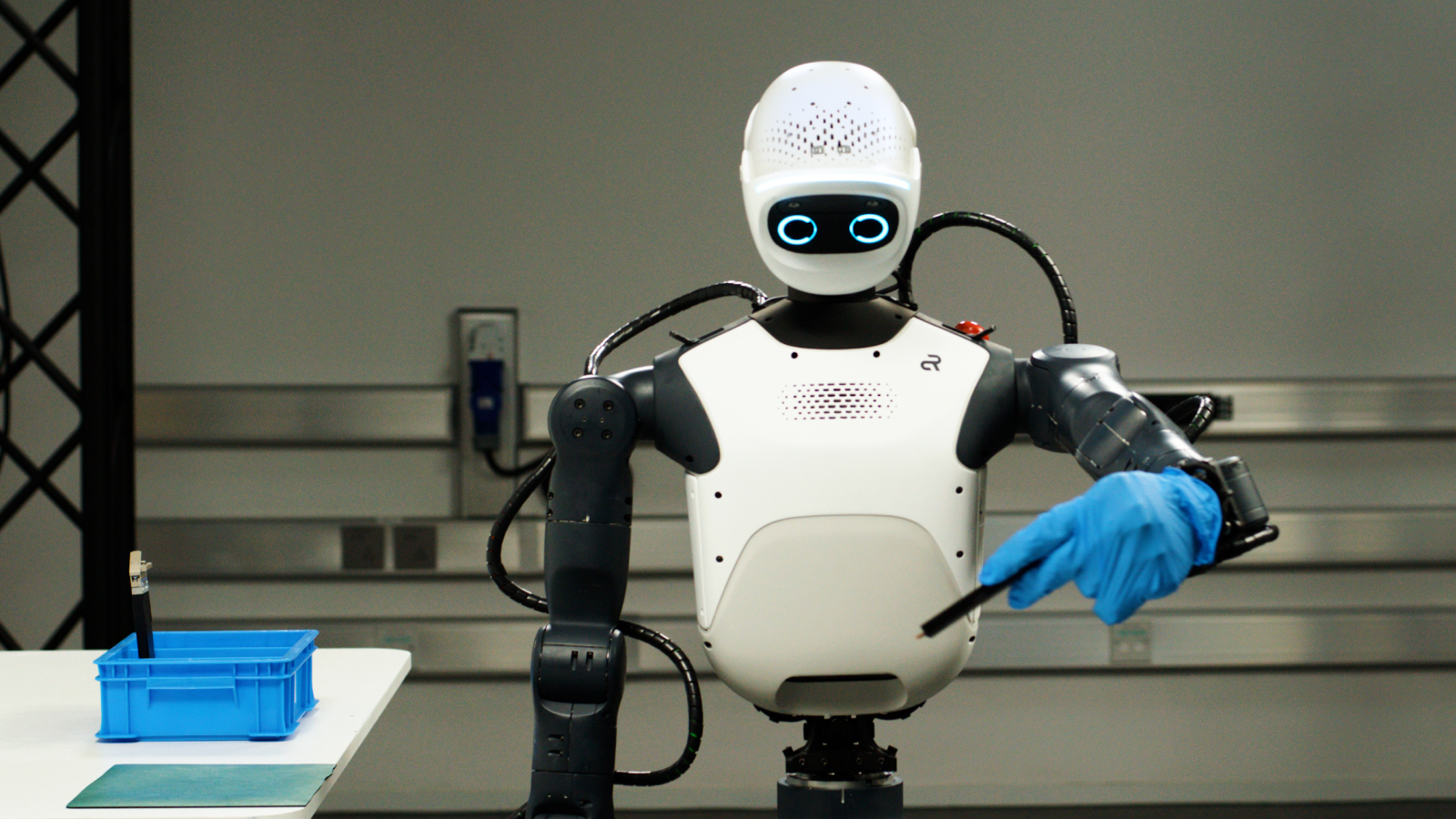
Still, moving from a research platform to actual production leaves the return on investment for humanoid robots unproven.
In January this year, Gartner estimated that by 2028 fewer than 20 companies will actually put humanoid robots into manufacturing and supply-chain production operations. The firm noted that humanoid robots still face limits in dexterous manipulation, battery life, system integration, and maintenance costs. In some warehouse tasks, wheeled multi-function robots are actually more efficient.
As an easter egg during this year’s keynote, four robot ducks called Microduck took the stage. They walked, stood, and sat on Huang’s command. Microduck comes from Pollen Robotics, part of Hugging Face. It is about 25 centimeters tall, uses an open-source design, sells for $399, and the robot duck blew up overseas right after launch.
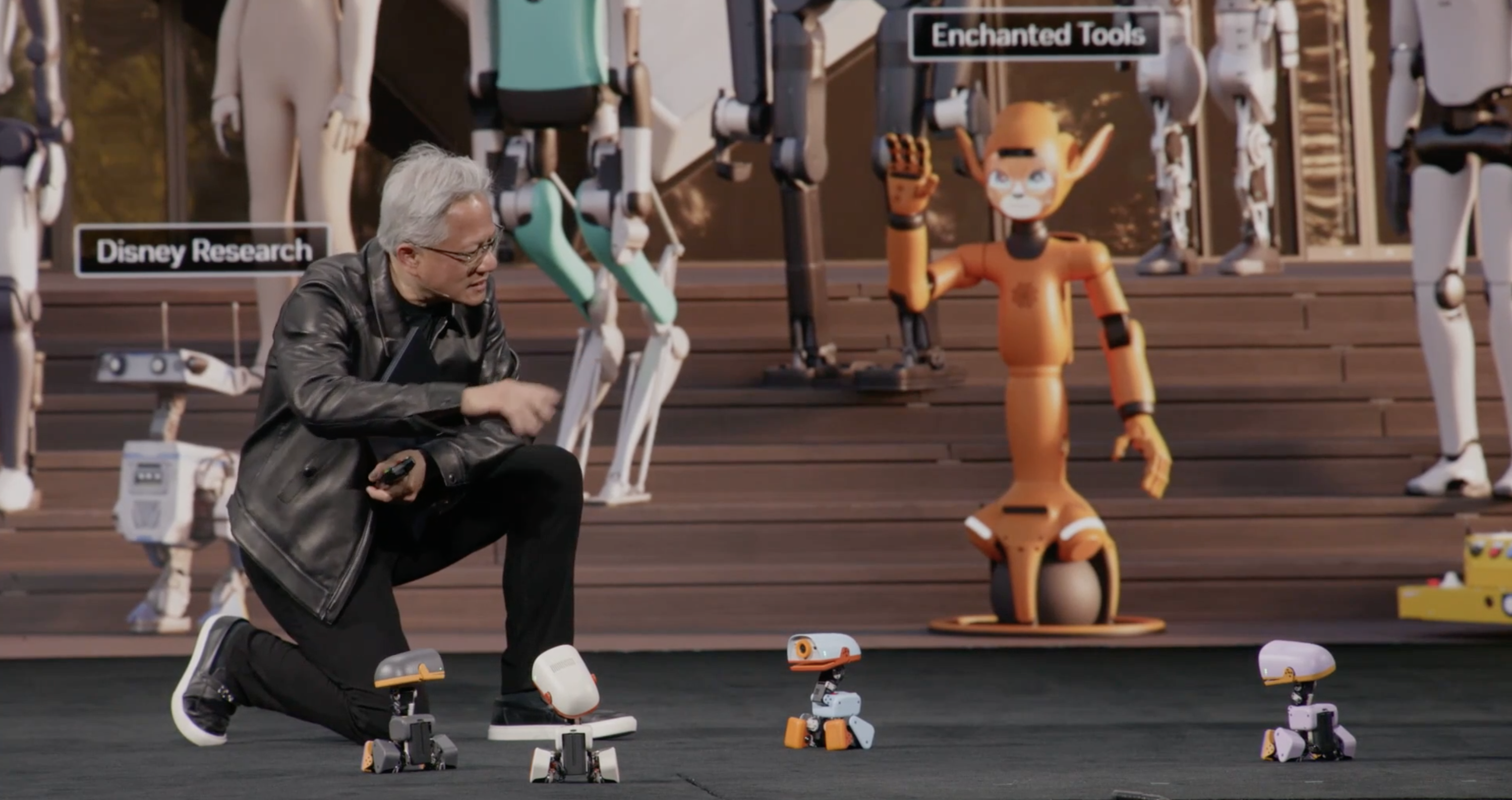
The demo showed how Microduck is trained. Developers can build a simulation environment in Isaac Sim, train robot actions in the cloud, and then deploy the trained policy to the physical robot duck. NVIDIA used this to show its robot development flow from simulation training to real-world execution.
When talking about humanoid robots, Huang said that if robots can quickly learn new tasks, then for small and medium-sized businesses without dedicated robot development teams, the future may simply involve showing the robot the work to be done, and the robot can learn and adapt.