At its 2026 fall event held early morning Beijing time on September 10 at Apple Park in California, Apple officially rolled out the iPhone 18 Pro, iPhone 18 Pro Max, and its first foldable phone, the iPhone Duo.
But the new lineup came with price hikes across the entire product range. The iPhone 18 Pro series is more expensive across the board compared with the previous iPhone 17 Pro series — the top-spec 2TB iPhone 18 Pro Max costs ¥3,500 more than the same version last generation, the biggest jump for a Pro model in recent years. At the same time, Apple’s China website also raised prices on four older models still on sale: the iPhone 17, iPhone Air, iPhone 17e, and iPhone 16. The iPhone Air 1TB saw the largest increase among older models, up ¥2,300.
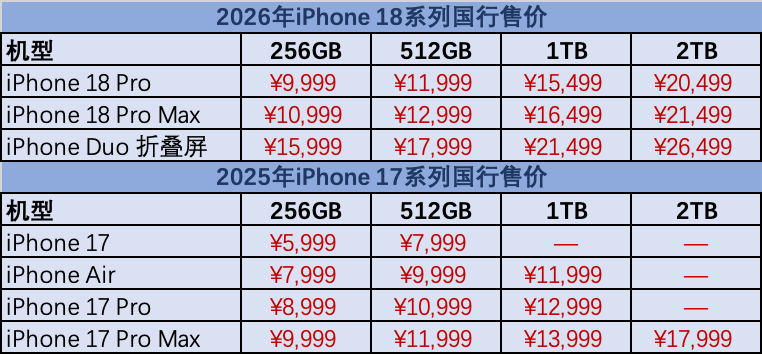
Here’s the breakdown, based on Apple China’s official website: The iPhone 18 Pro 256GB is priced at ¥9,999, up ¥1,000 from the iPhone 17 Pro’s ¥8,999; the 512GB version is ¥11,999, also up ¥1,000; the 1TB version is ¥15,499, up ¥2,500 from ¥12,999; and the all-new 2TB version is ¥20,499.
The iPhone 18 Pro Max 256GB costs ¥10,999, up ¥1,000 from ¥9,999; the 512GB is ¥12,999, up ¥1,000; the 1TB is ¥16,499, up ¥2,500 from ¥13,999; and the top-end 2TB version is ¥21,499, up ¥3,500 from ¥17,999 — the biggest price hike of this round.
As the star of the show, Apple’s first foldable phone, the iPhone Duo, also came in above market expectations. The China model starts at ¥15,999 for 256GB, ¥17,999 for 512GB, ¥21,499 for 1TB, and ¥26,499 for the top 2TB version — making it the most expensive iPhone ever.
The device uses a horizontal book-style inward fold, with a 5.4-inch outer screen and a 7.6-inch inner display. It’s powered by the A20 Pro chip and Apple’s in-house C2 modem, with a frame and hinge made of grade-5 titanium. Pre-orders for the iPhone 18 Pro series open September 12, with official sales starting September 18. The iPhone Duo goes up for pre-order October 16 and launches October 23.
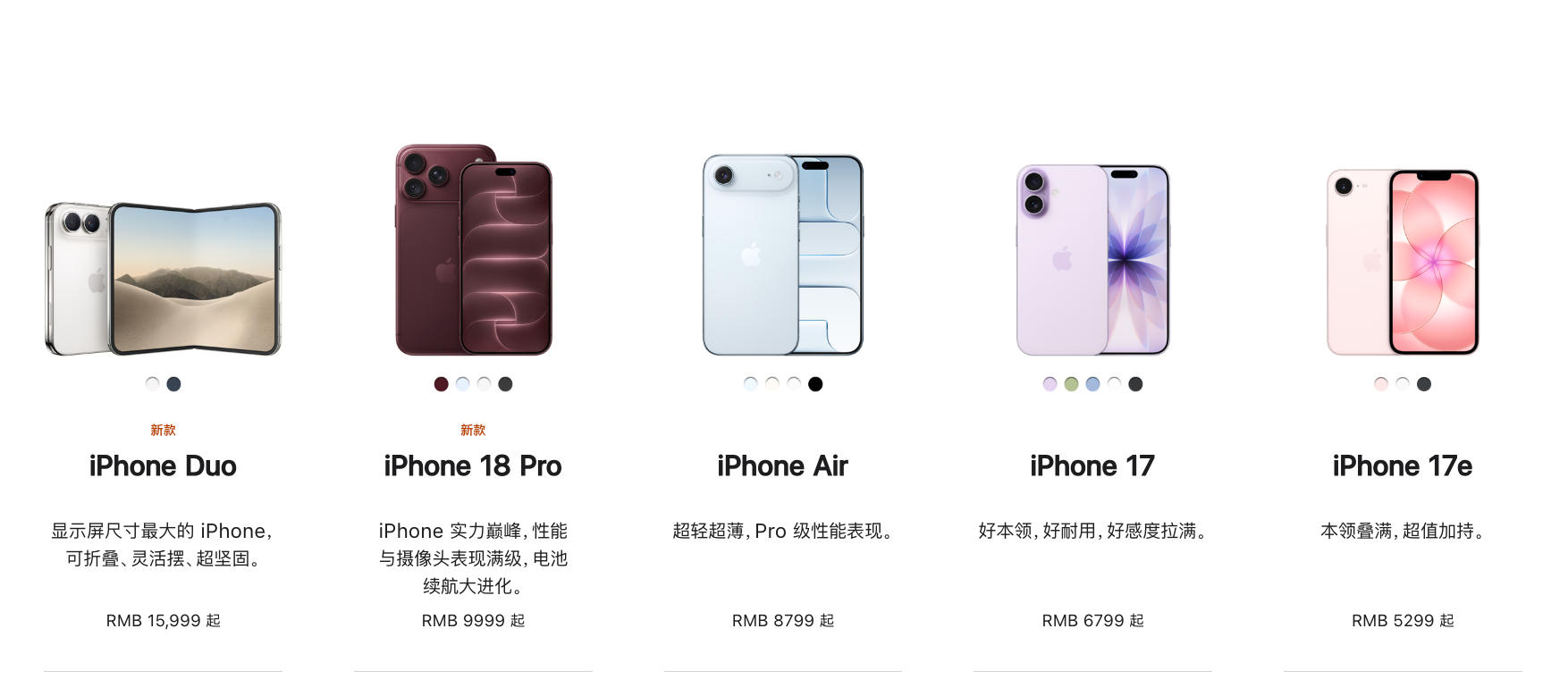
Alongside the new launches, Apple adjusted prices on older models still listed on its website — breaking its usual “new launches push old prices down” pattern. Anyone who was waiting for a discount just got burned. Four older models went up in price, spanning different tiers. The iPhone 17 256GB and 512GB both rose ¥800, with the starting price moving from ¥5,999 to ¥6,799; the iPhone 17e saw similar increases across versions; the iPhone 16 128GB edged up ¥100; and the biggest jump was the iPhone Air, with the 256GB and 512GB each up ¥800, while the 1TB version climbed from ¥11,999 to ¥14,299 — a single-version increase of ¥2,300, the largest among older models.
The main driver behind this full-line price increase is the explosive rise in upstream memory chip prices. Supply chain data shows that, squeezed by surging AI server demand, consumer-grade DRAM prices in Q1 2026 soared more than 90% year over year, NAND flash jumped over 90%, and 12GB LPDDR5X memory chips rose more than 230% compared with last year.
Although Apple locked in some capacity and pricing early through 3-to-5-year long-term agreements with suppliers thanks to its massive purchasing volume, its low-cost inventory is gradually running out.
According to estimates from TrendForce, the bill of materials cost for the iPhone 18 Pro 256GB is up about 38% year over year, with memory’s share of total device cost surging from roughly 10% a year ago to around 34% — and expected to exceed 40% in the first half of 2027. For the first time, memory chips have overtaken the main processor as the most expensive single component in a flagship phone.
Former Apple CEO Tim Cook described rising memory prices as a “once-in-a-century flood” on the company’s July 2026 earnings call, making clear that cost pressure keeps mounting and price increases are unavoidable.
In fact, Apple had already raised prices across several product lines, including Mac, iPad, and Mac Studio. The Mac Studio starting price rose ¥3,500 over the previous generation, and the MacBook Pro went up ¥2,000. The iPhone was the last major Apple product line to complete its price adjustment.