NUPIAO
Recently, after Apple opened pre-orders for the iPhone 18 series and iPhone Duo, quite a few users started posting their iPhone Air trade-in quotes on social media, sparking a lot of discussion. One tech blogger said he bought his iPhone Air for 8,000 yuan, and even though it was basically brand new and unused, a year later the second-hand platform only offered him 3,500 yuan. The topic “iPhone Air has terrible resale value” quickly blew up.
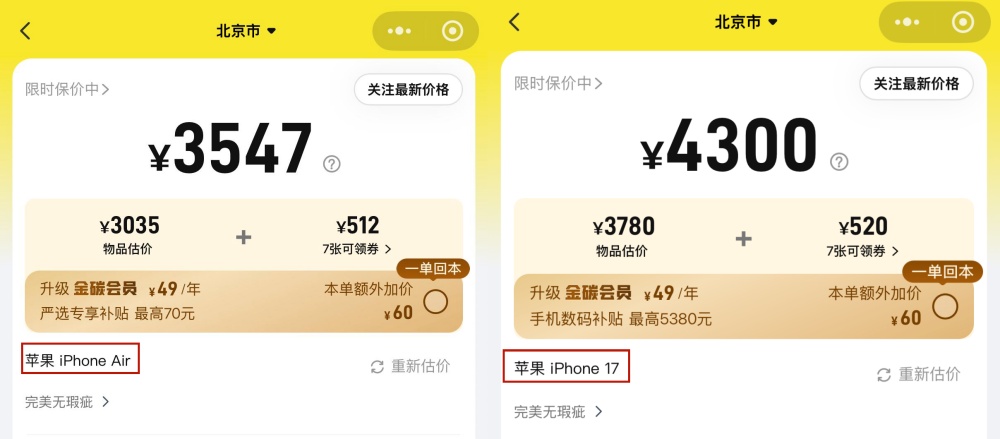
On October 21, NUPIAO checked the Aihuishou platform and found that a flawless iPhone Air (256GB) had a base valuation of only 3,035 yuan, and after all kinds of subsidies the final offer was 3,547 yuan. By comparison, a flawless iPhone 17 on the same platform had a base valuation of 3,780 yuan and a subsidized quote of 4,300 yuan. The two models launched around the same time, and even though the iPhone Air had a higher starting price, its second-hand trade-in value is already below the standard iPhone 17.
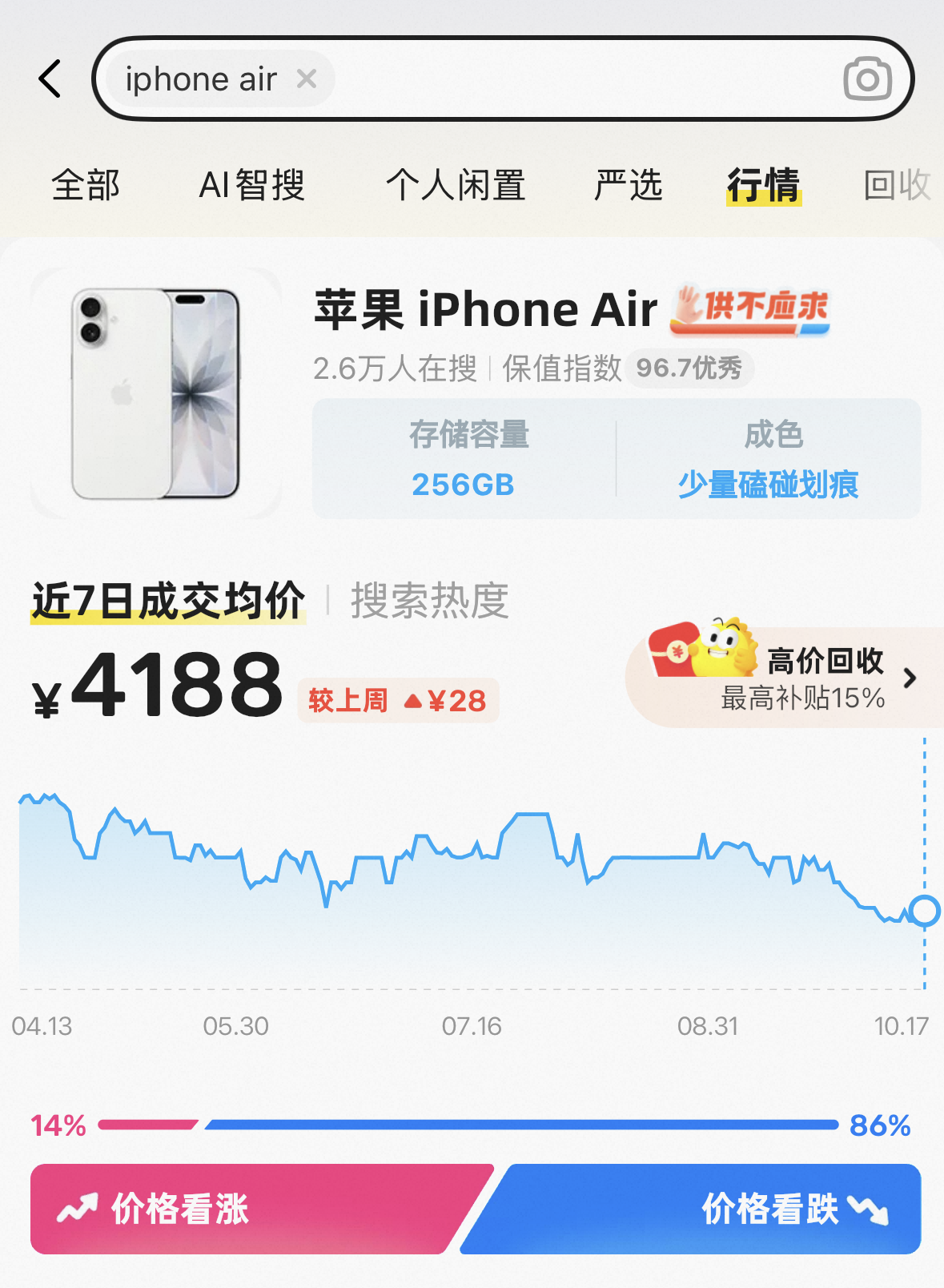
Data from Xianyu’s market section shows that for a 256GB iPhone Air with a few scuffs and scratches, the average transaction price over the past seven days was 4,188 yuan. The price curve has been sliding since late August, and the bearish index now sits at 86%, while the bullish index is only 14%.
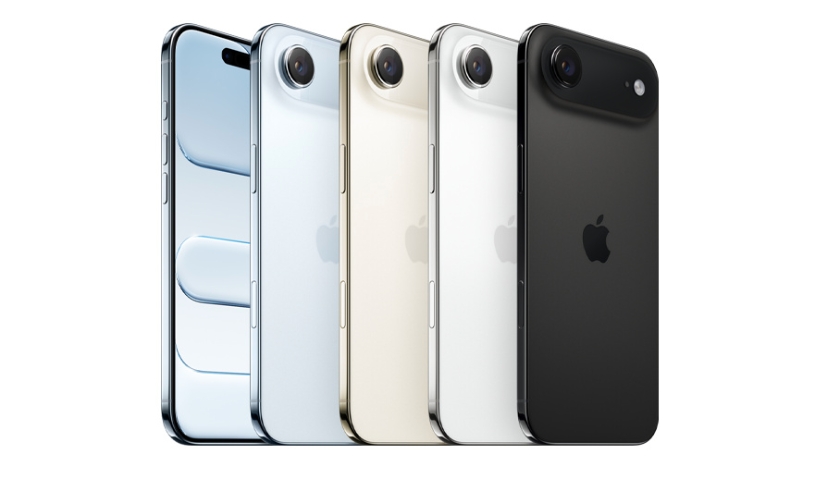
When this model first launched, Apple had high hopes for it as an innovative product. At Apple’s September 2025 fall event, the iPhone Air officially debuted; the China mainland version went on sale on October 22 last year, with the 256GB version priced at 7,999 yuan at launch. Its biggest highlight was a body just 5.64mm thick—the thinnest iPhone ever—and the entire lineup supported eSIM only, dropping the physical SIM card slot, a bold design trade-off. The ultra-thin body and lightweight feel were the core selling points Apple pushed at the time.
But from the very beginning, market feedback fell short of Apple’s internal expectations. IDC survey data shows that iPhone Air sales reached only about one-third of Apple’s highest forecast, and just a few weeks after launch, Apple cut the production plan for the phone in half.
In November last year, Huanqiu.com, citing people familiar with the matter, reported that Foxconn—one of the two assemblers for the iPhone Air—had already dismantled all but one and a half production lines and was expected to completely stop production by the end of that month. The other partner, Luxshare Precision, had already finished related production tasks by the end of October last year.
Market concerns generally centered on the eSIM approach, pricing, and weak battery life. Domestic eSIM coverage and usage habits are not yet widespread; without a physical SIM card, a large number of potential buyers were immediately put off. The ultra-thin body also forced compromises: battery capacity was limited, and battery life was weaker than other models in the same series. The nearly 8,000-yuan starting price put it right between the standard iPhone 17 and the iPhone 17 Pro.
A Forrester analyst said iPhone Air’s pricing was rather “awkward”: too close to the high-end iPhone 17 models, yet too far from the base model, which kept consumers from getting interested.
TF International Securities analyst Ming-Chi Kuo argued that the iPhone 17 Pro series and standard models already covered most high-end users’ needs well, leaving almost no room to open up a new segment and positioning—an important reason for the iPhone Air’s poor sales.
After the production cut, channel discounts arrived quickly. Just three months after launch, e-commerce platforms kept rolling out big promotions; after stacking trade-in subsidies, the final price was around 5,099 yuan—2,900 yuan below the launch price.
At the time, Lin Lin, head of Honor China’s smart life business department, wrote about the iPhone Air price cut. He believed sales would improve slightly in the short term but wouldn’t change the fundamentals, because it was a product going against the needs of the vast majority of users—it wasn’t a pricing problem.
But once new-phone prices loosened, that further squeezed the resale value of used units, and second-hand buyers naturally weren’t willing to pay a high price for this model.
In fact, overseas research firm SellCell had already warned about this model’s resale performance last December. According to SellCell’s tracking, the iPhone Air’s average depreciation rate reached 44.3% ten weeks after launch, with the 1TB top-end version hitting 47.7%—a new three-year depreciation record for an iPhone. Over the same period, the iPhone 17 series averaged only 34.6% depreciation, a clear gap in resale value. The report pointed to uncertainty over long-term demand for the iPhone Air as the core reason for the much faster depreciation.
Even though the first-generation iPhone Air flopped in the market, Apple didn’t just kill the product line. In April this year, according to well-known tech reporter Mark Gurman, Apple was still developing another iPhone Air. He noted that when Apple launches a new iPhone, it usually tries at least twice before pivoting to something else—the iPhone 5C being the only exception.
“Take the iPhone mini, for example—we saw Apple launch the iPhone 12 mini and iPhone 13 mini. For the more popular but still underperforming iPhone Plus, Apple launched the iPhone 14 Plus, 15 Plus, and 16 Plus. If the iPhone Air were killed off after just one year (and a lot of hype), that would be a huge embarrassment,” Gurman said.
Gurman also said the iPhone Air isn’t a bad phone. It has a cool design and a group of fans; it just isn’t right for most users. Moreover, the iPhone Air is a building block for future devices, so continuing to push it forward is very important. The iPhone mini and iPhone Plus were just new screen sizes, which made them easier to abandon.
It’s worth noting that, affected by rising memory chip prices, Apple’s China website raised prices for three storage versions of the China mainland iPhone Air in September this year, by between 800 yuan and 2,300 yuan. The 256GB version now starts at 8,799 yuan, the 512GB at 10,799 yuan, and the 1TB at 14,299 yuan. Both the 256GB and 512GB went up by 800 yuan, while the 1TB version rose by as much as 2,300 yuan—nearly 20%—the most obvious price change among the adjusted products.
Some netizens said that, judging by the post-price-hike levels, now might actually be a good time to pick up a used iPhone Air.