It’s been almost a month since the iPhone 18 Pro series officially went on sale in China, and some buyers are already speaking up on social media. They say their phones—used completely normally—are showing patches of faded color. The most obvious complaints are about the Burgundy finish, this year’s headline color, where the discoloration is pretty easy to spot.
Looking at the photos users have shared, the area around the camera on the Burgundy model has developed pale pink marks.
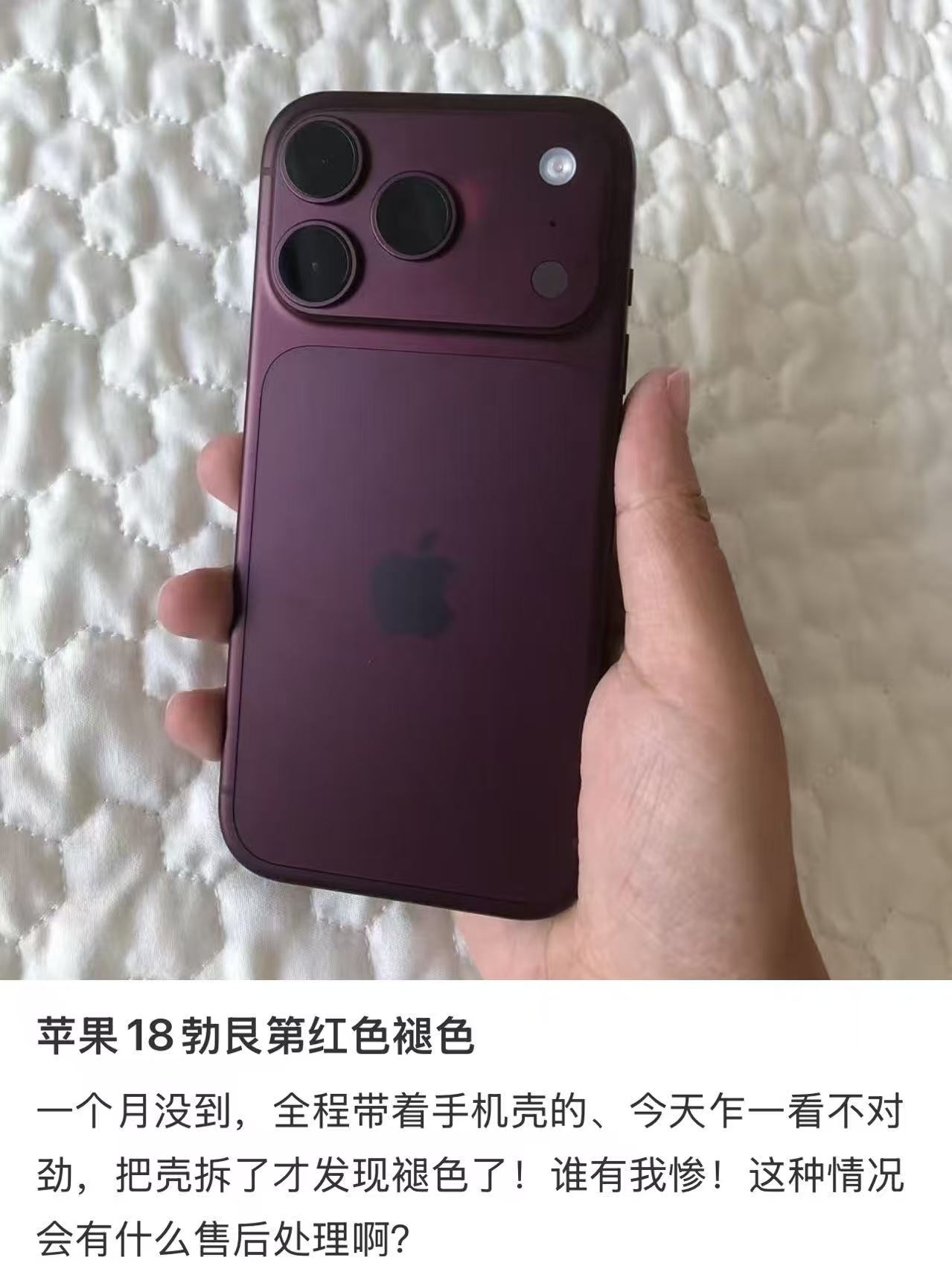
On October 15, NUPIAO reached out to Apple’s customer service about it. A rep told us: “Under normal circumstances, this fading shouldn’t happen. So far we’ve had relatively few reports about the 18 fading. The 17 has been out longer, so we do get more people bringing up color loss on that one.”
The rep added that if fading does occur, customers can visit a physical store for a closer look or apply for after-sales service.
NUPIAO has learned that the previous iPhone 17 Pro series had a similar issue. Its flagship Cosmic Orange color drew attention after some units faded during normal use.

Public analysis from materials engineering experts has pointed out that for years, the iPhone Pro lineup has used aerospace-grade aluminum alloy for the frame and the area around the camera. The color comes from an anodizing process that builds a micro-porous oxide layer on the metal surface, which is then filled with dye. How stable that finish ends up being depends heavily on whether the final “sealing” step at the end of production is done thoroughly.
If some production batches don’t get a proper seal, those tiny pores in the oxide layer stay open. Sweat, skin oils and everyday moisture from the environment can then slowly work their way inside, breaking down the dye molecules over time. Eventually, you get visible fading and uneven color in certain spots.
Fading isn’t the only problem, either. Recently, quite a few users on social media have reported that their new iPhone 18 Pro and iPhone 18 Pro Max will suddenly shut down and restart after Face ID freezes.
According to a recent report by Luzhong Morning Post, Apple (AAPL.US) has officially confirmed a serious system bug tied to Face ID on both the iPhone 18 Pro and iPhone 18 Pro Max.
The bug can cause the phone to freeze during certain Face ID unlock or authentication scenarios, then trigger an automatic reboot that cuts off whatever the user was doing.
On the afternoon of September 28, NUPIAO called Apple’s official customer service as a customer. A rep said: “We’ve had other consumers report this before, and our engineering team is looking into it. If you run into the issue, you can start with a diagnostic to see what’s causing it. There will also be system updates down the road, and those may fix the problem.”
On top of those two issues, several early buyers of the recently launched iPhone 18 Pro series have flagged a “green ghosting” problem. The main symptom is strange green patches or halos showing up in photos or videos, even though the camera preview and Live Photos look normal at the time.
One user posted on social media: “My iPhone 18 Pro has weird green ghosting when I freeze a Live Photo. It comes and goes, and restarting didn’t fix it.” Based on feedback from multiple users, the green ghosting or green patches tend to show up under specific conditions: mostly indoors, in dim or warm lighting; more often when shooting at 2x or longer zoom, while 1x is usually fine; and it seems tied to the new iPhone’s variable aperture, showing up more clearly when shooting at the wide f/1.48 aperture.
In the early hours of September 10, Apple unveiled the iPhone 18 Pro series, its first foldable phone iPhone Duo, the Apple Watch Series 12 and other new products.
The iPhone 18 Pro and Pro Max come with 6.3-inch and 6.9-inch displays respectively, keep the unibody aluminum design, and are available in Black, Silver, Glacier Blue and Burgundy. Both start at 256GB and go up to 2TB.
Both phones run on the A20 Pro chip, with a six-core CPU, seven-core GPU and dual 16-core Neural Engines. Each GPU core is also said to include a neural accelerator for handling AI workloads like image generation, photo editing and on-device large models.