Story by |
Edited by | NUPIAO
On September 21, Imagination Technologies shared the first performance numbers and demos for its E-Series GPU IP, and also rolled out a neural super-resolution technology called NSR.
Unlike Nvidia and AMD, which sell GPU chips directly, Imagination is a GPU IP supplier. It licenses processor architectures, software, and development tools, and customers use that foundation to design their own chips.
The newly announced NSR tech is meant to help GPUs take on more AI workloads, on top of their usual graphics and general-compute duties.
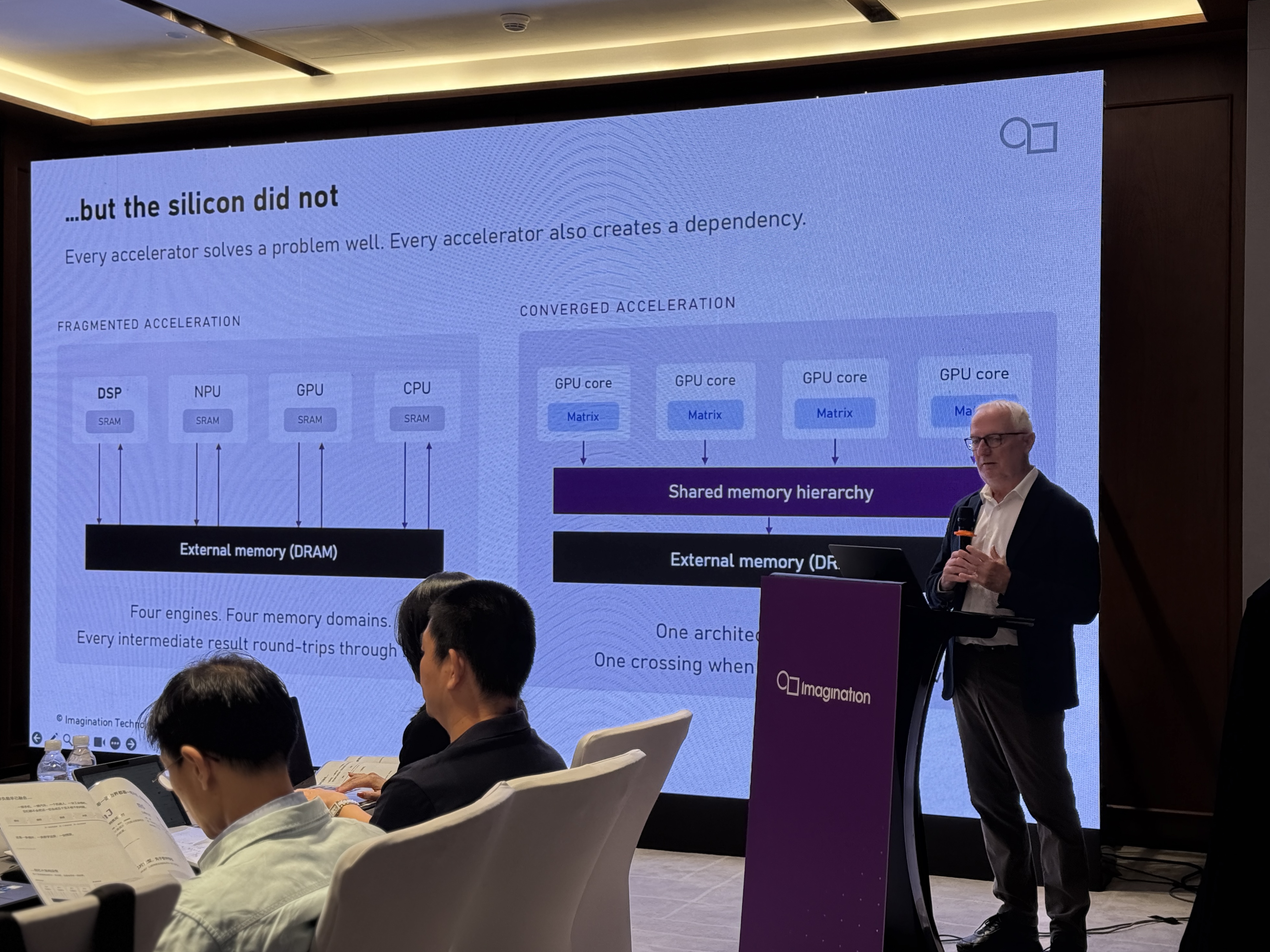
In a traditional SoC, the CPU, GPU, NPU, and DSP usually split up the work. When graphics output gets handed to an NPU for AI super-resolution, the data may have to be written to external memory and then read back by another processor. Imagination instead places matrix-compute capability near the GPU’s unified shader cluster, so graphics and AI work can stay on the same data path as much as possible.
So Imagination integrates matrix acceleration units inside the GPU and lets different tasks share memory, scheduling, and a software stack. The company hopes this will cut data shuttling between accelerators inside the chip and reduce the cost of maintaining multiple software stacks.
The E-Series first appeared last year, and these new numbers make its positioning clearer. According to Imagination, several partners have already licensed the E-Series, with the first related chips expected to tape out in late 2026.
In tests provided by Imagination, the E-Series delivers 4.7x better prefill performance than the previous D-Series on a typical edge language model.
Take the Qwen 3.5 4B dense model as an example: a quad-core EXD-64-2048 running at 1.5GHz, with W4A16 precision and both input and output lengths set at 1,500 tokens, generated its first token in 0.2 seconds and decoded at 150 tokens per second.
Graphics is still the E-Series’ core job. The architecture supports DirectX 12 FL11_0, Vulkan, and OpenCL. Company tests show up to 54% better performance in real gaming workloads than the previous generation of comparable products, and up to 39% better performance per watt. A quad-core setup can top 60 fps in some desktop-class games.
Imagination frames the E-Series as part of the industry’s push toward converged acceleration. Phones, cars, robots, and industrial devices need to handle perception, inference, decision-making, and rendering at the same time, yet chips often rely on several different processor types. Every extra dedicated accelerator tends to bring more drivers, compilers, security mechanisms, and maintenance work.
Imagination CEO Markus Mosen calls the data exchange between different compute blocks a “border tax.” That cost includes the energy and latency of moving data around, plus the engineering resources chipmakers spend on multiple toolchains and software stacks.
That is also where GPUs can create industrial value in edge AI. If a GPU can handle some AI compute, chipmakers can get more out of existing hardware, cut back-and-forth communication between standalone accelerators, and extend the value of software investments they have already made.
Still, versatility does not mean GPUs will replace every NPU. Fixed models and specific operators may still be better suited to dedicated accelerators, and CPUs will keep handling model scheduling, tool calls, and data management.
The real competition may still come down to software. Imagination is contributing its optimized Llama.cpp backend upstream and plans to offer native PyTorch and ONNX Runtime support later.
But the company also admits that moving away from CUDA to another architecture takes rewriting and adaptation. Open-source drivers often cannot move forward until customer chips and development boards show up, and if customers do not share low-level information, device-specific optimization is limited. Chief Revenue Officer Jake Kochnowicz told NUPIAO and other media that in real deployments, “software is the biggest cost, not the hardware itself.”
China matters a lot to Imagination. On one hand, Chinese chipmakers and device companies need GPU IP to develop desktop graphics cards, automotive chips, robotics, and edge-computing products. On the other hand, Chinese customers’ demand for higher performance and fuller feature sets is shaping Imagination’s product roadmap.
Jake said, “GPU demand in China is obviously huge. When it comes to Imagination’s GPU IP, what we see is a market that moves faster, pushes for higher performance, and asks for fuller feature sets—really stretching the boundaries of what GPU IP can do.”
For Chinese chipmakers, the value of buying GPU IP is a shorter path from underlying architecture to a shippable product, while keeping design control over chip specs, memory systems, and target applications. That gives them more room to make their own calls on chip implementation, driver adaptation, system development, and developer ecosystem building.
Imagination reshuffled its China management and sales team this year. Markus Mosen told NUPIAO that the company has already signed one new strategic customer license this year, with another in the works. Xie Wei, the newly appointed executive vice president and general manager of China, said shipments of Chinese desktop-class products using its GPU IP are approaching 1 million units this year.
Xie Wei also said the company will keep focusing on China’s desktop GPU market, along with edge AI, automotive, and embodied-intelligence robotics scenarios.