Nearly six years after spinning off Honor, Huawei is once again surrounded by rumors that it plans to launch a new phone sub-brand.
According to NUPIAO, on Oct. 11 the topic “Huawei reportedly to launch sub-brand Xingmang” climbed onto Weibo’s trending list. The chatter says “Xingmang” could target the same space Honor once did: the mid-range, value-for-money segment. It would reportedly use Huawei’s self-developed Kirin 8-series chips and native HarmonyOS, but skip high-end flagship features such as satellite communications.
Asked about the rumor, a Huawei representative told NUPIAO: “Please refer to official information.” On the morning of Oct. 12, a NUPIAO reporter posed as a consumer and contacted Huawei customer service. The staff member told NUPIAO: “We haven’t verified the relevant information at the moment. We suggest you follow the company’s future announcements.”
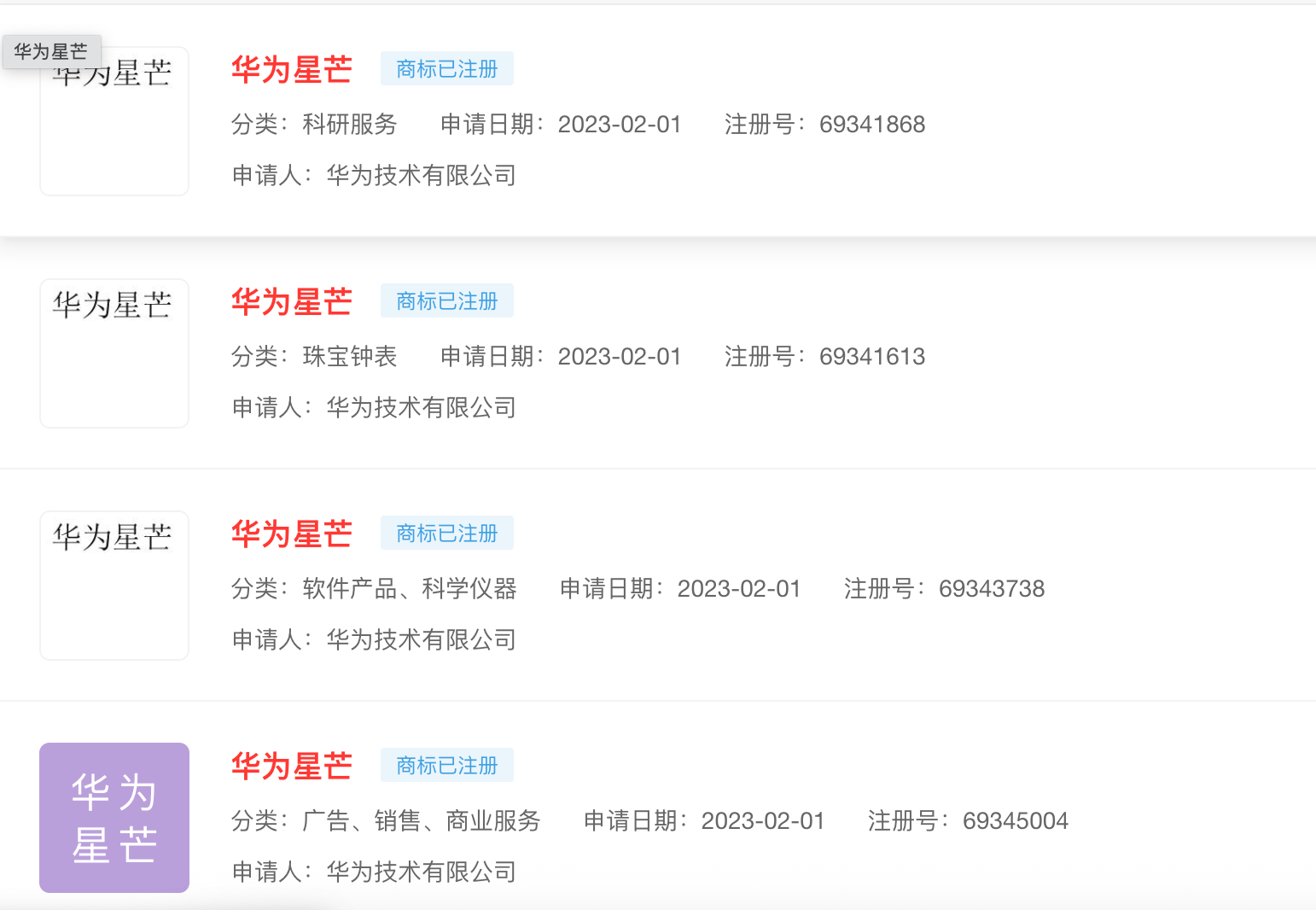
According to Tianyancha, Huawei Technologies Co., Ltd. applied to register the “Huawei Xingmang” trademark on Feb. 1, 2023. The international classes cover Class 09 scientific instruments, Class 14 jewelry and watches, Class 35 advertising and sales, and Class 42 website services. The registration announcement date was Sept. 14, 2023, and the trademarks are all currently registered.
Rumors about Huawei planning a new phone brand have been around for a while. As early as early 2024, according to NUPIAO, reports claimed Huawei had registered the “Xingyao Phone” brand trademark, positioned for the mid-range phone market. Huawei never confirmed that.
“We’ve seen the information about Xingyao, but we haven’t received product details or a notice to start offline distribution. As for the either-or issue with other brands, I’ve heard dealers in other provinces talk about it, but for now there’s no more action on the Huawei channel side,” a core Huawei dealer in Guangdong told NUPIAO.
According to Tianyancha, Huawei Technologies applied in 2023 to register trademarks including “Xingyao Phone” and “Xingyao Edition,” with international classes in scientific instruments.
At the end of September this year, market talk surfaced again: Huawei’s phone business was said to be preparing a new sub-brand called “Xingyao,” while Huawei’s nova series was evolving from a product line into an independent sub-brand.
Huawei’s phone lineup previously used a dual-brand strategy with Huawei and Honor. Honor was made independent internally in 2013, filling the gap in Huawei’s phone lineup for younger users and value-for-money models.
After becoming independent, Honor went hard on a model blitz, quickly launching Honor 3C, Honor 3X, Honor X1, Honor 6, Changwan (Play), and other products within a year. Total sales topped 10 million units in 10 months. In 2014, Honor shipped more than 20 million units, with sales of $3 billion, up 24 times year on year. In 2015, Honor surpassed the previous year’s full-year performance in just half a year. In 2019, when the overall industry was struggling, Honor and Huawei were the only two phone brands to grow against the trend.
In November 2020, Huawei spun off its Honor phone sub-brand, and Shenzhen Zhixin New Information Technology Co., Ltd. completed the full acquisition of Honor-related business assets. After the sale, Huawei held no shares in the new Honor company.
Explaining why Huawei sold Honor, founder Ren Zhengfei said: “Under wave after wave of severe U.S. sanctions, Huawei finally understood that some U.S. politicians were not trying to correct us, but to kill us. We have the ability to overcome Huawei’s short-term difficulties. We don’t want to drag innocent people down because we ourselves are suffering. But agents and distributors in 170 countries would see their channels dry up without water, which could put millions of people out of work. Suppliers would also be stuck with inventory and falling sales because we can’t buy from them, dragging down the stock market. What did they do wrong? Why can’t we make some sacrifices? You are going to share weal and woe with them, so that the dried-up channels can be filled with flowing water before the source is cut off.”
In nearly six years, Huawei’s phone business has climbed out of the trough step by step. IDC data shows that China’s phone market shipped 285 million units in 2025, down 0.6% year on year. Huawei topped the full-year list with 46.7 million units and a 16.4% market share, returning to No. 1 after five years.
In the first half of this year, China’s smartphone market shipped about 134 million units, down 4.2% year on year. Against that weak backdrop, Huawei’s second-quarter shipments rose 19.4% year on year, giving it a 22.6% market share and the top spot, making it a bright spot in the market.
Looking at the current lineup, Huawei’s Mate and Pura series focus on the high end, nova leans offline, and the roughly 2,000-yuan online value-for-money segment has long been empty. Industry analysts believe Huawei needs a brand with a positioning similar to the old Honor to capture that volume-driven market. The new sub-brand’s first job would be to complete the price ladder and win back the mid- and low-end user base it lost.
This year, memory chip prices have kept rising, pushing phone makers across the industry to raise prices, and Huawei’s nova series recently adjusted prices too. On Oct. 9, NUPIAO learned exclusively from a Huawei offline store that starting at midnight on Oct. 9, 2026, Huawei adjusted prices for the nova16 series: the suggested retail prices (RRP) of nova16 and nova16 Pro rose by 400 yuan, while nova16 SE rose by 200 yuan, with channel pickup prices (STP) raised in tandem.
Huawei Executive Director and Chairman of the Terminal BG Yu Chengdong said in an interview with international media on Sept. 29 that memory component prices had risen sharply, adding more than $200 to the hardware cost of a single phone. Because Huawei phones have higher memory configurations than other models, the cost increase is even bigger. “We have been raising prices very slowly, trying to absorb the cost ourselves so consumers don’t have to bear it. But honestly, our overall profit margin has dropped sharply. We will have to raise product prices later. Once the business falls into losses, operations will be hard to sustain. A company first has to survive.”