News Reporter |
News Editor | NUPIAO
Huawei used a single launch event to answer the two questions everyone’s been asking: How do you make chips without the most advanced lithography machines? And where do you take an operating system when Android and iOS are off the table?
On September 7, Huawei launched the Mate XT 2 tri-fold phone. It’s powered by the latest Kirin 9050 Pro chip — the first high-performance chip built on logic-folding technology, and Huawei’s first brand-new Kirin chip at a flagship launch in six years.
According to official specs, the Kirin 9050 Pro is the world’s first mass-produced mobile chip featuring the LogicFolding architecture (known as “Tao’s Law”). The core idea: instead of laying out core logic circuits on a flat 2D plane, they’re stacked vertically in two layers. It swaps the industry’s usual “geometric scaling” for “temporal scaling” — rather than chasing smaller transistor dimensions, it reconfigures circuit layout in 3D space.
The numbers speak for themselves: transistor density is up 53.5% to 238 million per square millimeter (238 MTr/mm²), theoretically on par with Intel’s 18A process. Performance-core efficiency improved 41%, and max clock speed rose 12.7%. On the product side, the Kirin 9050 Pro packs a 9-core Lingxi CPU with hyper-threading, a Maleoon GPU, and a Da Vinci architecture NPU. Compared to the previous Mate XTs, overall performance is up 42%, CPU single-core peak performance is up 24%, multi-core concurrent performance is up 52%, and the NPU comes with the industry’s first on-device 30Btotal-parameter multimodal large model.
What this means: without access to EUV lithography for the most advanced nodes, Huawei has achieved 3nm-equivalent process performance through foundational architecture innovation, putting its chips in the top tier of consumer mobile processors.
On the foldable front, the Mate XT 2 ditches last generation’s Z-fold design for a left-right “spread-wing” dual inward-fold structure: the two side screens fold inward, the main display tucks entirely inside the body, and the flexible bending area is no longer exposed when closed.
At just 3.5mm when unfolded, it houses two screens — the inner display unfolds to a 10.2-inch 3K panel, the largest foldable screen in the industry; a new 6.5-inch independent outer screen lets you handle calls, scan-to-pay, and other frequent tasks without opening the phone. Pricing starts at 19,999 yuan, with a top-end privacy-protection edition at 24,999 yuan. It goes on sale September 12, making it Huawei’s most expensive mass-produced phone ever.
Richard Yu, Huawei’s Executive Director, Chairman of the Device BG, and Director of the Product Investment Review Board (IRB), responded on stage: “Considering memory prices have gone up by over 2,000 yuan, this is a very sincere price.”
Alongside the Mate XT 2, the official HarmonyOS 7 release completed its first commercial rollout at the event, debuting on both the Mate XT 2 and the first “wide bar” phone Pura X View launched at the same event. Huawei frames this generation as HarmonyOS moving from “Internet of Everything” into the “Agent Era” — becoming “the first operating system to complete an AI transformation.”
Huawei announced at the event that HarmonyOS now supports over 140 Huawei terminal devices, with HarmonyOS 6 and 7 device numbers exceeding 85 million. Major apps like WeChat, Taobao, and Meituan have all adapted HarmonyOS-exclusive features.
Specifically, the upgrade unfolds on three levels. First, an Agent-friendly system architecture: the kernel embeds Pangu 6.0, allowing AI tasks to run locally. The system’s organizational unit shifts from “App” to “intent” — users state what they want to do, and the system breaks it down and executes across apps and devices. Second, the HarmonyOS Agent Framework 2.0, which officially claims a complex-task success rate above 90%, opens over 20 system-level AI capabilities to developers, and for the first time opens GUI control capabilities. Third, the system agent Xiaoyi, upgraded from a voice assistant to a “smart brain” that can call on over 200 system-level sensing data points and over 2,100 HarmonyOS capabilities. Huawei disclosed that Xiaoyi has 180 million daily active users and 3 billion daily wake-ups.
On performance, the Ark Engine now features a performance large model for the first time, making the system 15% faster than HarmonyOS 6. On security, the Star Shield system adds anti-fraud capabilities like AI voice-change detection and AI foreign fake number identification.
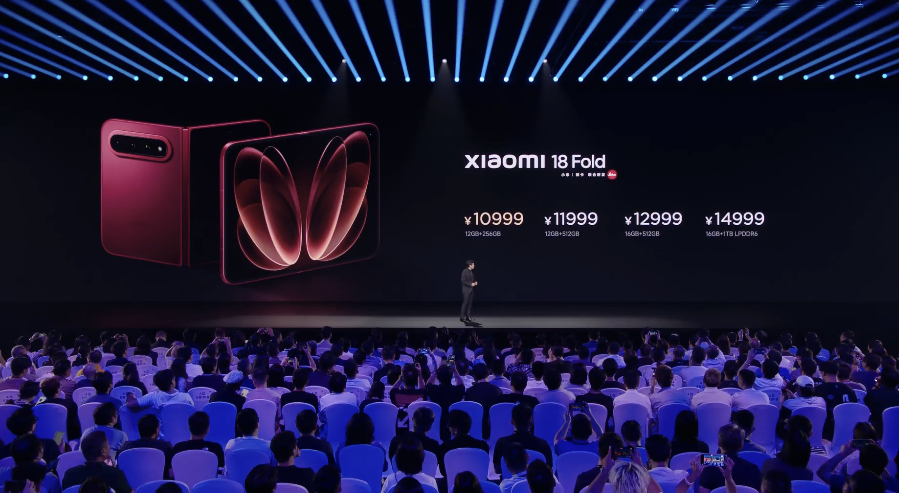
Worth noting: Huawei chose today for its launch event, the same day Xiaomi is holding its fall flagship event. Xiaomi is also rolling out its first wide-fold phone, the Xiaomi 18 Fold, along with its self-developed Xuanjie O3 chip. Meanwhile, Apple is set to unveil its first foldable iPhone Ultra and the iPhone 18 Pro series in the early hours of September 10.
An industry insider told NUPIAO: “Huawei and Xiaomi are launching foldables back-to-back to capture consumer mindshare and seize the vacuum before Apple’s foldable hits the market.” The three events are less than 72 hours apart, breaking the industry convention where domestic brands would deliberately stagger launches to avoid Apple.
Counterpoint data shows Huawei already held 60% of China’s foldable market in Q1 2026. With Apple officially entering the space, plus growing demand for wide-fold products from Samsung and Huawei, Counterpoint Research forecasts global foldable phone shipments will grow 37% year-over-year in 2027 and cross the cumulative 100 million unit milestone within three years.