NUPIAO |
NUPIAO | NUPIAO
As major automakers rush to develop smart-driving chips and solutions in-house, Horizon founder and CEO Yu Kai told NUPIAO and other media that only the top 20% of carmakers will really do this themselves. The other 80%, he expects, will team up with smart-driving suppliers.
At a September 15 event marking 15 million smart-driving chip solutions shipped, Horizon put two markets on the same slide: in ADAS for domestic-brand cars, it already holds half the market; in the more advanced urban NOA segment, it still trails Nvidia by more than 10 percentage points. Yu said he wants Horizon to fight for the No. 1 spot in the high-level smart-driving market next year.
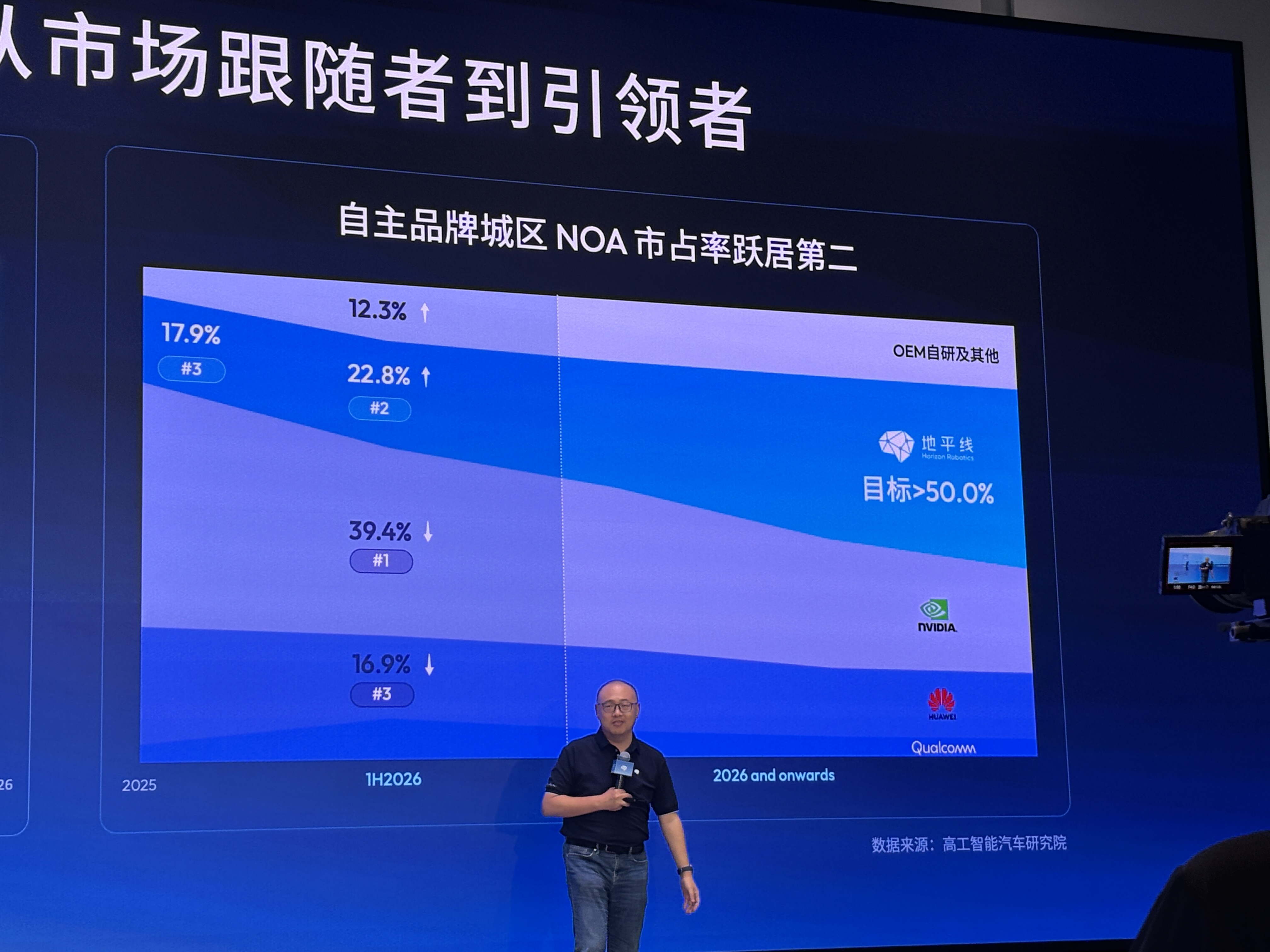
But that goal is not just about Horizon’s own chip share. It also includes what the company calls “extended share”—the share generated by customer self-developed chips built on Horizon’s technology IP.
Whether Horizon is selling chips outright or embedding its technology into customers’ in-house products, expanding its reach in high-level smart driving comes down to one question: how to bring urban NOA costs down to a level more models can actually afford.
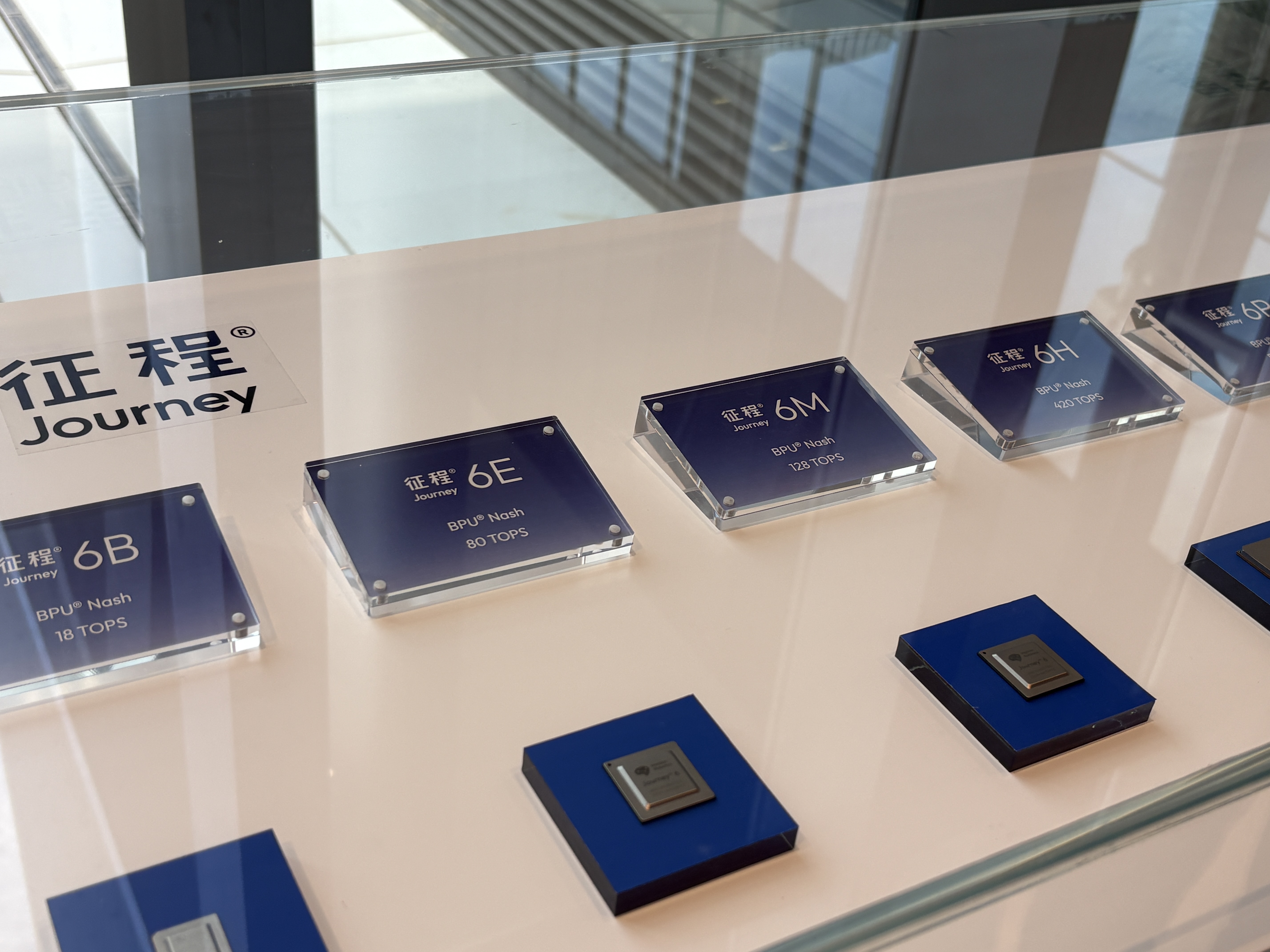
One visible shift is that urban NOA is moving into cheaper cars—and not just electric ones. On the same day, Horizon and Zhijia Xincheng said a fuel SUV priced around RMB 100,000 will use a single Journey 6M chip to enable urban NOA. Zhijia Xincheng is a smart-driving system supplier jointly set up by Horizon and German Aumovio Group. Its CEO, Li Biao, said at the event that the company’s urban NOA solution has been upgraded from two Journey 6M chips last year to a single chip.
Yu credits that progress to joint software and hardware optimization. He wants mid-compute chips to handle more complex smart-driving functions, which would lower the cost of the whole solution for customers. But he also stressed that Horizon is not simply trying to sell chips more cheaply. Customers get higher value and a more competitive cost structure, he said, “but Horizon is still a beneficiary.”
It is worth noting that some automakers still see smart driving as a capability they want to keep in their own hands, and that will directly affect Horizon’s future market share. Yu expects roughly 80% of automakers to work with suppliers, while about 20% at the very top will stick with vertical in-house development. His view is that as the industry matures, specialization will be more efficient than every company developing everything on its own—and Horizon only needs to cover the 80% outside that small group of top players.
That sounds like a promising outlook for independent suppliers, but automakers’ in-house efforts do not come in just one form. An analyst at Gasgoo Automotive Research Institute told NUPIAO in an earlier interview that most carmakers are likely to use a mix of in-house development, joint development, and external sourcing. In-house work will mainly focus on algorithms and models, including through joint-venture subsidiaries; using external chips does not stop automakers from owning some software capabilities.
Horizon is already adapting to this hybrid division of labor. As NUPIAO previously reported , the company supports customers’ own development by licensing its BPU architecture, foundation models, software, and toolchains. Yu likens technology licensing to the ARM and Android model. Even if customers do not buy a complete solution, he hopes they will keep using Horizon’s underlying technology.
That also means Horizon’s share target has to be looked at in two parts. Yu explained to NUPIAO and other media that next year’s goal of becoming No. 1 in the high-level market includes both direct share from Horizon’s own products and extended share from products developed with Horizon’s technology IP. The latter measures how widely the technology is adopted and cannot all be converted into sales of Horizon-branded chips.
Still, engineering work does not disappear just because technology licensing becomes a bigger part of the model. The more customers and models there are, the more Horizon has to deal with the “diseconomies of scale” of system development, adaptation, and validation. Horizon’s answer is to let partners take on more of the hands-on engineering while it focuses on the underlying technology platform. Yu said 95% of the company’s shipments are completed through partners.
Yu said these partners are not just sales channels for chips. They also take part in system development, vehicle integration, and mass-production delivery, connecting Horizon’s underlying technology with automakers’ specific needs.
The intelligent upgrade of joint-venture brands is putting this division of labor to the test. Horizon’s 15 millionth Journey chip solution is being used in the upcoming FAW-Volkswagen ID. AURA T6. Wang Shengli, deputy general manager for commercial operations at FAW-Volkswagen Automotive Co., Ltd., said the car’s smart-driving assistance system is led by CARIZON, the joint venture between Volkswagen and Horizon, and uses the Journey 6H chip and related HSD technology. The cooperation covers product definition, experience tuning, and vehicle validation.
Volkswagen keeps room to join research and development through the joint venture while also using external chips and technology. Yu noted that the cooperation also involves software version iteration, hardware quality testing, and chassis response and control latency that affect the driving experience.
The same partner network is now being used overseas. According to Horizon’s disclosure that day, its overseas order book covers more than 20 million vehicles, spanning L2 and higher-level assisted driving. That includes Chinese automakers going global as well as global automakers’ overseas business. These are full-lifecycle vehicle orders, with deliveries expected to be completed over the next three to five years.
Partners are getting ready for delivery. Li Biao said Zhijia Xincheng will speed up overseas mass-production rollout starting at the end of this year and will support customer development through local operations including its German research and development center.
But overseas markets will not follow China’s timetable. Yu’s judgment is that, for now, overseas consumer demand is still mainly for basic assisted driving. Reaching the level of urban NOA demand China has today will “probably take five years” overseas.
Horizon plans to take part in the “smart-driving going global” process in two stages: supplying chips and solutions to projects already in mass production, and providing technology licensing to overseas automakers that have already started developing next-generation high-level smart driving. That allows technology cooperation formed during the research and development stage to gradually extend into mass production.
Technology licensing lets Horizon enter customers’ research and development systems earlier, but it does not mean the company can expand shipments at its own pace. How much chip demand the orders for the next three to five years will translate into still depends on automakers’ mass-production progress and actual sales.